Cooked in the embers.
Escalivada.
Catalan fire-roasted vegetables, two ways: peppers, aubergine and onion charred black in embers, peeled warm, dressed in their own smoky juices and good oil.
- Prep
- 15 min
- Cook
- 50 min
- Total
- 1h 5min
- Servings
- 4
- Difficulty
- Easy
Getting ready…
Ingredients
For 4 servings · 10 items
For the escalivada
For the dressing
To serve
Method
5 steps · check as you go
- →
Serve
Serve at room temperature, the strips loosely arranged and glossy with their dressing, with bread to spoon it onto. It is a side, a starter, or part of a spread; in Catalonia it often shares a table with anchovies, with grilled meats, or piled onto a coca. A drizzle of the saved juices over the top at the table, and a final scatter of flaky salt, is all the finishing it needs.
The story
Escalivada is a dish whose name is a cooking instruction. It comes from the Catalan escalivar — to cook in the embers and ash — and behind it sits caliu, the ember itself, from the Latin calivu. Long before it was a tapa on a white plate, it was what Catalan and Aragonese shepherds and farmers made in the same wood fire that kept them warm through long hours with the livestock: peppers, aubergine, and onion buried in the embers until their skins blackened and their insides went soft and sweet with smoke. The blackened skin is not a mistake to apologise for. It is the recipe, written into the name.
I learned to make it the summer I spent at La Riuà in 2018, cooking arroces in the lanes of El Carmen in Valencia. Escalivada belongs to Catalonia more than to Valencia, but it travels down the coast, and one of the older cooks — a Catalan man working a season away from Tarragona, whose name I think was Jordi though I won’t swear to it — made it on the grill at the end of service when the coals were dying. He let the peppers go past what looked like ruin, completely black, and when I winced he said the char was the point: “El negre és el gust.” The black is the flavour. Then he covered them, walked away, and let the steam do the peeling for him.
This escalivada has nothing animal in it, and it never needed anything — it is vegetables, fire, and good oil. Char them black, steam them soft, peel after not before, and save every drop of the smoky juices. It is not a “vegan starter.” It is escalivada, the way the man from Tarragona made it on dying coals, cooked in the embers exactly as its name says.
À la maison
The weeknight reading is the recipe above, and it asks for two things most recipes skip. First, real char — take the peppers and aubergines genuinely black over a flame or under a hot grill, past the point that makes you nervous, because the smoke in that blackened skin is the entire flavour of the dish. Second, save the juices: when you peel the vegetables, a dark, smoky liquid pools in the bowl, and most people pour it down the sink. Sieve it into the dressing instead. Peel after charring, never rinse under the tap, dress while warm, and serve at room temperature.
Au bistrot
The bistronomique reading takes the same charred vegetables and composes them with a little more control and one or two extra notes. Char and peel as before, but tear the flesh into long, even strips and dry them briefly on a cloth so they take a dressing cleanly. Reduce the saved roasting juices in a small pan with a splash of sherry vinegar until they turn syrupy and glossy — a smoke-dark vinaigrette to brush on the plate. Make a quick smoked-almond romesco or a saffron alioli to set against the sweetness of the peppers.
Plate it as ribbons, not a heap: weave the red pepper, bronze aubergine, and soft onion into a loose, deliberate tangle, leaving negative space. Dot the reduced juices and a few points of romesco around it, lay a single charred spring onion or a black olive for contrast, and finish with the greenest oil in droplets and flaky salt at the last second. A crisp shard of toasted coca underneath gives the crunch the soft vegetables lack. The shepherds’ fire dish, read slowly, with its own smoke turned into sauce.
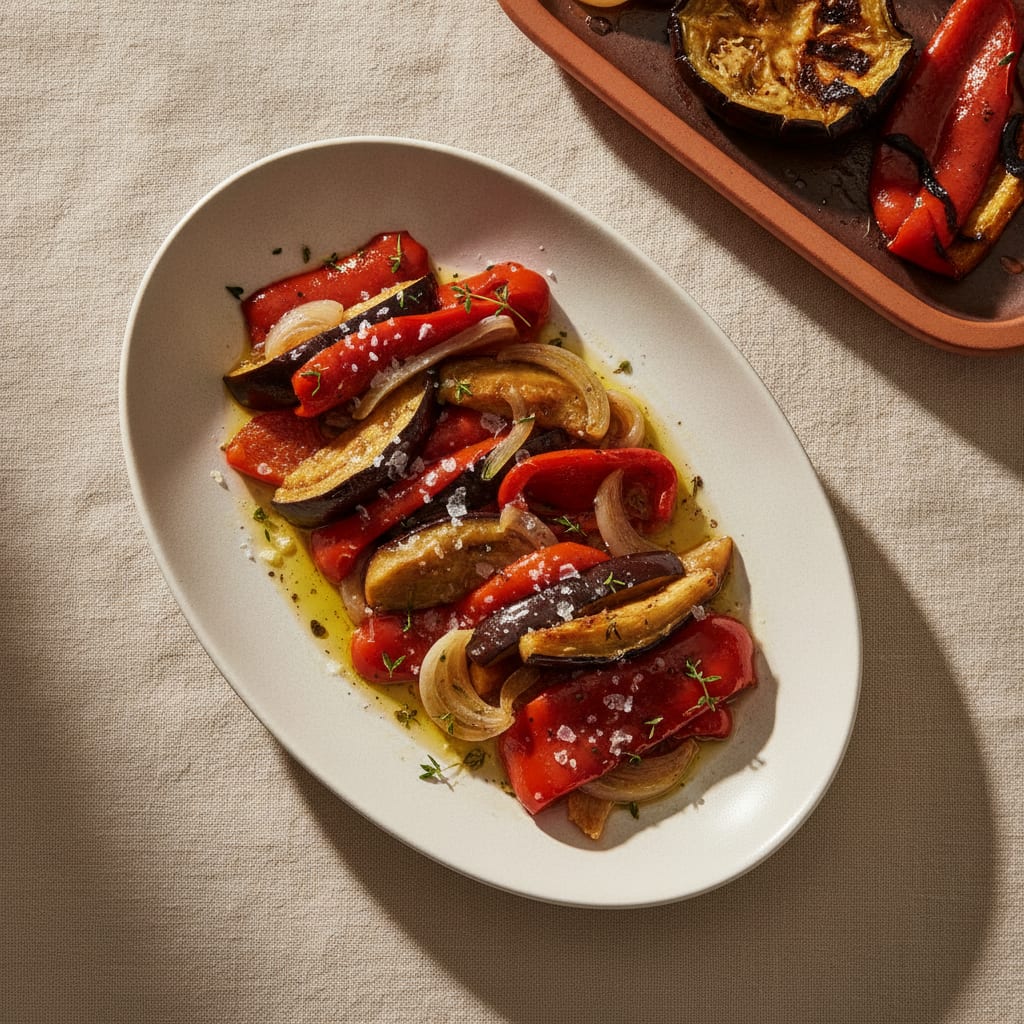
El emplatado — Overhead, tight. A loose woven tangle of red, bronze and pale strips on a wide matte plate, dark syrupy juices and points of romesco dotted around, droplets of green oil catching the light. Negative space, flaky salt. The plate should say fire and patience — a humble ember dish given a quiet, smoky elegance.
What the other recipes get wrong
Most escalivada recipes online — I read the top ten in March 2026 — undersell two things: how black the char needs to go, and what to do with the juices. I ran the test over a week in March 2026: six batches, same vegetables, comparing how hard I charred them and whether I kept or discarded the roasting juices and whether I rinsed the peeled flesh.
- Gently roasted, no real char: sweet and soft but flat — it tasted of roasted vegetables, pleasant and anonymous. None of the smoke that makes escalivada itself.
- Charred black, but rinsed under the tap and juices discarded: better char flavour in the flesh, but washed-out and watery, the best of the smoke literally rinsed down the drain.
- Charred black, peeled dry, juices saved into the dressing: deep, smoky, savoury, with a dark concentrated sauce of its own. This was the dying-coals plate.
The reason is where the flavour lives. Charring blackens and blisters the skin and drives smoke compounds — the same aromatic phenols that flavour anything cooked over wood — into the flesh just beneath it. Steaming the charred vegetables covered loosens that skin so it peels off cleanly, leaving the smoke-soaked flesh behind. The dark juice that weeps out as they sit is that smoke and the vegetables’ own concentrated sugars in liquid form: it is, quite literally, the most flavourful part of the dish. Rinse the flesh and you wash it away; discard the bowl’s juices and you bin your own sauce. Char hard, peel dry, keep the juice — three moves, and the difference between roasted vegetables and escalivada.
The line I draw
I will not rinse the peeled flesh under the tap, and I will not pour away the juices. It is tempting — the peeled peppers carry flecks of black skin, and a quick rinse makes them look tidy. But that water carries off the smoke and the concentrated juice that are the whole reason the dish exists. Pick the stray flecks off with your fingers if you must; leave a few, they are flavour, not dirt. And the dark liquid pooling in the bowl is not waste to tip down the sink — it is escalivada’s natural sauce. Rinse and discard, and you have made clean, pretty, forgettable roasted vegetables. Keep the smoke, and you have made escalivada.
When this can fail
Three ways, all from my own kitchen between 2022 and 2026:
- The pale, smokeless plate. Roasted the vegetables in a moderate oven until soft but barely coloured, too timid to let them blacken; the result tasted of nothing in particular. Fix: char hard — over flame or under a fierce grill — until the skins are genuinely black all over, past the point that looks like ruin.
- The washed-out flavour. Rinsed the peeled peppers under the tap to get rid of the black flecks, and rinsed the smoke away with them. Fix: never rinse — pick off stray skin with dry fingers and keep every drop of the pooled juices.
- The bitter aubergine. Pulled the aubergines off while the centres were still firm; they peeled badly and tasted green and bitter. Fix: cook them until they fully collapse and slump, then steam covered — only then is the flesh silky and the skin willing to slip off.
FAQ
QWhat does escalivada mean?
Escalivada comes from the Catalan verb escalivar, meaning to cook in embers and ashes — from caliu, an ember, which traces back to the Latin calivu. The name is a description of the method: vegetables, traditionally peppers, aubergine and onion, charred directly in the embers of a wood fire. It began as a rural shepherds' and farmers' dish in Catalonia and neighbouring Aragon, Valencia and Murcia, cooked in the same fire that kept them warm.
QWhy do you char the vegetables black?
Because the smoke is the flavour. Escalivada is defined by the blackened skin and the smoke it imparts to the flesh beneath — that is what the name means. The skin is charred to ruin on purpose, then peeled off and discarded; what you eat is the silky, smoke-perfumed flesh inside. Vegetables roasted pale and gently are pleasant, but they are not escalivada, which is a dish built entirely on real, aggressive char.
QShould I peel the peppers before or after roasting?
Always after. Char the whole peppers and aubergines until the skins are blackened, steam them covered for 15 minutes so the skin loosens, then peel it off with your fingers. Peeling before roasting is impossible and pointless — you would lose the char that flavours the flesh. And resist rinsing the peeled flesh under the tap: that washes away the smoky juices, which are the best part.
QCan I make escalivada without a barbecue or open fire?
Yes. A gas flame, a hot grill, or a 220°C (425°F) oven all work — the goal is the same blackened, collapsed skin. Open flame or charcoal gives the most authentic smoke, but a hot grill or broiler gets you most of the way. The key moves don't change: char hard, steam covered, peel after, and save every drop of the roasting juices for the dressing.
QHow long does escalivada keep?
It keeps 4 to 5 days in the fridge, covered in its oil, and the flavour deepens over the first day or two. Always bring it back to room temperature before serving — cold dulls both the smoke and the olive oil. It is excellent made ahead for exactly this reason, and any leftover juices and oil are worth saving to dress bread or fold into a sofrito.