Read the crimp.
Empanadas.
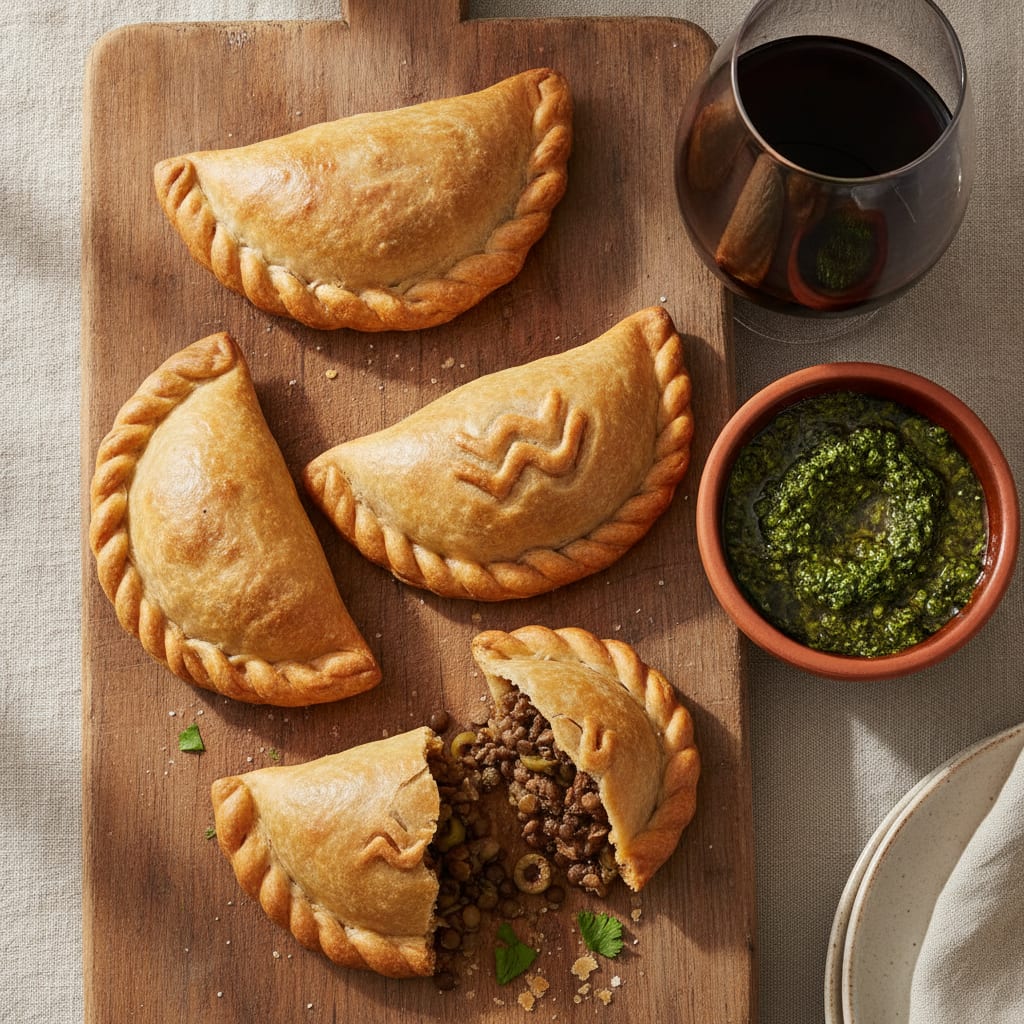
Argentine baked hand pies with a knife-cut mushroom-lentil picadillo, cumin and pimentón, olive and a brined-caper bind, sealed with the repulgue crimp.
- Prep
- 40 min
- Cook
- 25 min
- Total
- 1h 5min
- Servings
- 4
- Difficulty
- Medium
Getting ready…
Ingredients
For 4 servings · 17 items
For the dough
For the filling (picadillo)
To finish
Method
6 steps · check as you go
- →
Serve
Serve warm, with chimichurri for dipping and a bowl of more on the table, and a glass of cold Malbec. Eat them with your hands; the repulgue is also the handle. In Salta they'd hand you a wedge of lime; squeeze it over the first bite.
The story
An empanada is a sealed, hand-sized pie, and in Argentina it is also a small flag: the way the edge is crimped — the repulgue — tells you, or once told you, what is inside before you bite. I learned this in November 2019, in San Telmo, on the same Buenos Aires trip that taught me what a milanesa was for. There was a tiny empanadería off Calle Estados Unidos with a tray of them in the window, each filling marked by a different rope of crimp along the curve, and a woman behind the counter folding them faster than I could follow. I don’t know her name. I asked which was which and she pointed with the back of a floured knuckle: carne, pollo, humita, verdura — beef, chicken, corn, greens — reading the edges like a sentence.
The empanada came to Argentina through Spain — the word is 16th-century Galician, and Galician immigrants carried the form across the Atlantic, where every country bent it to itself. Argentina splintered it into provinces: Salta with its fine, juicy, finely crimped little pies; Tucumán fried and blistered; each with its own dough and its own repulgue. The crimp was never decoration. It was an edible label.
This empanada has no beef in it, and the structure didn’t move. The classic Argentine filling is a picadillo — knife-cut beef, onion, cumin, pimentón, green olive, and chopped hard-boiled egg. I build mine from mushrooms chopped by hand and browned hard for the meaty depth, brown lentils for body, and the same olive — with chopped capers standing in for the egg’s bright, salty punctuation. It is not a “vegan empanada.” It is an empanada, crimped the way I was shown.
À la maison
The weeknight reading is the recipe above, and it lives or dies on two cold things and one hot one. Keep the dough cold so the fat stays in flecks, and chill the filling completely before you assemble — warm filling melts the dough and the empanadas weep in the oven. The hot thing is the browning: cook the mushrooms past their watery stage into real colour, because that is where the savoury, meaty depth comes from. Crimp them however you can to start; the rope repulgue is a knack that arrives after a dozen. The sweetened plant-milk wash gives you the bakery-gold shell without an egg.
Au bistrot
The bistronomique reading keeps one empanada per person and turns it into a composed first course.
Make the dough a touch richer and roll it thinner, so the shell shatters rather than crumbles, and cut smaller discs for a more delicate pie. Refine the picadillo: finer dice, a splash of red wine reduced into it, the olives and capers chopped to a near-tapenade so each bite is seasoned evenly. Crimp a careful Salta-style repulgue — fine folds down the whole curve, as close to the sixteen-to-nineteen count as your fingers manage — because at this altitude the edge is the dish’s signature and the camera will read it. Plate it on a streak of bright chimichurri thinned to a sauce, with a quenelle of smoked-pepper purée, a few fried caper buds that burst open like flowers, and a single chicory leaf dressed in lime for the lift Salta gives you at the table. One empanada, set down like a jewel, the repulgue facing the guest so they can read it.
Le dressage — Three-quarter, close. Pale stone plate, one empanada centred with the repulgue turned to camera, a brushstroke of green chimichurri beneath, fried capers and a smoked-pepper quenelle off-centre. Steam from the broken corner. The plate should say a street pie, read aloud — the crimp as the hero, everything else quiet around it.
What the other recipes get wrong
Most plant-based empanada recipes online — I read the top ten in March 2026 — solve the filling by reaching for the food processor, and they ruin it in the same motion. They blitz mushrooms and beans into a smooth, wet paste, and the empanada that comes out is a sealed pocket of mush. I ran the test over a weekend in March 2026, four batches, same dough, same seasoning, only the filling’s texture and moisture changed:
- Processor-blitzed mushroom-and-bean paste: smooth, wet, monotone. Leaked through the dough, and every bite was identical baby-food. No “what is inside” to read.
- Canned lentils, undrained, knife-cut onion: wetter still; the bottoms went soggy and a few split open in the oven.
- Mushrooms blitzed but cooked dry: better seal, but the texture was uniform and faintly pâté-like — no chew, no chunks of olive to find.
- Hand-chopped mushroom browned hard + drained lentils + chopped olive and caper, fully chilled: distinct pieces, a dry savoury body, briny punctuation, and a clean seal that held every time. Not close.
The reason is texture and water, not preference. An empanada is defined as much by its bite as its flavour: the traditional filling is knife-cut precisely so you meet different things — meat, onion, olive, egg — across one pastry. Blitzing destroys that and, worse, ruptures every cell so the filling sheds water as it bakes, soaking and splitting the shell. Browning the hand-chopped mushroom past its wet stage drives the water off and builds savoury depth through Maillard browning; draining the lentils keeps the parcel dry; the chopped olive and caper give the salty high notes the smooth version flattens. Hand-cut and dry: every batch, a clean seal and a filling you could read.
The line I draw
I will not blitz the filling smooth to save ten minutes. The empanada is a textured thing — the whole pleasure is biting through a crisp gold shell into pieces you can tell apart, a chunk of mushroom, a bright shard of olive, a salty caper. A smooth paste is a different food in the same wrapper: a savoury turnover, fine, not an empanada. The knife is the work and the knife is the point. If you only have a processor and you reach for it here, you will get a sealed pocket of brown purée, and it will not be this.
When this can fail
Three ways, all from my own kitchen between 2022 and 2026:
- The weeping seam. Filled them warm, in a hurry, straight from the pan. The heat melted the fat in the dough, the parcels relaxed and leaked, and the seams split in the oven. Fix: chill the filling completely — an hour minimum, overnight is better — and keep the cut dough cool until you fill.
- The soggy bottom. Used undrained canned lentils and under-cooked mushrooms, so the filling was wet. The undersides steamed grey and a couple burst. Fix: cook the mushrooms past their water into browning and drain the lentils well; the filling should hold its shape on the spoon.
- The pale shell. Brushed with plain plant milk and no sugar; the empanadas baked through but stayed blond and matte, like they were undercooked. Fix: whisk a little sugar or maple into the wash so the Maillard reaction browns the shell to a proper bakery gold.
FAQ
QWhat goes in a vegan empanada filling?
A picadillo built to read like the classic Argentine beef one: hand-chopped mushrooms browned hard for meaty depth, brown lentils (or chopped seitan) for body, slow-cooked onion and spring onion, cumin and sweet pimentón, and the briny duo of chopped green olives and capers. The capers stand in for the chopped hard-boiled egg of the traditional filling — same bright, salty punctuation. Knife-cut everything; a blitzed filling turns to paste and loses the texture that makes an empanada an empanada.
QAre Argentine empanadas baked or fried?
Both exist, but the most common Argentine style is baked — al horno. Baked empanadas use a sturdier dough brushed with a wash for colour; fried ones (often Tucumán style) use a thinner dough and blister in hot fat. This recipe is baked. For colour without egg, brush with plant milk whisked with a little sugar or maple so the Maillard reaction browns the shell.
QWhat is the repulgue and does the crimp mean anything?
The repulgue is the folded, rope-twisted edge that seals an Argentine empanada. It is both a seal and a code: historically the crimp pattern identified the filling before baking, so you could tell beef from chicken from cheese by the edge alone. Salta empanadas are known for a fine, delicate repulgue traditionally counting roughly sixteen to nineteen folds. To make one, fold a corner over and pinch, then keep folding the edge over itself down the curve.
QWhere do empanadas come from?
The word empanada dates to 16th-century Galicia in Spain, and Galician immigrants carried the folded hand-pie to Latin America, where each country reshaped it. The folded-dough form itself is far older, with roots in Moorish and Middle Eastern pastry. In Argentina it split into strong regional styles — Salta, Tucumán, Mendoza and more — each with its own dough, filling, and repulgue.
QCan I make empanadas ahead and freeze them?
Yes, and they freeze beautifully. Assemble and crimp them, then freeze raw on a tray before bagging. Bake straight from frozen, adding 5–8 minutes and brushing with the wash just before they go in. The filling is also better made a day ahead — it must be fully cold before assembling anyway, or it melts the fat in the dough and the empanadas leak.