Rolled tight, simmered under a plate.
Dolmades.
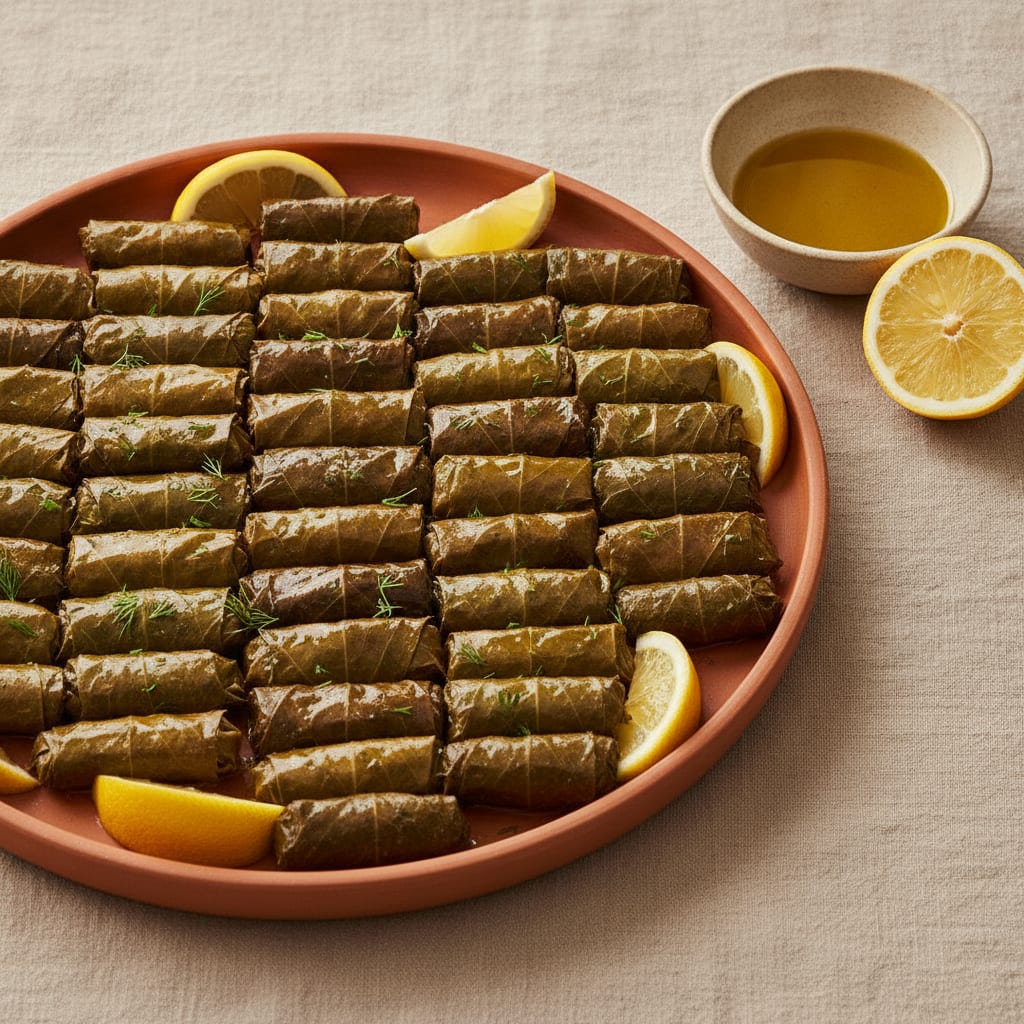
Greek stuffed vine leaves, two ways: a rice, herb and pine-nut filling rolled tight, simmered packed under olive oil and lemon, served cool with more lemon.
- Prep
- 1h
- Cook
- 50 min
- Total
- 1h 50min
- Servings
- 6
- Difficulty
- Ambitious
Getting ready…
Ingredients
For 6 servings · 15 items
For the leaves
For the filling
For cooking and serving
Method
7 steps · check as you go
- →
Serve
Serve at room temperature, never hot, arranged in tight rows on a platter, glossy with oil, with lemon wedges to squeeze over and a final thread of good olive oil. The fasting (nistisimo) version stops here, with oil and lemon. They keep beautifully for days in the fridge and are, if anything, better on day two.
The story
Athens, spring 2017. The first job Eleni gave me that I couldn’t fake my way through was rolling dolmades. She sat me at the end of the prep table with a bowl of softened leaves, a bowl of lemony rice, and a single instruction — “small, tight, but not angry” — and then she watched my first dozen come out fat, lopsided, and split down the seam when she pressed one. She didn’t take over. She rolled one slowly in front of me, narrating nothing, just her thumbs moving, and the leaf closed around the filling like it wanted to. Then she pushed the bowl back at me and went to do something else. By the end of the morning my hands had found it, the way hands do.
She had her own rules. The shiny side of the leaf faces out, always. A level teaspoon, never more, because the rice “grows hungry” in the pot. And the inverted plate on top of the packed rolls was not optional — she called it the kapaki, the lid, and said a dolma that floats is a dolma that opens. When the pot came off the heat she would not let anyone touch it for half an hour. “They are not finished cooking when the fire stops,” she said. “They finish in the cool.”
Dolmades are ancient — the Greeks were wrapping food in leaves long before the vine leaf became standard, in a dish the classical writers called thrion, stuffed fig leaves that Aristophanes already joked about in The Acharnians in 425 BCE. The rolled vine-leaf form we know was perfected in the Ottoman kitchens of Constantinople, and the name comes from the Turkish dolmak, to be stuffed. The rice-and-oil version, dolmades gialantzi, is the nistisimo — the fasting dish, made without meat, egg, or dairy for the long Orthodox fasts. This is not a vegan version of dolmades. The oil-and-lemon dolma is the older, fasting standard. It is dolmades, rolled the way Eleni taught me, small and tight but not angry.
À la maison
The weeknight reading is the recipe above — though “weeknight” is generous for a dish that asks you to roll sixty small parcels by hand. The skill is real but it arrives fast; give it the first dozen to find your hands. Three things carry the whole dish: soften the brined leaves in hot water first so they roll without cracking; use a level teaspoon of raw filling and roll with a little give, because the rice swells and will split a packed, tight roll; and pack the pot tight under an inverted plate so nothing floats up and unravels. Then simmer gently and — this is the part people skip — let them cool in their own liquid before you serve. They finish in the cool.
Au bistrot
The bistronomique reading keeps the same rolls and the same lemony rice but plates them as a precise cold starter with a warm, bright counterpoint — the same dolma, read as a course.
Roll the dolmades smaller and even more uniform — finger-length, identical — so a row of them reads as deliberate. Simmer and cool them as before. For the plate, build the lemon-oil into a proper emulsion that mimics the gloss of avgolemono without the egg: blitz warm cooking liquid with a little aquafaba and a spoon of the dolma rice itself, then stream in olive oil and a lot of lemon until it thickens into a pale, pourable, tart cream. Make a quick herb oil from dill and parsley, strained bright green. Toast extra pine nuts dark. On a long plate, lay three dolmades in a precise row, spoon a slick of the lemon emulsion beneath, dot the herb oil around it, scatter the toasted pine nuts and a few currants plumped in lemon, and finish with micro dill and a grating of lemon zest. Serve cool, the emulsion cold and sharp against the soft, savoury rolls.
Le dressage — Overhead or low three-quarter. Three identical dolmades in a precise row on a long pale plate, a slick of pale lemon emulsion beneath, herb oil dotted around in green, dark pine nuts and plumped currants scattered, micro dill and lemon zest on top. Soft cool light to keep the greens fresh. The plate should say a humble fasting parcel has been read as a refined cold course, all its lemon and oil intact, with no egg anywhere near it.
What the other recipes get wrong
Most dolmades recipes online — I read the top ten in April 2026 — tell you to use pre-cooked or parboiled rice “so they don’t come out crunchy.” It is the same shortcut that ruins gemista, and it ruins dolmades the same way. I ran the test over a week that April: nine pots, identical leaves, herbs, and method, changing only three things — raw versus parboiled rice, level teaspoon versus heaped, and weighted under a plate versus left loose.
- Parboiled rice, heaped filling, loose in the pot: mushy, blown-out rolls, several burst, the rice tasting of the water it was first boiled in. The filling slumped and the leaves tore.
- Raw rice, heaped filling, loose in the pot: better flavour, but the over-filled rolls split as the rice swelled and the loose ones floated up and unrolled.
- Raw rice, level teaspoon, weighted under a plate: tender, distinct grains tasting of the lemony oil they cooked in, every roll intact, holding its shape cleanly when cool.
The reason, again, is where the starch gelatinises. Raw rice rolled into a leaf swells by absorbing the oil-and-lemon cooking liquid, so the grains gelatinise in flavour and end up tasting of the dish — and because they expand against the packed leaves and the weight of the plate, the rolls stay tight rather than splitting. Parboiled rice has already gelatinised in plain water; cooked a second time it only breaks down further into paste, and having no more room to expand usefully it just bursts whatever it is wrapped in. The level teaspoon and the inverted plate are not fussiness — they are the two controls that give the swelling rice somewhere to go and something to hold it. Across all nine pots, the raw-rice, lightly-filled, weighted batches were the only ones with both clean rolls and rice that tasted of more than water.
The line I draw
I will not finish a fasting dolma with avgolemono. The whole identity of dolmades gialantzi is that it carries no egg, no dairy, no meat — it is the dish you can eat through Lent and the Dormition fast, sharpened with nothing but olive oil and lemon. Reaching for the egg-and-lemon sauce to make it “richer” misses the point entirely: the brightness is supposed to come from the lemon and the good oil the rice drank in the pot, not from an emulsion poured over the top. If I want avgolemono gloss I build it from aquafaba and the dolma’s own starchy liquid, as in the bistrot plate, so the dish stays what it is. The egg sauce belongs to the meat dolma served hot. The fasting roll is finished with oil and lemon, and it does not need rescuing.
When this can fail
Three ways, all from my own kitchen between 2022 and 2026:
- The burst rolls. Heaped the filling in to use it up faster; the swelling rice split half the leaves and the pot turned to loose rice and torn leaves. Fix: a level teaspoon per leaf and a roll with a little give — the rice needs room to grow, not a tight casing.
- The floating, unravelled pot. Skipped the inverted plate once because I couldn’t find one that fit; several rolls bobbed up, opened, and spilled into the liquid. Fix: pack them tight in rings and weight them with a heatproof plate so nothing can float or move.
- The scorched bottom layer. Set the rolls straight onto a bare pot base; the bottom row caught and stuck before the rice was done. Fix: line the pot with the spare torn leaves first — a sacrificial bed that takes the direct heat and lifts away cleanly at the end.
FAQ
QAre dolmades vegan?
The oil-and-lemon version, yes — and it is one of the oldest meat-free dishes in Greek cooking. These are dolmades gialantzi (sometimes 'yalantzi,' loosely 'the fibber,' because they fib at being a meat dish): vine leaves stuffed with rice, herbs, onion, and pine nuts, simmered in olive oil and lemon. They are a classic nistisimo, eaten during the Orthodox fasts when no animal products are allowed, especially through Lent. A separate version stuffs them with meat and finishes them in an egg-and-lemon avgolemono sauce — but the rice-and-oil dolma came first and is the fasting standard.
QShould I use fresh or jarred vine leaves?
Jarred brined leaves are easier and more reliable, which is why most Greek cooks use them outside of vine season. They come pre-softened and uniform; you just soak them in hot water for ten minutes to de-salt and loosen them. Fresh leaves are wonderful in late spring when they are young and tender, but they must be blanched 30 seconds first and the tough older ones discarded. For a first attempt, use jarred.
QWhy do my dolmades fall apart or burst?
Three usual causes, all fixable. Overfilling — the raw rice nearly triples as it swells, so a level teaspoon per leaf is plenty; pack them full and they split. Rolling too tight, leaving the rice no room to grow. And not packing the pot tightly or not weighting them with an inverted plate, so they float, unroll, and spill. Tight in the pot, lightly filled, and pinned under a plate, they hold together through the whole simmer.
QWhat is the difference between dolmades with avgolemono and without?
Avgolemono is the egg-and-lemon sauce — whisked egg and lemon juice tempered into the hot cooking liquid to make a velvety, tart sauce poured over the rolls. It is the classic finish for the meat-stuffed, served-hot version. The fasting and the rice versions are finished simply with olive oil and lemon juice and served cool, no sauce. Because avgolemono depends on egg, the oil-and-lemon dolma is the one eaten during the fasts — and it is the version here. A lemony oil emulsion, sharpened with a little extra lemon, gives the same bright, glossy finish without the egg.
QCan I make dolmades ahead?
Yes, and you should — they are better the next day. Cool them in their cooking liquid, then refrigerate. The rice finishes settling, the flavours deepen, and the rolls firm up so they hold their shape cleanly. They keep four to five days in the fridge. Bring them back to room temperature before serving, with fresh lemon and a thread of oil. This is one of the rare dishes genuinely improved by being made in advance.