Provence's sealed pot.
Daube provençale.
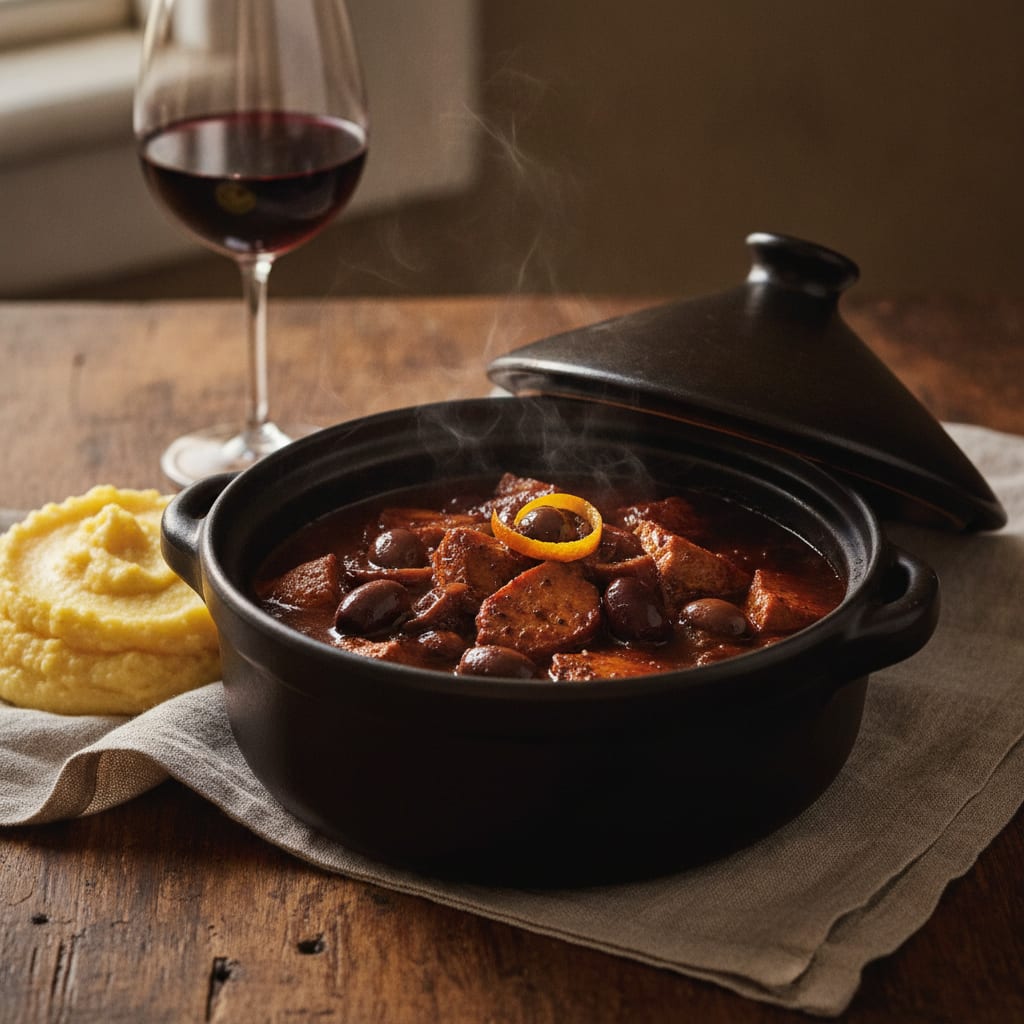
The Provençal red-wine braise, two ways: seitan and mushroom slow-cooked in wine, orange zest and olives, the daubière sealed and left to go deep and dark.
- Prep
- 40 min
- Cook
- 2h 30min
- Total
- 3h 10min
- Servings
- 6
- Difficulty
- Ambitious
Getting ready…
Ingredients
For 6 servings · 17 items
For the marinade
For the braise
To serve
Method
6 steps · check as you go
- →
Serve
Serve the daube hot, spooned over soft polenta, wide pasta, or boiled potatoes, with the dark sauce pooling around. A few extra olives and a fresh curl of orange zest on top. In Provence this is often eaten the second day, reheated, when the flavours have settled — make it ahead if you can. A southern red, a Côtes du Rhône or a Bandol, is the pour.
The story
A daube is the south’s answer to the brown braise — beef, traditionally, cooked slow in red wine, but where Burgundy reaches for bacon and pearl onions, Provence reaches for orange peel, black olives, and the scrub-hill herbs. The name comes from the Provençal adobar, to prepare or arrange, by way of dòba, and the dish was peasant and routier food: tough cuts made tender over a dying wood fire, carried between the hill villages of Haute-Provence by the carters who popularised it in the nineteenth century. It is named for its pot — the daubière, a squat, big-bellied vessel of clay or copper with a tight lid, made to sit sealed in the embers and hold its steam through a long, slow afternoon.
I came back to it in February 2025, in Washington, in a cold-snap week in a Petworth row house with a borrowed enameled pot standing in for a daubière I didn’t own. A friend who grew up outside Aix watched me reach for the wine and stopped me before I could leave the orange in the bowl. “Sans l’orange, c’est pas une daube,” she said — without the orange, it isn’t a daube, it’s just a stew. She was right. The strip of bitter peel and the few black olives are the whole difference between this pot and a bourguignon, and I had nearly skipped them out of habit.
This daube has no beef in it. It has seitan and king oyster mushroom marinated overnight in southern red, a base built on porcini and soy for depth, and the orange and olives doing the work they have always done. The method is unchanged — the overnight marinade, the brown, the sealed pot, the bare two-hour simmer, the late olives. It is not a “vegetable version” of a daube. It is a daube, with the orange left in.
À la maison
The weeknight reading is the recipe above, though “weeknight” is generous — a daube wants an overnight marinade and a slow afternoon, so make it on a day you’re home. The two moves that matter: marinate the seitan and mushrooms in the wine overnight so the orange and herbs go all the way through, and keep the braise below a boil so the seitan stays tender. Everything else is patience. Make it a day ahead if you can; like every daube, it is better reheated, when the wine and citrus have settled into each other. Serve it over soft polenta and don’t forget the fresh curl of orange at the end.
Au bistrot
The bistronomique reading is the same braise, separated into its parts and recomposed so the daube reads as a plated course rather than a pot.
Braise as above, then lift the seitan and mushrooms out and reduce the sauce hard, on its own, until it’s a glossy, near-syrupy jus that coats a spoon — a daube reduced to its essence. Strain it for a clean shine. Set a few pieces of seitan back in the warm jus to glaze. For the plate, make a smooth, soft polenta enriched with a little olive oil, and spoon it as a bed; pile a small olive tapenade sharpened with orange zest at the side as the briny counterpoint, in place of the olives stirred through. Add a single confit shallot, slow-cooked soft and sweet, for a third texture. Plate the glazed seitan and mushroom off-centre on the polenta, spoon the dark jus around — not over — so the gloss frames the meat, and finish with a fine curl of fresh orange zest and a few leaves of picked thyme. The plate is dark, glossy, and Provençal: wine, citrus, olive, each one a distinct note instead of a blur.
Le dressage — Three-quarter, low and warm. Wide dark plate, a swipe of pale polenta, the glazed seitan stacked off-centre, near-black jus spooned in a clean arc around it. A bright curl of orange zest and a quenelle of tapenade for colour. Side light to catch the gloss on the sauce. The plate should say Provence reduced — a rustic pot pulled into one focused, shining course.
What the other recipes get wrong
Most plant daube recipes online — I read the top ten in February 2026 — treat it as a generic red-wine vegetable stew and quietly drop the two things that make it a daube: the overnight marinade and the orange. The result tastes of wine and nothing else. The marinade is not optional, and neither is the citrus. I ran the test over a week in February 2026, four batches, same seitan, same long braise, only the front end changed:
- No marinade, orange added at the end: the wine sat on the surface of the seitan and the orange read as a garnish bolted on, not woven in. Thin.
- Overnight marinade, no orange at all: deep and savoury, but it tasted like a southern bourguignon — there was nothing to tell you which region you were in.
- Quick 1-hour marinade with orange: better, but the citrus and herbs hadn’t penetrated; the centre of each piece was plain.
- Overnight marinade with orange peel and juice, orange refreshed at the finish: the wine, garlic, herbs, and citrus had gone all the way through, and the late splash of fresh juice lifted the whole pot. This was a daube.
The reason is part tradition, part chemistry. A daube provençale is, by every regional definition, distinguished from its Burgundian cousin by orange zest, olives, and herbes de Provence — drop them and you’ve made a different dish. And the marinade does real work: time lets the wine’s acid and the orange’s volatile oils migrate into the seitan, so the flavour is internal rather than a coating, while drying the pieces afterward lets them take a proper Maillard crust. Strain the marinade and reduce that same wine into the braise and nothing is lost. Marinate overnight, keep the orange, refresh it at the end: every batch that did all three tasted of Provence.
The line I draw
I will not make a daube without the orange. Not because the peel ran out, not because a guest finds citrus in a stew strange, not to make it “more like a bourguignon.” The strip of bitter orange — in the marinade and refreshed at the finish — is the single thing that makes a daube a daube and not just a southern beef stew. Take it out and you have flattened the dish into its Burgundian neighbour, which is a fine dish but a different one. My friend from Aix was right: sans l’orange, c’est pas une daube. The orange stays in, every time.
When this can fail
Three ways, all from my own kitchen between 2022 and 2026:
- The boiled-tough seitan. I let the braise climb to a real boil to “speed it up,” and the seitan went tight and rubbery instead of fork-tender. Fix: keep it at the barest simmer, on the lowest flame or in a 150°C oven, and give it the full two hours.
- The raw-wine sauce. I added the marinade wine and rushed straight to the lid without boiling it first; the finished sauce had a harsh, alcoholic edge that never resolved. Fix: bubble the wine hard for five minutes before you seal the pot, to cook off the raw alcohol.
- The dissolved olives. I stirred the olives in at the start and after two hours they’d gone to mush and turned the sauce bitter. Fix: add the olives in the last fifteen minutes so they stay plump and briny.
FAQ
QWhat makes a daube provençale different from a boeuf bourguignon?
Both are red-wine braises, but the daube is the Mediterranean one. Bourguignon is Burgundy: a full-bodied Burgundy red, beef stock, bacon, and mushrooms, wine-forward and smoky. The daube is Provence: a southern red, orange zest, black olives, and herbes de Provence, garlic-and-citrus-forward. The orange peel and olives are the daube's signature — leave them out and you've drifted toward bourguignon. The daube is also traditionally marinated overnight and cooked sealed in an earthenware daubière.
QCan you make a daube provençale without beef?
Yes. A daube is defined by its method and its Provençal flavours — the overnight wine marinade, the orange and olive, the long sealed braise — not by the beef. Seitan gives the dense, fork-tender chew and king oyster mushroom gives a second fibrous texture; both marinate in the wine and brown for the Maillard crust. Dried porcini and soy sauce supply the deep, meaty backbone the marrowbone once gave. It reads as a daube because it follows every daube rule.
QWhy marinate the daube overnight?
The overnight wine marinade is what separates a daube from a quick stew. It perfumes the meat — here, seitan — all the way through with the orange, garlic, herbs, and wine, so the flavour is internal, not just a coating. It also lets the wine's tannins and the citrus oils settle. Strain and dry the pieces before browning, and reduce the marinade wine into the braise so nothing is wasted.
QWhat is a daubière and do I need one?
A daubière is the squat earthenware or copper pot the daube is named for, built with a tight lid to trap steam through hours of low cooking — traditionally set in the embers of a dying fire. You don't need one: any heavy pot with a snug lid, on the lowest flame or in a low oven, does the same job. The point is a sealed, gentle, moist braise, not the specific vessel.
QIs daube better the next day?
Yes, and most Provençal cooks make it a day ahead. Resting overnight lets the wine, orange, herbs, and olives settle into one rounded flavour, and any fat sets on top to be lifted off. Reheat it gently, below a boil, and brighten it at the end with a fresh splash of orange juice. It keeps three to four days refrigerated and freezes well.