Leave the stones in.
Clafoutis.
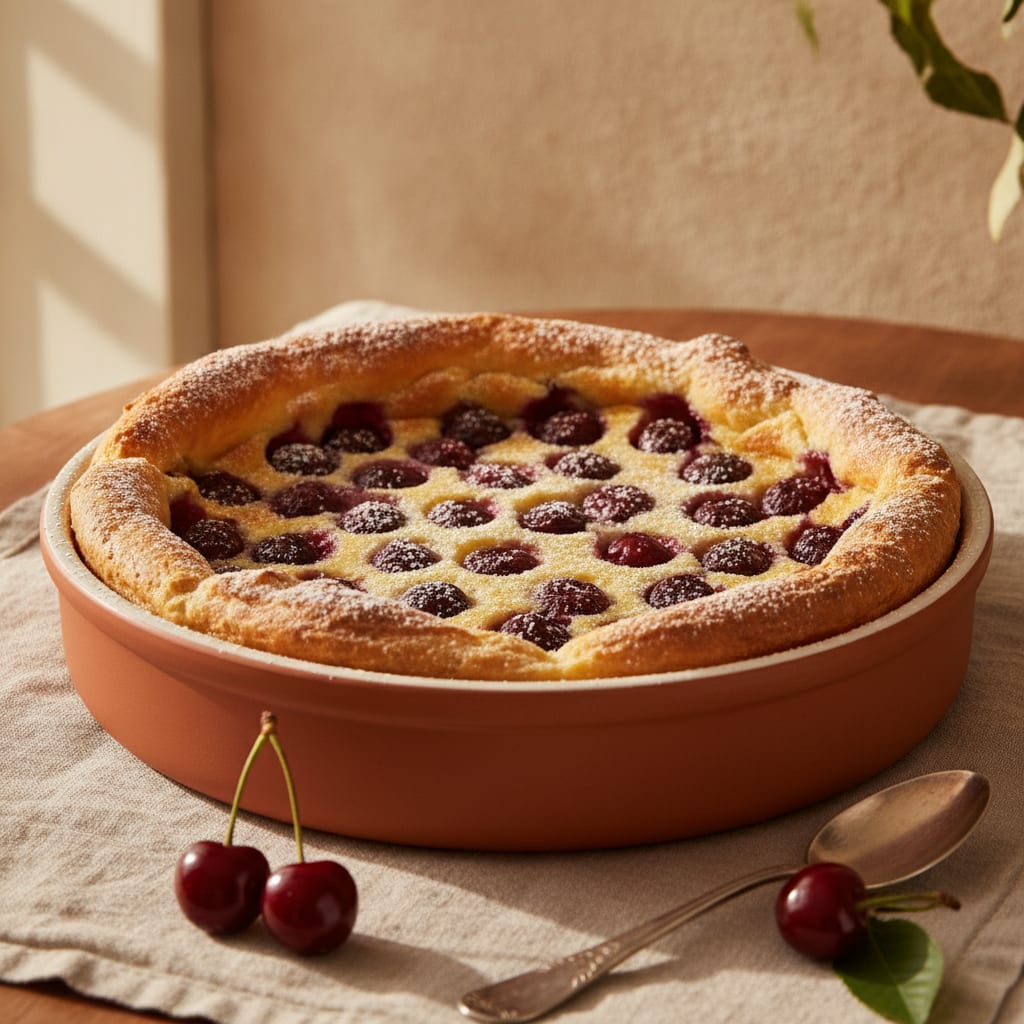
The Limousin cherry clafoutis, two ways: a silky chickpea-flour custard baked over whole cherries at home, and a plated clafoutis with cherry sauce at the bistro.
- Prep
- 15 min
- Cook
- 40 min
- Total
- 55 min
- Servings
- 6
- Difficulty
- Easy
Getting ready…
Ingredients
For 6 servings · 13 items
For the dish
For the cherries
For the custard
To finish
Method
7 steps · check as you go
- →
Serve
Serve the clafoutis warm or at room temperature, dusted with powdered sugar, straight from its dish — it is a homely dessert and looks best a little rustic. A scoop of vanilla ice cream or a spoon of plant cream alongside is welcome but not required. Remind everyone the cherries have their stones in.
The story
Clafoutis is the dessert that taught me a custard does not need an egg to behave like one. I learned it in Lyon, in the early summer of 2011, from a pastry cook named Bernadette who ran the cold station at the bouchon and made one most afternoons when the cherries came in from the market. She refused, flatly, to pit them. The first time I offered to stone the cherries for her — trying to be useful — she looked at me as though I had offered to improve the Mona Lisa. “On laisse les noyaux,” she said. We leave the stones. The smell as it baked was warm batter and cherry and something almost like marzipan, drifting out of a dish that had no almonds in it at all.
That marzipan note is the stones. A true Limousin clafoutis is baked with the cherries unpitted, and as it cooks the amygdalin in the pit breaks down and releases benzaldehyde — the same compound that gives almond extract its smell. The amount that escapes a whole, uncrushed stone is tiny, more aroma than anything, but it is real, and it is half the reason the dish tastes the way it does. The other reason to leave the stones in is plain practicality: unpitted cherries hold their juice instead of weeping it into the batter and turning the custard to soup. (Make the same batter over apples or pears and it is no longer a clafoutis at all — it is a flognarde.)
This clafoutis has no egg in it. The custard is set with chickpea flour and the protein in soy milk, which together firm and bind exactly the way egg yolk did — a tender, sliceable, custardy set around the fruit. A whisper of almond extract leans into the note the stones give. It is not a “vegan clafoutis.” It is a clafoutis, made the Limousin way, with what is in my hands now.
À la maison
The weeknight reading is the recipe above, and it is one of the easiest desserts in the French repertoire — one bowl, one whisk, one dish. The two moves that matter: leave the cherries whole and unpitted so they keep their juice and lend the almond note, and use chickpea flour with soy milk for the set, because soy’s protein firms where oat or almond milk stay loose. Whisk the batter dead smooth, pour it over the cherries, and bake until just set with the faintest wobble. Let it deflate and cool before you dust and serve — the collapse is the texture, not a mistake.
Au bistrot
The bistronomique reading is the same custard, baked in individual dishes and dressed up with a cherry component and a clean plate-up.
Bake the clafoutis in buttered, sugared ramekins or small skillets rather than one big dish, so each guest gets their own puffed, golden edge — pull them a minute early, as small ones set fast. While they bake, make a quick cherry sauce: simmer a handful of pitted cherries with a spoon of sugar, a strip of orange zest, and a splash of kirsch (or cherry liqueur) until syrupy, then blitz half smooth and leave half whole. Plate each clafoutis warm with a spoon of the glossy sauce pooled to one side, a quenelle of vanilla plant ice cream or whipped cashew cream, a few fresh cherries with stems on for the eye, and a dusting of powdered sugar. A scatter of toasted flaked almonds, lightly, picks up the stone-and-extract note. The homely dish becomes a composed dessert course — still the same chickpea-and-soy custard over cherries underneath.
Le dressage — Three-quarter, close. A single warm clafoutis in its ramekin, a glossy cherry sauce spooned alongside, a clean quenelle of pale ice cream, fresh stemmed cherries and a few toasted almond flakes, powdered sugar drifting. Warm afternoon light, the custard’s wobble just catching it. The plate should say a rustic country dessert, composed with care — not fussy, but considered.
What the other recipes get wrong
Most egg-free clafoutis recipes — I read the top ten in June 2026 — reach for the wrong milk and the wrong binder, then wonder why the custard never sets. I ran the test over a week in June 2026, four clafoutis, same cherries, same oven, changing only the milk and the binder:
- Oat milk + cornflour: never properly set; it stayed loose and pudding-wet in the centre even baked long, and weeped liquid as it cooled. The cornflour gelled but the milk had no protein to firm it.
- Almond milk + plain flour only: thin and pale, custard slid rather than sliced, faintly raw-tasting in the middle. No structure.
- Soy milk + plain flour only: better — the soy protein helped — but the set was fragile and a little sloppy without a stronger binder.
- Soy milk + chickpea flour + plain flour: tender, custardy, sliceable, holding the cherries cleanly with a faint wobble. This was the dish.
The reason is protein. A real clafoutis sets because egg proteins coagulate and trap the liquid into a soft custard. Without egg you have to rebuild that from two sources: soy milk, whose protein content is high enough to coagulate and firm on baking the way lower-protein oat or almond milks cannot, and chickpea flour, whose own protein and starch set into a tender, binding gel as it heats. Plain flour alone gives structure but not the custardy bind; cornflour gels but stays wobbly-wet; the soy-and-chickpea pairing rebuilds both jobs the egg did. Across every batch, that was the combination that set into something you could call a custard and not a soup.
The line I draw
I will not pit the cherries. Not “to be safe,” not because a guest might prefer it, not to make it tidier to eat. The Limousin clafoutis is defined by the whole cherry: the stone keeps the juice sealed so the custard sets instead of weeping, and it gives the faint almond note that is half the dish’s character. Pit them and you get a wetter, blanker clafoutis that has thrown away the one thing that makes it itself. I warn the table — every time — and I leave the stones in. Bernadette would not have it any other way, and she was right.
When this can fail
Three ways, all from my own kitchen between 2022 and 2026:
- The soup that never set. I used oat milk and only cornflour to bind; it came out wet and loose in the middle no matter how long I baked it. Fix: use soy milk for its setting protein and chickpea flour for the bind — the two together are what hold.
- The watery, bleeding custard. I pitted the cherries because a guest was nervous about stones; they bled their juice into the batter and thinned it to a weep. Fix: leave the cherries whole and unpitted, and warn the table instead.
- The dry, dense clafoutis. I overbaked it chasing a “fully clean” knife and lost the custardy wobble, ending up with something closer to a cake. Fix: pull it at the first clean knife with the faintest wobble — it firms as it cools.
FAQ
QWhy do you leave the stones in a clafoutis?
Tradition in the Limousin is to leave the cherry stones in, for two real reasons. First, unpitted cherries keep their juice sealed inside instead of bleeding it into the batter, so the custard sets cleanly rather than going watery. Second, the stones lend a subtle almond note as the clafoutis bakes — the almond-like aroma comes from benzaldehyde produced as amygdalin in the pit breaks down with heat. The amount that diffuses from whole, uncrushed stones in normal baking is tiny and not a safety concern, but you should always warn anyone at the table so they don't bite down hard on a stone.
QWhat is the difference between a clafoutis and a flognarde?
Strictly, a clafoutis is made with cherries — black cherries, the purists say. When you make the same batter over any other fruit — apples, pears, plums, prunes — it is properly called a flognarde, not a clafoutis. Both come from the Limousin and surrounding regions of central France and use the same custardy batter poured over fruit and baked. So 'apple clafoutis' is, by the old naming, an apple flognarde.
QHow do you make a clafoutis without eggs?
The egg in a clafoutis is doing two jobs: thickening the custard and binding it so it sets around the fruit. Chickpea flour does both. Its starch and protein firm up as the clafoutis bakes, giving you the same tender, sliceable, custardy set without egg. Soy milk helps too — soy's protein sets firmer than oat or almond milk, so the custard holds rather than staying loose. A little almond extract echoes the note the cherry stones give.
QWhy is my clafoutis watery or not set?
Usually one of three things: the cherries were pitted and bled their juice into the batter, the milk was too low in protein to set, or it was underbaked. Use whole unpitted cherries so they keep their juice, use soy milk for its setting protein plus chickpea flour for the bind, and bake until the centre is just set with only the faintest wobble and a knife comes out clean. Then let it cool 20 minutes so the custard finishes firming.
QShould clafoutis be served warm or cold?
Warm or at room temperature, never fridge-cold. It is best about 20–30 minutes out of the oven, once it has deflated and the custard has set enough to spoon cleanly, while still carrying a little warmth. Dust it with powdered sugar just before serving. It keeps a day or two covered, and a cold slice the next morning with coffee is one of the quiet pleasures of having made one.