Baked in oil, never stewed.
Briam.
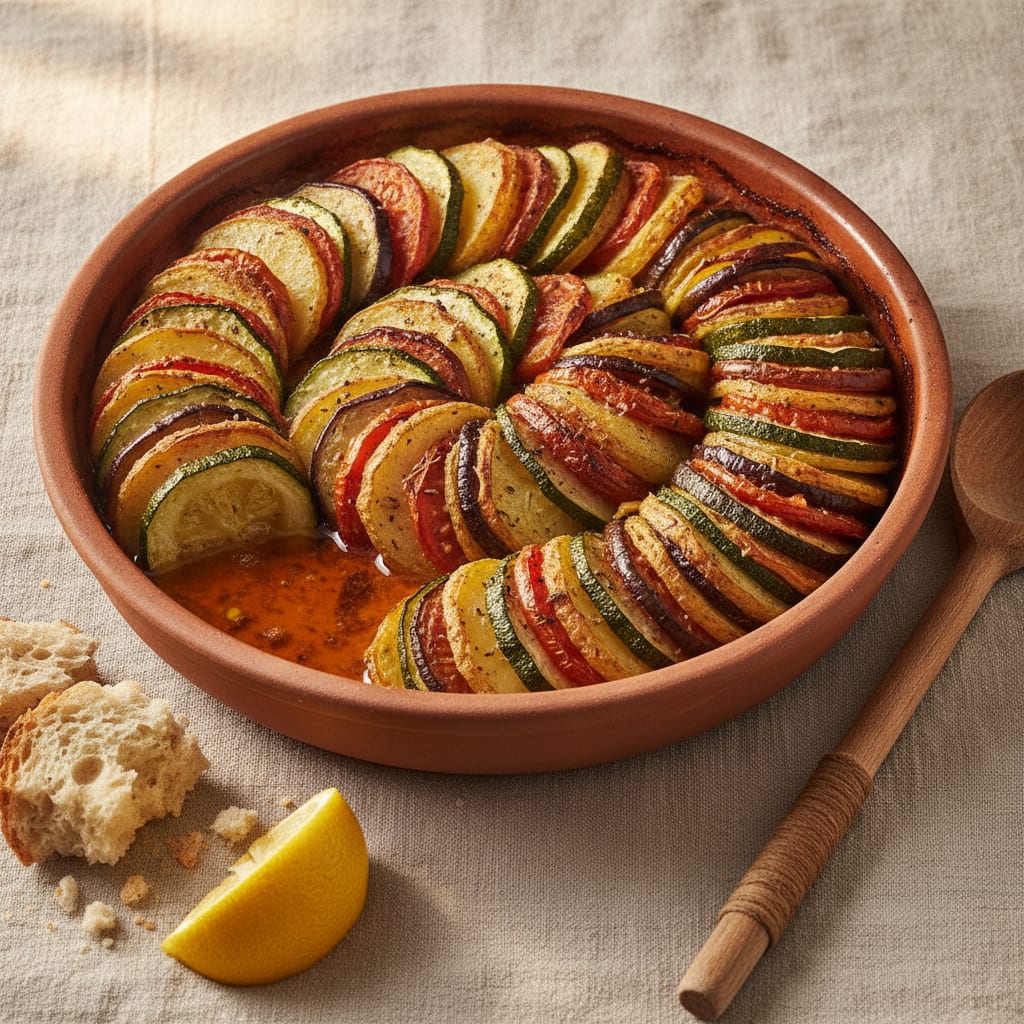
Greek summer vegetables baked slowly in olive oil, two ways: thin-sliced potato, courgette and tomato confited low until the oil and juices become one sauce.
- Prep
- 25 min
- Cook
- 1h 30min
- Total
- 1h 55min
- Servings
- 6
- Difficulty
- Easy
Getting ready…
Ingredients
For 6 servings · 13 items
For the vegetables
For the sauce and dressing
To finish
Method
6 steps · check as you go
- →
Serve
Serve warm or at room temperature, never scalding, with the orange oil from the base spooned over each portion. Bread on the table to wipe the dish is non-negotiable. A slab of feta-style curd and a wedge of lemon on the side make it a full meal — in a Greek summer it needs nothing else.
The story
Athens, August 2017. The Dormition fast had settled over the city and Plaka with it — half the menus shrank to the things you could eat when no animal products were allowed, and Eleni’s kitchen leaned hard on the dishes she’d been making her whole life anyway. Briam was the one she made when the morning’s tomatoes were too soft to sell whole. She’d grate them straight into the dish, slice everything else thin, drown the lot in oil, and slide it into the oven before the heat off the stones got unbearable. By early afternoon the top was blistered almost black and there was a slick of orange oil in the base that I learned, quickly, you mopped with bread before anyone caught you using a fork.
“Not ratatouille,” she told me the first time I called it that, not even looking up. To her the French dish was a different animal — fussed over, stewed in a pan, the vegetables cooked apart and married late. Briam went into the oven raw and came out an hour and a half later as one thing. “We bake. We don’t stir.” She said it the way she said most things, as if it had always been obvious and I was slow.
Briam is a ladera — a dish cooked in olive oil — and one of the oldest meat-free dishes in Greek cooking, a nistisimo eaten through the long Orthodox fasts. The name most likely comes through the Turkish biryan, a roasted dish, and in some villages you’ll hear it called tourlou — “a jumble,” a bit of everything. This is not a vegan version of briam. It always was vegetables and oil. It is briam, the dish Eleni baked on the hot mornings of that August.
À la maison
The weeknight reading is the recipe above, and it asks for almost no technique — only that you respect the oil and the heat. Slice everything thin and lay it in one shallow layer, because a deep mound steams grey instead of roasting. Use the grated tomato; it is the sauce, not a garnish. And do not cut the olive oil — this is a ladera, and the oil reduces with the tomato into the slick you spoon over each plate. Cover it to confit the vegetables soft, then uncover to blister the top. The browned, almost-burnt edges are the prize, and a rest of twenty minutes is when it all comes together.
Au bistrot
The bistronomique reading keeps the long, oily bake but composes the plate and turns the pooled oil into a proper dressing — the same dish, read as a course.
Slice the vegetables on a mandoline to an even 3 mm and build them into tight, upright spirals in individual baking dishes or a tian — potato, courgette, aubergine, tomato alternating, packed on edge so they fan like a rose. Brush with the oregano-garlic oil, cover, and confit at 160°C until the spiral is meltingly soft, then uncover and push the heat to caramelise the exposed edges. Meanwhile take the tomato-and-oil liquid that pools at the base, reduce it in a pan to a glossy, spoonable sauce, and sharpen it at the end with a few drops of lemon to cut the richness. Plate the tian off-centre on a warm matte plate, a brushstroke of the reduced tomato oil beneath, a scatter of fried capers or crisp garlic chips for salt and crunch, and a last thread of raw green olive oil and torn parsley over the top so they land cold and bright against the warm, sweet vegetables.
Le dressage — Three-quarter, low. A single tight vegetable spiral standing off-centre, edges caramelised and bronze, a stroke of glossy reduced tomato-oil beneath. Crisp garlic and torn parsley on top, a thread of raw olive oil catching the light. Warm matte plate, soft directional light to make the oil gleam. The plate should say a peasant tray of vegetables has been read as a course, with every drop of its oil intact.
What the other recipes get wrong
Most briam recipes online — I read the top ten in February 2026 — tell you to roast the vegetables uncovered the whole way, “to get them browned.” That single instruction is why so much home briam comes out as a dry tray of roasted vegetables with burnt onions and hard potatoes. I ran the test over a week that February: nine dishes, identical vegetables and identical oil, only the bake changed.
- Uncovered the whole time: the tops and edges burned while the potatoes underneath stayed firm, the oil scorched rather than reduced, and the dish was dry with no sauce to spoon.
- Covered the whole time: the vegetables steamed soft and the flavours melded, but nothing browned — pale, slack, and one-note, more vegetable stew than briam.
- Covered 45 minutes, then uncovered: the vegetables confited through and gave up their juices into the oil first, then the uncovered stage blistered the tops and reduced the liquid to a glossy sauce. Tender potatoes, caramelised edges, real sauce. Not close.
The reason is gelatinisation and reduction, in that order. Potato starch needs to be held in moist heat long enough to gelatinise fully and turn tender — roughly 60–80°C in the presence of water — which the covered stage guarantees by trapping the steam. Only once the potatoes are soft does it make sense to drive off the water and let the sugars at the cut edges brown. Uncover too early and you try to brown before the inside is cooked, so you scorch the surface chasing a tender centre that never comes. Across all nine dishes, the cover-then-uncover batches were the only ones that gave both at once. The oil matters here too: a generous pool of oil conducts heat evenly around the vegetables and carries the tomato into a sauce, where a thin film just burns.
The line I draw
I will not make briam with a mean hand on the oil. Not “a light drizzle, it’s healthier,” not a non-stick spray. Briam is a ladera, and the whole identity of the dish is vegetables cooked in olive oil until the oil and the tomato become one orange sauce you wipe up with bread. Cut the oil back and there is no sauce, the tomato has nothing to emulsify into, the edges burn dry instead of caramelising, and you have made a sad tray of roasted vegetables that happens to share briam’s ingredients. The oil is not a cooking aid you can minimise. The oil is the dish. Eleni would have grated more tomato and poured more oil, and she would have been right.
When this can fail
Three ways, all from my own kitchen between 2022 and 2026:
- The dry, burnt tray. Roasted it uncovered the whole way the first time, chasing colour; the onions blackened, the potatoes stayed hard, and there was no sauce at all. Fix: cover for the first 45 minutes to confit and steam through, then uncover to brown and reduce.
- The grey, stewed middle. Piled the vegetables deep to fit a big batch in one dish; the centre stewed pale and watery while only the very top caught any heat. Fix: spread it in one shallow layer, even if it means two dishes — briam roasts, it doesn’t braise in a mound.
- The watery base. Used pale, underripe winter tomatoes and skipped the tomato paste; the dish never built a real sauce and stayed thin and washed-out. Fix: grate ripe summer tomatoes and add the spoon of paste — the tomato is the body, not the garnish, and out of season the paste carries it.
FAQ
QWhat is the difference between briam and ratatouille?
They share the same summer vegetables, but the method is different and that changes everything. Ratatouille is, classically, stewed — the vegetables cooked down in a pan, often separately, on the stovetop, with the tomato as a base. Briam is baked: the raw vegetables are layered in a dish, drenched in olive oil and grated tomato, and roasted slow and long until the oil and juices reduce into one sauce and the tops blister. Briam uses far more olive oil and far fewer aromatics — it is a ladera, a dish defined by being cooked in oil. The oven and the oil are what make it briam and not ratatouille.
QIs briam vegan?
Traditionally, yes. Briam is a ladera — vegetables cooked in olive oil with no meat or dairy — and like most ladera it has long been a fasting dish (nistisimo) in the Orthodox calendar, eaten during the many weeks of the year when observant Greeks eat no animal products. Potatoes, courgettes, tomatoes, onion, olive oil, and herbs are the whole dish. It did not become meat-free to suit anyone modern; it was built that way centuries ago.
QWhy is my briam dry?
Almost always too little oil, or too little liquid, or both. Briam is cooked in oil — around 150 ml for a dish of six — and the grated tomato supplies the moisture that becomes the sauce. Cut the oil back to a drizzle and the vegetables roast dry and the tops burn instead of browning. Cover the dish for the first 45 minutes to trap the steam, and if it looks dry before the potatoes are tender, add a splash of hot water and keep going.
QCan I make briam ahead?
Briam is better the next day. Like all ladera it is a room-temperature dish, and an overnight rest lets the oil and tomato set into a thicker, deeper sauce as the flavours marry. Make it a day ahead, keep it covered at cool room temperature or in the fridge, and bring it back to just-warm or full room temperature before serving. Do not serve it fridge-cold, and do not blast it scalding hot — both flatten the flavour.
QDo the potatoes go in raw?
Yes — everything goes in raw, sliced thin, in one shallow layer. The potatoes form the base because they take the longest and they sit in the most liquid, drinking the oil and tomato as they cook. Slicing them 4–5 mm thin is the only thing that matters: too thick and they stay hard in the centre when the tops are already done. There is no need to parboil anything for briam.