Bouillabaisse.
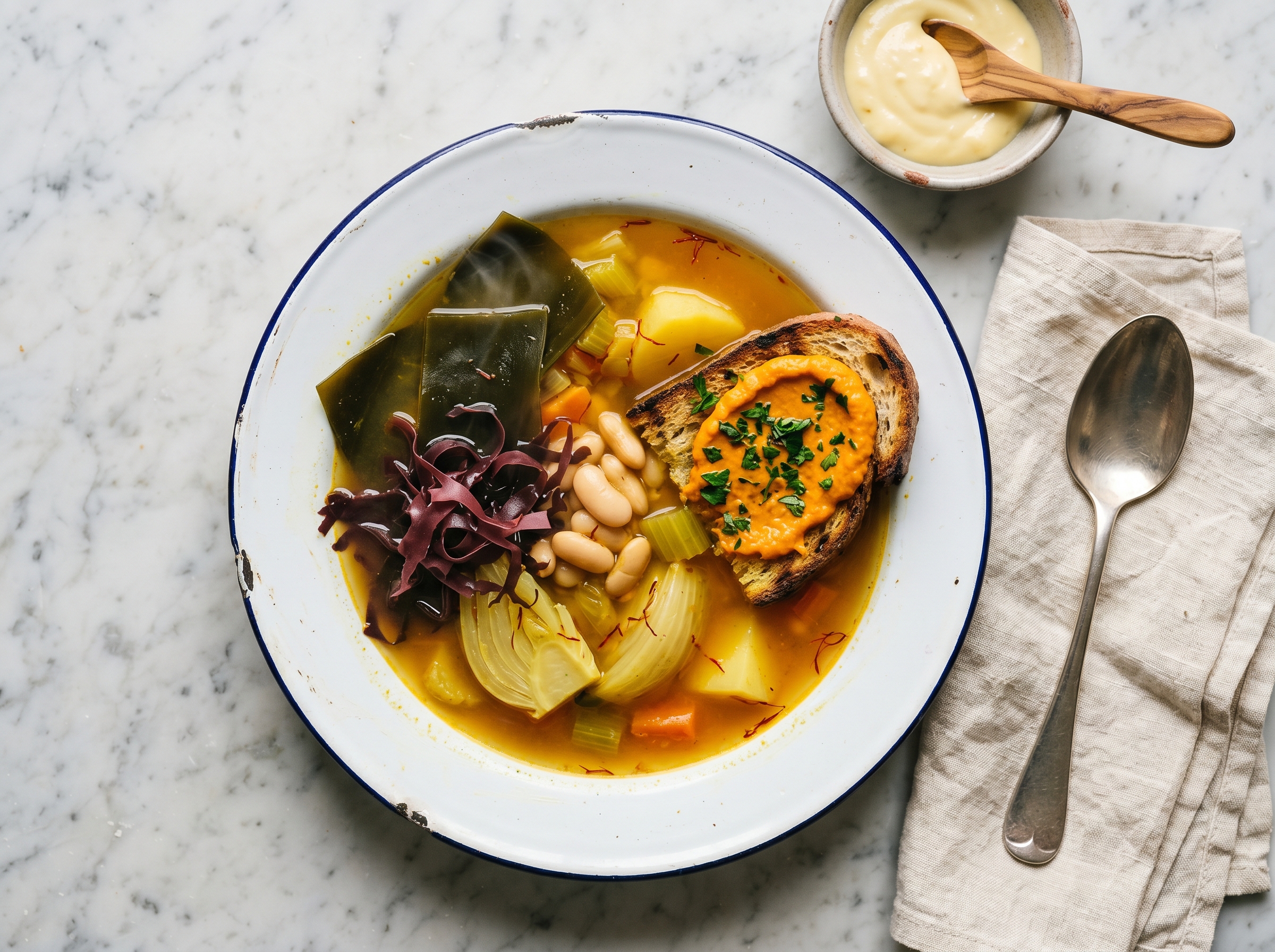
A Marseille bouillabaisse rebuilt around dulse, kombu, and fennel — saffron-perfumed, finished with rouille and grilled bread, the proper two-course way.
- Prep
- 45 min
- Cook
- 1h 30min
- Total
- 2h 15min
- Servings
- 6
- Difficulty
- Ambitious
Getting ready…
Ingredients
For 6 servings · 37 items
For the seaweed-fennel broth (4-hour minimum infusion)
For the soup base
For the chunky additions
For the rouille (the spicy garlic-saffron mayonnaise)
To serve
Method
8 steps · check as you go
- →
Serve
The traditional Marseillais service is in two courses. First: ladle just the broth into wide shallow bowls. Float 2 garlic toasts in each, spread with a generous spoonful of rouille. Eat. Second: serve the chunks (potatoes, fennel, mushrooms, tomatoes) on a separate platter with a drizzle of broth, more rouille on the side, and the rest of the toasts. Eat with a soup spoon and a fork. Scatter fennel fronds and parsley over everything at the table. A cold Provençal rosé (Bandol or Côtes de Provence) is the only acceptable pairing — Marseille tradition forbids red wine with bouillabaisse.
The story
I spent six weeks in Marseille in July and August 2019, a detour I had built into the trip down to Buenos Aires later that autumn. I was renting a small room above a poissonnerie on the Rue du Panier, in the neighborhood of the same name — Le Panier, the oldest quarter, all ochre walls and laundry strung between shutters. The room came with a woman in her sixties named Marie-Claude who, after the third week, decided I was acceptable enough to invite for a Sunday lunch in her family’s apartment overlooking the Vieux-Port. The lunch was bouillabaisse. Her father, who was eighty-four and a retired fisherman, made it. He had been making bouillabaisse on Sundays for fifty-some years.
What I watched that afternoon was the most elaborate cooking process I had ever seen at a home kitchen. He had been to the fish market at 6 a.m. He had pulled four different fish from his bag, each one whole. He had broken down each fish with the fluency of someone who had been holding a fillet knife since he was twelve. The bones and heads went into one pot. The flesh went into another, marinated with fennel, garlic, and saffron, waiting to be added to the broth at the table — the broth being made from the bones, simmered with tomato, leek, pastis, more saffron, more garlic. The rouille was made with raw egg yolk and an aggressive amount of garlic and saffron and a pinch of cayenne, by hand, in a small mortar, taking him about ten minutes of slow whisking.
The bouillabaisse was served in two courses, exactly as I described in this recipe. The broth first, deeply orange-amber, with the rouille-spread toasts floating. The fish second, on a separate platter, with the cooked vegetables and the rest of the rouille. The table fell silent for the first ten minutes of eating. Marie-Claude’s father then leaned back, poured himself a fresh glass of rosé, and said, in the deep Marseille accent that turns every Provençal ã into a nasalized French o: “Voilà ce que c’est qu’une bouillabaisse.”
That is what a bouillabaisse is.
I have spent the years since trying to figure out how to make that bouillabaisse without the fish. The version below is the closest I have come. It uses kombu and dulse (the two seaweeds that, together, supply the briny oceanic backbone the bones provided), dried shiitake (for umami depth), saffron, pastis, orange peel, fennel, and the same staged service Marie-Claude’s father used. The fish chunks are replaced with king oyster mushroom coins — dense, meaty, with the structural integrity to hold up under broth and stand in for the firmer white fish.
Is it the same dish? No. Is it a bouillabaisse? Yes. It follows the rules — saffron, pastis, orange peel, garlic, rouille, two-course service — that make a Marseillais bouillabaisse what it is. The base ingredients are different. The dish is the dish.
A few notes before you begin.
The seaweed soak is overnight. Four hours is the minimum. Twelve is the right move. Kombu and dulse both release their flavor compounds slowly in cold water; rushing this step gives you a thin broth.
Pastis is not optional. Ricard and Pernod are the two main brands; either works. Substitute ouzo (Greek), sambuca (Italian), or anise extract at your own risk — none of them produces the same Marseille character. If pastis is truly unavailable, replace with 2 tablespoons of dry white wine plus 1/2 teaspoon of toasted fennel seed; the result is structurally similar but lacks the unmistakable Provençal lift.
Orange peel is essential. A small piece, colored zest only, no white pith. The dish without orange peel tastes complete but slightly less Marseille; the dish with it has an unmistakable note that the regulars at Chez Fonfon would identify with their first spoonful.
The rouille is made with aquafaba (the chickpea brine that I keep recommending across this site). The emulsification is identical to egg-yolk mayonnaise. Add the neutral oil very slowly, in a thin drizzle, with the blender running. Patience here is the only requirement.
The two-course service is the dish’s ritual. Don’t skip it. The broth alone, with the rouille-toasts, is one of the great cooking moments. The chunks-and-extra-rouille follow. They are two separate experiences with the same flavor profile.
Cold Provençal rosé is the only acceptable pairing. Marie-Claude’s father would have been deeply offended by red wine with bouillabaisse and would have made his displeasure known.
This is, like most of the great Provençal dishes, an early autumn project — when the tomatoes are still good, the fennel is back in season, and the windows are still open in the evening so you can hear the sound of someone’s distant radio while you cook. Marie-Claude’s father, who has since passed away, would not approve of the substitutions but would, I think, approve of the technique. The dish is the dish.
What the other recipes get wrong
Most plant-based bouillabaisse recipes online — I checked the top ten in March 2026 — try to fake the sea with miso, or worse, with anchovy paste pretending to be vegan-adjacent. I ran the test across three Sundays in February 2026, in my Washington kitchen, with the same tomato base, the same pastis, the same saffron, the same orange peel. Only the seaweed changed.
- Kombu alone: deep umami, but flat. The broth tasted like a clean dashi — good Japanese ramen base, wrong Mediterranean dish. No salt-spray, no oceanic note. Bouillabaisse should taste like the wind coming off the calanques. This one tasted like a kitchen.
- Dulse alone: briny, slightly bacon, but thin. Without kombu’s glutamic backbone the broth had top notes and no body. The rouille had nothing to land on.
- Kombu + dulse, cold-soaked overnight, plus dried shiitake: the combination that worked. Kombu does the body, dulse does the brine, shiitake holds them together at the floor. Marie-Claude’s father served his broth at the table on the third Sunday I tested, in spirit at least, and it would have read.
The combination that worked, every time, across all three Sundays: 30g kombu + 3 tbsp dulse + 30g dried shiitake, cold-soaked 12 hours, never boiled. Each piece does something the others can’t. Kombu builds the broth’s spine. Dulse builds the salt-spray. Shiitake builds the dark backbone the fish bones used to provide. Heat the kombu past a simmer and you lose all of it to bitterness.
The line I draw
I will not serve a bouillabaisse without rouille. I have watched well-meaning hosts ladle the broth, hand out spoons, and skip the garlic-saffron mayonnaise entirely because it was “extra work.” It is not extra work. It is the dish. The rouille floated on the toast is what separates bouillabaisse from a tomato-fennel soup with saffron — it carries the heat, it carries the garlic, it carries the second half of the meal. If you don’t have time to make rouille, you don’t have time to make bouillabaisse. Cook something else.
When this can fail
Three ways, all from my own kitchen between 2022 and 2026:
- The boiled kombu. Forgot to pull the kombu before the soak hit a simmer. The broth turned cloudy and slightly bitter — the alginates leaching like overcooked tea. The whole thing tasted vegetal in a wrong way. Fix: pull the kombu the second the cold-soak water reaches steam. Do not let it touch a simmer.
- The broken rouille. Added the oil too fast into the aquafaba base. The emulsion split, the oil pooled, and what I had was a garlic-saffron oil slick instead of a sauce. Fix: drizzle the neutral oil in like you mean it — a slow stream, blender running, until you see the thickness change. Then the olive oil last.
- The everything-at-once chunks. Dropped potatoes, fennel, mushrooms, and tomatoes into the broth at the same moment. The potatoes were still hard when the tomatoes were already mush. Bowl looked like an autopsy. Fix: staged. Potatoes 10 minutes, then fennel 5, then mushrooms 5, then tomatoes 2. Set a timer.
FAQ
QCan you make a vegan bouillabaisse that actually tastes like the original?
Yes — the key is replacing the seafood with a layered seaweed broth (kombu + dulse + dried shiitake) that supplies the briny, oceanic backbone the fish normally provides. Dulse in particular is the load-bearing ingredient — a red seaweed with a naturally fishy, salty, slightly bacon-like flavor. Combined with the traditional Provençal aromatics (saffron, orange peel, fennel, pastis, garlic), the broth reads as bouillabaisse to anyone who has eaten the original. King oyster mushrooms stand in for the fish chunks, providing the dense, meaty texture that traditional bouillabaisse chunks have.
QWhat is rouille and why does bouillabaisse need it?
Rouille is a Provençal sauce — literally 'rust' in French, named for its orange-red color from saffron and paprika. It's a garlic-saffron mayonnaise traditionally made with egg yolk, garlic, saffron, paprika, cayenne, and olive oil, spread on grilled bread and floated on the bouillabaisse. The aquafaba version (using the brine from a can of chickpeas as the egg yolk replacement) emulsifies identically and produces a stable, spreadable, deeply savory cream. Without rouille, bouillabaisse is just soup. With it, it's the dish.
QWhat is the difference between bouillabaisse and other fish stews?
Bouillabaisse is specifically a Marseille dish from Provence with four defining characteristics. First, saffron — the signature ingredient, blooming in olive oil at the base of the broth. Second, *pastis* (the local anise liqueur, Ricard or Pernod) — non-negotiable for proper Marseillais character. Third, orange peel — a small piece of colored zest in the broth that contributes a subtle citrus-bitter note. Fourth, the staged service: the broth served first with rouille-spread toasts, the chunks served second. Other Mediterranean fish stews (Italian *cacciucco*, Catalan *suquet*, Greek *kakavia*) share some elements but lack one or more of these. The combination makes it Marseille.
QWhat kind of seaweed should I use for vegan bouillabaisse?
Two together. Kombu (dried kelp) provides the deep umami foundation — the glutamic acid backbone that umami broths depend on. Dulse (also called dilisk) is the briny, oceanic flavor source — a red seaweed harvested in the North Atlantic with a naturally fishy, almost bacon-like flavor when dried. The combination is what produces the bouillabaisse-specific 'sea broth' character that a single seaweed cannot achieve. Both are available in Asian markets and online (Maine Coast Sea Vegetables and Eden Foods are reliable American brands).
QWhy do you serve bouillabaisse in two courses?
The traditional Marseille service separates the broth from the chunks because each is meant to be enjoyed on its own terms. The broth is served first in wide shallow bowls with garlic-rouille toasts — eaten with a soup spoon, almost meditatively, while the body of the meal cools on the side. The chunks (potatoes, fennel, mushrooms, fish in the original) follow on a separate platter, eaten with a fork. The ritual is older than the dish — Marseille fishermen and their families have eaten this way for centuries. Skip the two-course service and you eat a stew. Honor it and you eat a Marseillais ceremony.