Sealed, steamed, never stirred.
Vegetable Dum Biryani.
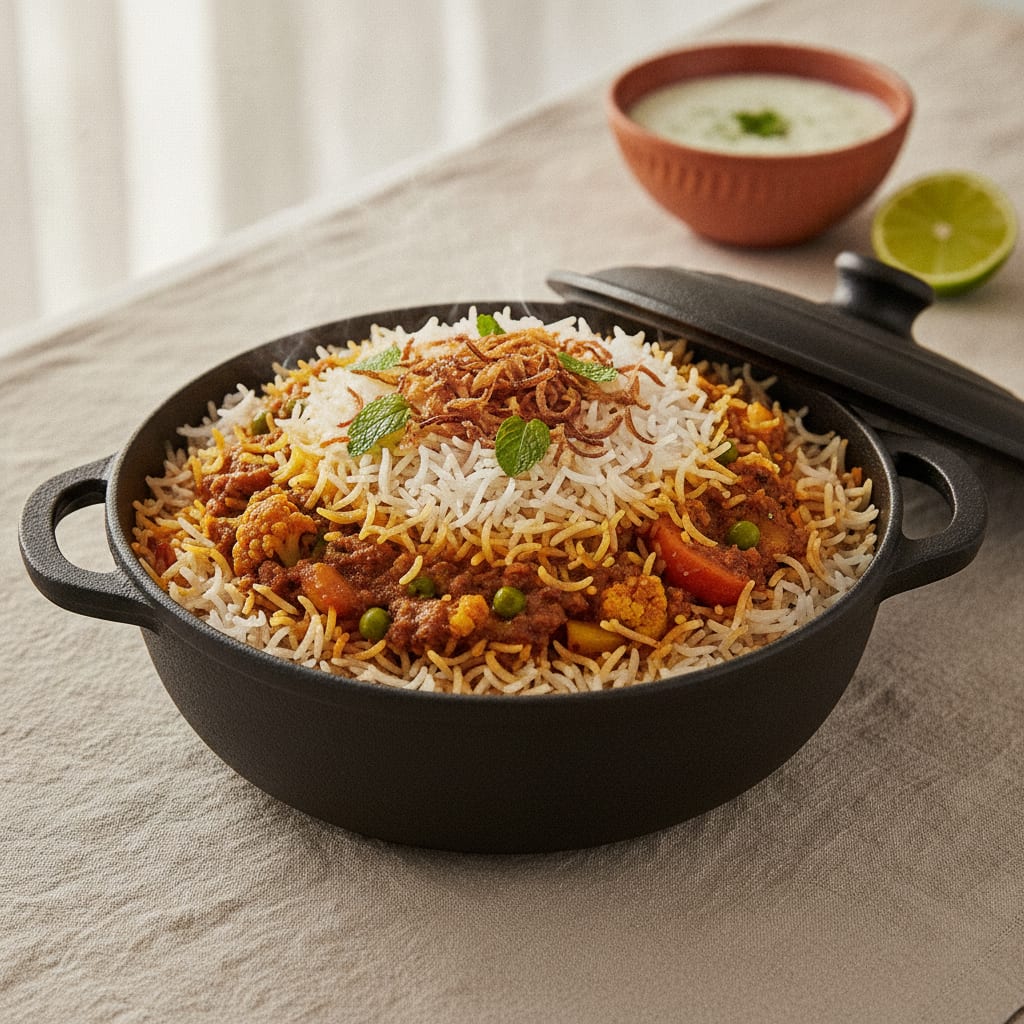
Layered dum biryani done properly: aged basmati par-boiled and sealed over a saffron-scented vegetable korma, fried birista, steamed under its own breath.
- Prep
- 45 min
- Cook
- 50 min
- Total
- 1h 35min
- Servings
- 6
- Difficulty
- Ambitious
Getting ready…
Ingredients
For 6 servings · 18 items
For the rice
For the birista (fried onions)
For the vegetable layer
For the dum and finish
To serve
Method
7 steps · check as you go
- →
Serve
Bring the sealed pot to the table and open it there — the rush of saffron and kewra steam is part of the meal. Lift out vertical portions so each plate shows the strata: white and saffron rice over the deep-spiced vegetable layer, crowned with birista and mint. Serve a cooling raita (cucumber-mint in coconut yogurt) and lime alongside, and nothing else — biryani is the whole table.
The story
Biryani did not come to me in India — it came to me in a strip-mall kitchen on a snowbound February day in 2025, off Wilson Boulevard near the Little Saigon end of Arlington, just across the river from Washington. The cook running the handi was a woman from Hyderabad who had married into a Telugu-Vietnamese family and cooked both halves of the marriage on the same line; I never got more than her first name, Naseem, before the lunch rush ate the conversation. What I remember is the moment she broke the dough seal on the pot. The steam came off it in a single column — saffron, kewra, fried onion, something green underneath — and the whole cold kitchen smelled of a wedding. “You don’t stir it,” she said, already lifting the rice out in vertical spadefuls. “You lift it. Stirring is for people who don’t trust the dum.”
The dish has a long road behind that pot. Its bones are Persian — birian, fried before cooking; birinj, rice — carried into the subcontinent through Mughal kitchens and split, over centuries, into a hundred regional grammars. The two that matter most argue with each other to this day: Hyderabadi kacchi, where raw marinated meat goes under the rice and both finish together in the seal, and Lucknowi pakki, where everything is cooked nearly through, then layered and married in a short steam. The word dum itself is Persian dumpukht — cooked airtight, by its own breath.
This biryani has no mutton in it. It has a yogurt-marinated vegetable korma where the meat would be, aged basmati par-boiled to seventy percent, birista fried to mahogany, saffron in streaks, and a real sealed dum. The method is the method. It is not a “vegetable version” of biryani. It is biryani, built from what was in Naseem’s other pot.
À la maison
The weeknight reading is the recipe above, and it asks for three kinds of patience rather than skill: the birista fried slowly to gold and pulled early, the rice par-boiled to a firm core and not a grain past it, and the dum left genuinely alone on low heat. You do not need a dough seal — a tight lid and a heat diffuser will hold the steam. The single move that makes it read as biryani rather than spiced rice is the par-boil: drain that rice while it still fights you a little, and let the sealed steam do the last third. Everything else is layering, and the only rule of layering is that you never, ever stir.
Au bistrot
The bistronomique reading is the same biryani, deconstructed onto the plate and built back up so each element reads clean and deliberate.
Cook the saffron rice on its own — par-boiled, then dum-steamed with nothing but saffron, caraway, and a knob of plant butter — so it comes out white and gold and entirely distinct. Treat the vegetables as a composed garnish rather than a buried layer: glaze baby carrots and cauliflower florets in a little of the spiced yogurt reduced to a clinging masala, and roast a wedge of potato until its edges crisp. Pull the birista apart into a tangle and fry a second, finer batch to scatter at the end. Make a quick raita gel — coconut yogurt set soft with a whisper of agar, cut into a clean quenelle. Plate a tall, loose mound of the saffron rice off-centre, lean the glazed vegetables against it, lay the crisp potato, spoon a streak of mint-coriander oil, set the raita quenelle to one side, and crown the whole thing with the crisp birista. At the pass, pour a teaspoon of warm saffron milk over the rice so the gold bleeds as the plate goes out.
Le dressage — Overhead, then a tight second frame at the saffron pour. Wide ivory plate, a loose tower of white-and-gold rice off-centre, glazed vegetables and one crisp potato wedge leaning in, a green oil streak, a pale raita quenelle, mahogany birista on top. Warm low light. The plate should say a festival dish, read once, slowly — not a heap, but every layer of the handi laid out where you can see it.
What the other recipes get wrong
Most vegetable biryani recipes online — I read the top ten in March 2026 — quietly stop being biryani and become a pulao: they cook raw rice directly in the spiced vegetable liquid until it absorbs, in one pot, stirred. That is a perfectly good dish. It is not biryani, and it will never have biryani’s separate, elongated, perfumed grain. I ran the test over a week in March 2026 — four batches, same vegetables, same masala, same aged basmati — and changed only how the rice was cooked:
- Absorption (pulao method): raw rice simmered in the vegetable liquid until drunk dry. Tasty, but soft and uniform — the grains swelled fat and round, broke at the edges, and tasted of one flat beige note. No strata.
- Fully boiled, then layered: rice boiled all the way, then dummed. Mush. With nowhere left to cook, the grains went to paste under the steam and the layers collapsed into each other.
- Par-boiled to ~70%, no seal: par-boiled correctly but finished under a loose lid. Better grain, but the top dried out and the rice cooked unevenly — steam escaping is steam not working.
- Par-boiled to ~70%, sealed dum: par-boiled to a firm white core, layered, sealed, low heat, rested. Long separate grains, distinct bands of rice and vegetable, the saffron in patches. This was the only batch that lifted out in clean vertical sections.
The reason is starch and water, not opinion. A rice grain gelatinises and softens as it absorbs water and heat; once it is fully cooked there is no structure left to hold under further steaming, so it collapses. Par-boiling to seventy percent leaves the grain’s core firm and its amylose still partly ordered, so the gentle, sealed dum finishes it just to tender — long, separate, intact. Aged basmati helps twice over: drier and harder, it resists breaking in the boil, and its lower moisture lets it elongate rather than bloat. The seal matters because dum is steam doing work: let it escape and the rice on top cooks in dry heat while the bottom braises. Trap it, and every grain finishes in the same perfumed vapour. Across all four batches, only the par-boiled-and-sealed pot was biryani.
The line I draw
I will not cook the rice all the way through before it goes in the pot. The whole architecture of biryani depends on the rice arriving at the dum underdone — seventy percent, a firm white core when you press a grain — so the sealed steam can finish the last thirty percent gently. The instant you boil that rice to fully tender “to be safe,” you have spent the grain’s entire structure, and the dum has nothing left to do but turn it to paste. A biryani is judged on whether you can lift out a spoonful of long, separate grains. You cannot do that from rice that was already cooked twice. Drain it while it still resists you.
When this can fail
Three ways, all from my own kitchen between 2022 and 2026:
- The burnt bottom. Ran the dum on a bare high flame to save ten minutes; the vegetable layer scorched onto the pot floor and a bitter, acrid smoke climbed up through the rice and ruined the whole pot. Fix: dum on genuinely low heat over a tava or diffuser, and keep enough yogurt-fat in the base layer to protect it. If you smell scorch, kill the heat immediately and don’t scrape the bottom when you serve.
- The over-boiled rice. Got distracted skimming the birista, left the par-boil going past five minutes; the rice came out fully cooked, then turned to mush under the seal. Fix: stand at the boiling pot, start pressing a grain at four minutes, and drain the instant the core is still firm and white. The boil is the timed step, not the dum.
- The pale, raw onions. Pulled the birista too early one festival lunch because the kitchen was slammed; they stayed limp and tasted of raw onion through the whole dish instead of sweet and crisp. Fix: fry to an even deep mahogany and pull one shade before done — they keep darkening off the heat — then let them crisp as they cool before they go anywhere near the layers.
FAQ
QCan you make a real biryani without meat?
Yes — biryani is defined by its method, not its protein. The defining moves are aged basmati par-boiled separately, a spiced base layer, fried onions (birista), saffron, and the sealed dum-pukht steam that finishes the rice. Build all of that under a vegetable korma instead of mutton and it is biryani, not a 'pulao.' The distinction blogs flatten is that biryani is layered and steamed sealed, while pulao is cooked together in absorbed liquid.
QWhat is the difference between kacchi and pakki biryani?
Kacchi (raw) biryani layers raw marinated meat under par-boiled rice and cooks both together in the dum — the Hyderabadi method, harder to time. Pakki (cooked) biryani cooks the base and the rice separately to nearly done, then layers and steams only briefly to marry them — the Lucknowi/Awadhi method, more forgiving. This vegetable version borrows from both: a yogurt-marinated base cooked partway (pakki for safety), finished under par-boiled rice in a real sealed dum.
QWhy use aged basmati rice for biryani?
Aged basmati (a year or more old) has dried from around 14–16% moisture down to 10–11%. That drier, harder grain absorbs water more evenly, elongates dramatically instead of bloating, and stays separate rather than clumping — exactly the long, distinct, fluffy grain biryani is judged on. Aging also concentrates 2-acetyl-1-pyrroline, the compound behind basmati's popcorn-and-pandan aroma.
QWhat is dum pukht?
Dum pukht is Persian for 'cooked by breath' — slow-steaming food in a sealed vessel so nothing escapes. In Awadhi tradition the technique is tied to the late-18th-century kitchens of Nawab Asaf-ud-Daula in Lucknow, where huge sealed cauldrons fed famine-relief workers building the Bara Imambara from 1784. For biryani, sealing the lid (classically with a dough rope) traps the rising steam and finishes the rice in its own perfumed vapour.
QHow do I keep the rice from going mushy?
Three controls. Par-boil only to seventy percent — a firm white core must remain when you drain it. Use aged, long-grain basmati, not a soft or broken rice. And keep the dum on genuinely low heat with a rest off the heat at the end, so the rice finishes gently in steam rather than frying or boiling on the pot floor. Lift, never stir, to serve.