Mix it all together.
Bibimbap.
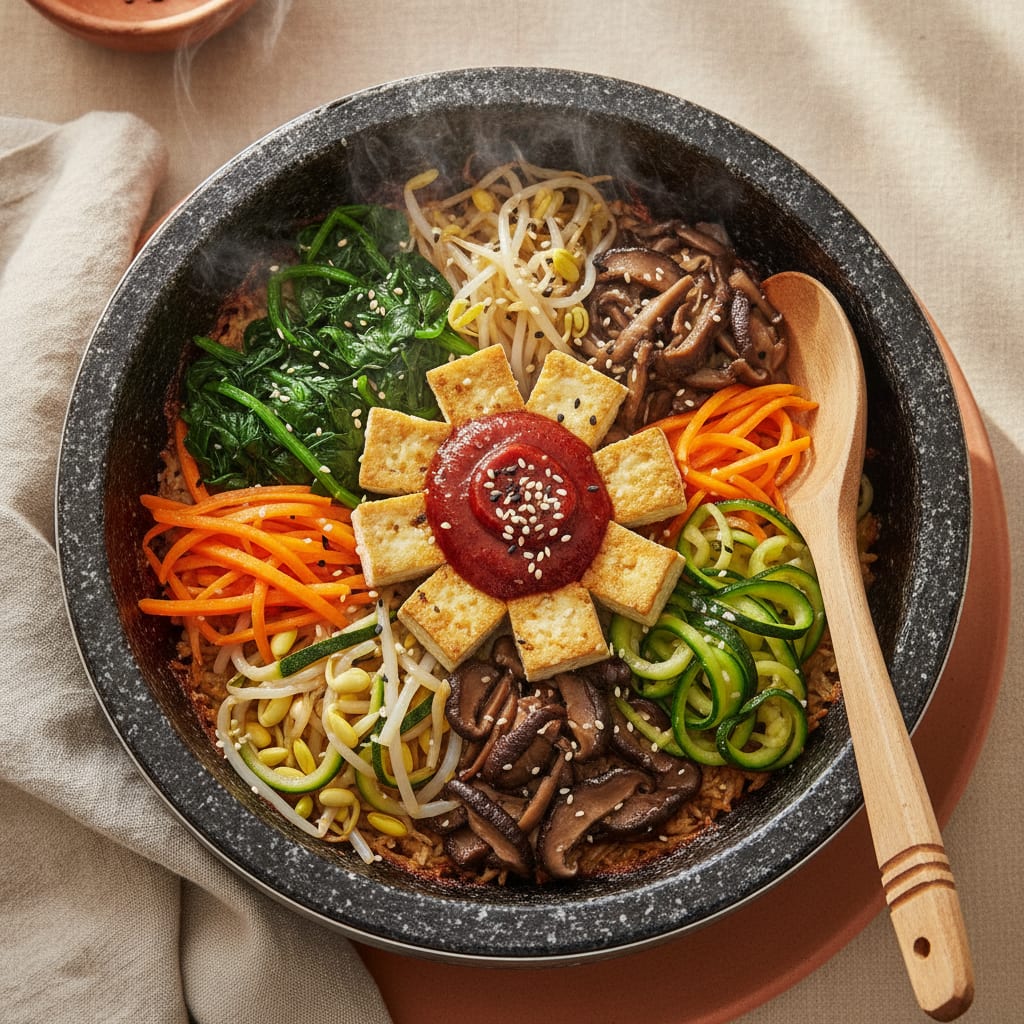
A Korean rice bowl built on disciplined namul vegetables, a crackling dolsot rice crust, a gochujang sauce, and crisp seared tofu where the egg usually sits.
- Prep
- 35 min
- Cook
- 25 min
- Total
- 1h
- Servings
- 4
- Difficulty
- Medium
Getting ready…
Ingredients
For 4 servings · 21 items
For the rice
For the namul (the seasoned vegetables)
For the seared tofu (the center)
For the gochujang sauce
Method
6 steps · check as you go
- →
Serve
Serve in the hottest bowl you have, arranged in its ring, with the gochujang sauce in the center and extra sauce on the side for those who like it hotter. Tell people to mix it themselves, hard, scraping the crisp rice up from the bottom. A bowl of kimchi and a cup of barley tea (boricha) alongside. The dish is eaten with a spoon, not chopsticks.
The story
I came to bibimbap in Washington, in the early summer of 2025, by way of Annandale — the stretch of strip-mall Korean restaurants out in the Virginia suburbs where the menus run to three laminated pages and the banchan keeps coming whether you asked or not. I had gone for cold noodles and stayed for the woman at the next table, a regular the staff clearly knew, who waited until her stone bowl had stopped hissing, then mixed it so hard and so long that I understood I had been doing it wrong my whole life. I asked the owner about the rice crust afterward. He just smiled and tilted an imaginary bowl: let it sit, don’t touch it. That was the lesson. Patience against hot stone.
The dish carries its history loosely. Nobody can prove where bibimbap began — some trace it to goldongban, mixed rice; some to the jesa ancestral rites, where the offerings were stirred together and shared; some to ordinary people clearing their leftover side dishes into a bowl on the eve of the lunar new year. It is first written down by name in the late-19th-century cookbook Siuijeonseo. The bowl is older than its record, and it was always about mixing.
This bibimbap has no egg and no beef. It has crisp seared tofu where the rich center usually sits, a ring of disciplined namul, a gochujang sauce, and the crackling nurungji crust from a hot bowl. It is not a “vegetable version” of bibimbap. It is bibimbap — the namul, the crust, and the final mix are all here.
À la maison
The weeknight reading is the recipe above, and it lives or dies on two habits. First, season each vegetable on its own — five small acts of cooking, each finished to its own taste. It feels fussy the first time and obvious the second. Second, get the rice crust: a hot stone bowl is ideal, but a hot oiled skillet with the rice pressed flat and left alone for four minutes gives you the same crackling nurungji. Mix it hard at the table, scraping the crust up. That mix is the dish finishing itself.
Au bistrot
The bistronomique reading keeps every namul but raises the precision and adds two refinements that turn a generous bowl into a composed plate.
Cut each namul to an exact, uniform julienne so the piles read as deliberate lines rather than mounds. Make the nurungji a separate element: toast a thin disc of rice in a ring mold against blistering cast iron until it sets into a single crisp wafer, then break it into shards. Glaze the seared tofu darker, almost lacquered, with a soy-and-gochujang reduction. Build on a wide flat plate, not in a bowl: a low bed of warm rice off-center, the namul laid in clean parallel strokes radiating from it, the lacquered tofu set with intention, a brushstroke of the gochujang sauce dragged across the plate, and the nurungji shards stood upright like sails so the crisp element is seen, not buried. A scatter of toasted sesame and a few threads of finely cut perilla or shiso leaf for green.
Le dressage — Overhead. Wide pale plate, namul in clean parallel strokes radiating from an off-centre bed of rice. Lacquered tofu, a dragged brushstroke of red gochujang, nurungji shards stood upright. Sesame scatter. The plate should say a mixed bowl, taken apart and composed — order before the eater stirs it all back together.
What the other recipes get wrong
Most no-egg bibimbap recipes online — I read the top ten in May 2026 — make two errors: they sauté all the vegetables together in one pan to save time, and they skip the rice crust entirely, serving warm rice in a cold bowl. I ran the test over a weekend in my Washington kitchen in May 2026: three bowls, same vegetables, same gochujang sauce, only the namul handling and the rice treatment changed.
- All vegetables sautéed together, rice in a cold bowl: edible but flat. The vegetables tasted of one thing — garlic and soy and each other — and the bowl was a soft, uniform mush with no textural contrast.
- Namul cooked separately, rice in a cold bowl: a real improvement. Each forkful before the mix tasted distinct, spinach against carrot against mushroom. But the bowl was still all-soft; nothing crackled.
- Namul cooked separately, rice crisped in a hot bowl: this was the dish. Distinct vegetables, and a chewy-crisp nurungji crust scraped up through the mix that gave every bite a base of crunch.
The reasons are both technique and chemistry. Cooking namul separately keeps each vegetable’s seasoning and moisture its own — combine them and they steam each other and the flavors homogenize. The crust is the Maillard reaction: pressed against stone or iron hot enough to drive off surface water and push past about 140°C, the rice’s starches and trace amino acids brown into nurungji, a chewy-crisp, nutty layer that plain steamed rice never develops. That browned crust, folded through the soft rice in the final mix, is the textural backbone of dolsot bibimbap. Drop the separate namul and you get muddy. Drop the crust and you get a soft pile. Keep both and you get bibimbap.
The line I draw
I will not pre-mix bibimbap for the eater, and I will not serve it without giving them a crust to scrape. The dish is named for the act of mixing — bibim — and that final, vigorous stir at the table, dragging the crisp nurungji up through the soft rice and folding the gochujang through every grain, is the moment the dish becomes itself. Serve it already stirred and you have handed someone a bowl of seasoned rice with the best part already done and lost. Arrange it, give them the hot crust, and let them finish it. The mix belongs to the person eating.
When this can fail
Three ways, all from my own kitchen between 2022 and 2026:
- The muddy bowl. Sautéed all five vegetables in one pan because I was short on time. They bled together into a single soy-garlic flavor and went limp; the whole point of namul — distinct, layered tastes — was gone. Fix: cook and season each vegetable separately, even if it means five quick turns in the same pan, wiped between.
- The soggy rice base. Used freshly steamed, very wet rice and a lukewarm pan, so it never crisped — it just sat and steamed into the namul. Fix: use day-old or cooled rice, and get the stone bowl or skillet genuinely hot before the rice goes in, then leave it untouched for four minutes.
- The harsh sauce. Dolloped raw gochujang straight from the tub onto the bowl. It was one loud, salty-hot note that flattened everything under it. Fix: thin the gochujang with sesame oil, vinegar, and a little sweetener into a balanced sauce before it touches the bowl.
FAQ
QCan you make bibimbap without egg or meat?
Yes. Bibimbap is defined by its rice base, its ring of separately seasoned namul vegetables, its gochujang sauce, and — in the dolsot version — its crisp rice crust, not by the fried egg or beef on top. Crisp seared tofu sits in the center as the rich protein the egg or beef provided. Everything that makes bibimbap bibimbap — the namul discipline, the nurungji crust, the final mix — is fully present. It is bibimbap, not a version of it.
QWhat is the crispy rice in dolsot bibimbap called?
The crackling golden layer at the bottom is called nurungji. It forms when rice is pressed against a screaming-hot stone bowl (dolsot) or cast-iron pan and left to dry-toast, so the surface starch browns through the Maillard reaction into a chewy-crisp crust. It is the most prized part of dolsot bibimbap for many people. If you do not have a stone bowl, you can build the same crust by pressing the rice into a hot oiled skillet and leaving it untouched for a few minutes.
QWhy cook each bibimbap vegetable separately?
Each vegetable in bibimbap is a namul — seasoned individually to its own character. Spinach takes more sesame oil; mushrooms take soy; bean sprouts take almost just salt and garlic; carrots take very little. Cooking them all together would blur them into one flavor and one texture. Seasoning and cooking each apart, then arranging them in separate piles, is the discipline that gives bibimbap its layered, distinct taste before you mix it all together.
QWhere does bibimbap come from?
There are several theories and no single proven origin. One links it to goldongban, an old term for mixed rice. Another traces it to jesa, the ancestral memorial rite, where the assorted food offerings were mixed into a bowl of rice and shared. A third holds that ordinary people mixed up all their leftover side dishes into rice on the eve of the lunar new year. The dish is first recorded by name in the late-19th-century cookbook Siuijeonseo. The truth is probably that several of these streams fed into the bowl we know now.
QWhat is gochujang and is there a substitute?
Gochujang is a thick, fermented Korean paste of red chili powder, glutinous rice, fermented soybean, and salt, aged until deeply savory, sweet, and hot. It is essential to bibimbap's sauce and has no close substitute — sriracha or generic chili paste lack its fermented depth and body. It is widely sold in tubs at Korean and most Asian groceries and keeps for many months refrigerated. Thin it with sesame oil, vinegar, and a little sweetener to make the bibimbap sauce.