The colony, eaten.
Bánh mì.
Vietnam's baguette sandwich, two ways: an airy rice-flour-lightened roll, lemongrass tofu, mushroom pâté, đồ chua pickle, cilantro, chili, and Maggi.
- Prep
- 40 min
- Cook
- 20 min
- Total
- 1h
- Servings
- 4
- Difficulty
- Medium
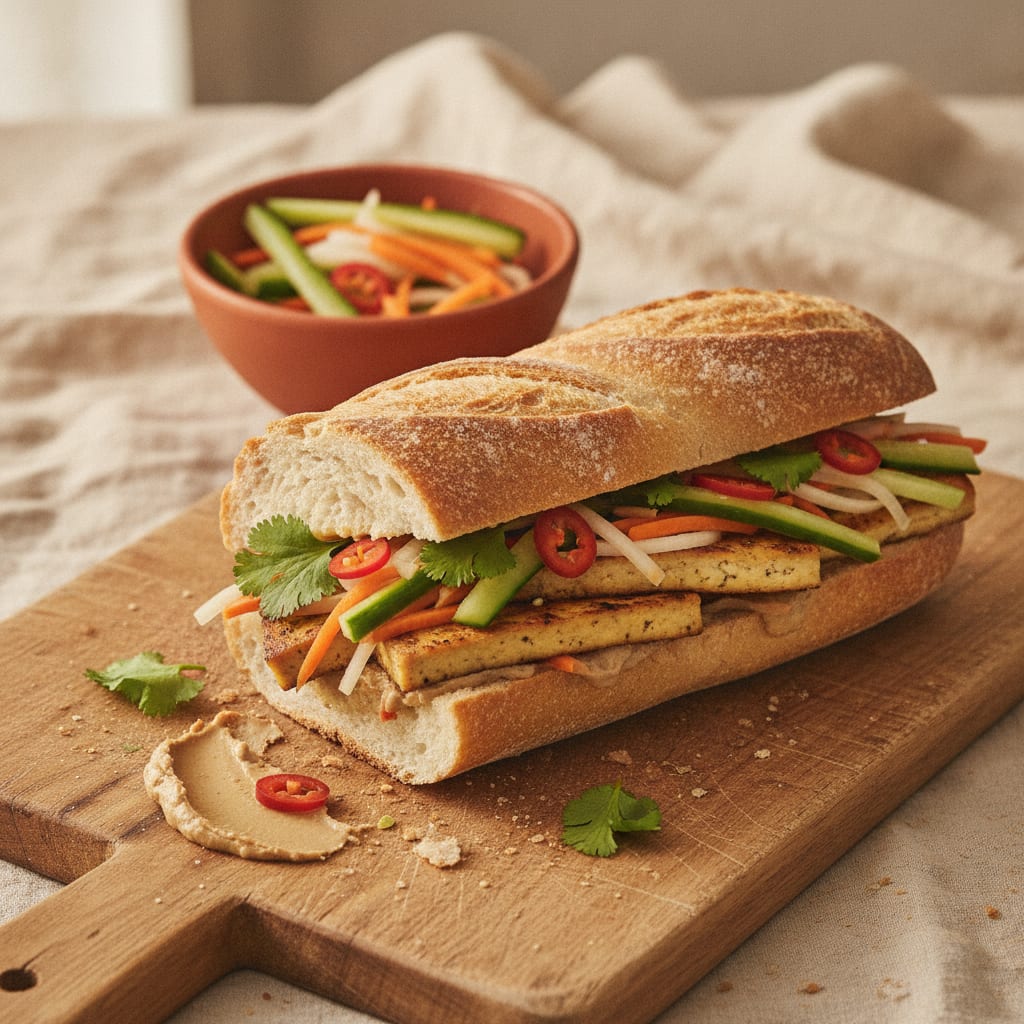
Getting ready…
Ingredients
For 4 servings · 24 items
For the đồ chua (pickle, make first)
For the lemongrass tofu
For the mushroom pâté
To build
Method
6 steps · check as you go
- →
Serve
Cut each bánh mì on the diagonal and serve immediately, while the crust still shatters and the tofu is warm against the cold pickle. Maggi seasoning and sliced chili on the table for those who want more. A cold beer, a Vietnamese iced coffee, or sparkling water with lime.
The story
A bánh mì is a colony you can hold in one hand. The French brought the baguette to Vietnam in the mid-nineteenth century, and for a long time it stayed a French thing — expensive, eaten by colonists and the local elite with butter and pâté, a loaf that meant power. Then Vietnamese bakers did the quiet, decisive thing: they cut the wheat flour with rice flour, because wheat grew badly and cost too much, and the loaf went lighter and crisper than anything in Paris. The modern sandwich came together in Saigon in the 1950s and 60s, after the 1954 partition pushed northern cooks south, and they filled the colonial loaf with đồ chua and cilantro and chili and Maggi until it stopped being French and started being Vietnamese. The bread is the empire; everything inside it is the answer.
I built this version in my Washington, D.C. kitchen through 2025, but I learned what the bread should do at the Eden Center in Falls Church, at a bakery counter where a man split a roll for me and the crust shattered into a small snowfall on the glass. He pressed the cut face with his thumb to show me how thin the crust was, how empty and light the crumb — “for the pickle,” he said, tapping the space. I’ve thought about that gesture every time I’ve warmed a roll since. The bread is built to be a vessel. Pack it.
This bánh mì has no pork in it. It has lemongrass-marinated tofu seared hard and lacquered, a mushroom-and-walnut pâté browned for depth, the đồ chua pickle, cucumber, cilantro, chili, and Maggi. The architecture is unchanged — fat against the bread, hot protein, cold acid and crunch and herb on top, eaten the moment it’s built. It is not a “vegetarian take” on bánh mì. It is bánh mì, packed the way bánh mì is packed.
À la maison
The weeknight reading is the recipe above, and it asks you to respect two things: the pickle and the bread. Make the đồ chua first so it has time to take — it is the brightness the whole sandwich is built around, and a drained, crunchy, tart pickle is the difference between a bánh mì and a soft sad sub. And warm the bread until the crust crackles, then build and eat at once. A bánh mì assembled and left to sit goes soggy from the inside; the magic is the crisp crust, the cold pickle, and the warm tofu meeting in the same bite. Everything else — the tofu, the pâté — you can make ahead and keep in the fridge.
Au bistrot
The bistronomique reading is the same sandwich pulled apart into a composed plate — the bánh mì read as a course rather than a handful.
Treat the elements as a deconstruction that still tastes like the sandwich. Crisp a thin disc of the baguette into a tuile — sliced thin, brushed with oil, baked until it shatters — so the crust is still the carrier but now it’s a cracker. Sear the lemongrass tofu and cut it into clean batons. Whip the mushroom pâté smooth with a little more fat so it pipes into a quenelle. Dress the đồ chua tight and bind a forkful into a small tangle. Make a herb oil from cilantro and scallion for a bright green line. Plate it as a line on a long dish: a swipe of the smooth pâté, the tofu batons leaning, the đồ chua tangle, the shattered baguette tuile standing upright in the pâté, dots of the herb oil, a single thin ring of red chili, a few drops of Maggi reduced to a glaze. The diner builds each bite — pâté, tofu, pickle, crunch — and tastes the sandwich, course by course, without the loaf.
Le dressage — Overhead on a long narrow plate. A clean horizontal composition: pâté swipe, leaning tofu batons, bright tangle of orange pickle, the upright shard of baguette tuile, dots of green herb oil, one red chili ring. White plate, hard side light to catch the shatter on the tuile. The plate should say the sandwich, taken apart and still itself.
What the other recipes get wrong
Most vegetarian bánh mì recipes online — I read the top ten in March 2026 — get the fillings roughly right and then lose the sandwich on the bread and the pickle. They build on a heavy sourdough or a soft sub roll, skip the pâté, and under-pickle the vegetables. So I ran the test in my Washington kitchen over a week in March 2026, eight sandwiches, the fillings held constant, three variables moved: the bread, the presence of the pâté layer, and the pickle time.
- Heavy sourdough / soft sub roll, no pâté, 10-minute pickle: dense, dull, soggy by the second bite. The bread fought the fillings instead of carrying them, and without the pâté the whole thing read flat and lean.
- Light thin-crusted baguette, no pâté, 1-hour pickle: bright and crisp but lean — you could taste the gap where the savory, fatty layer should be. Good, not bánh mì.
- Light rice-flour-lightened roll, mushroom-walnut pâté, 1-hour drained pickle: this was it. The crust shattered, the crumb stayed light, the pâté waterproofed the bread and gave the depth, and the drained tart pickle cut clean through everything.
The reasons are structural. The rice-flour-lightened crumb is genuinely lighter and crisper than a wheat-only baguette — it’s why Vietnamese bakers adopted it — so the sandwich never goes heavy. The pâté layer does two jobs: a fat barrier that keeps the brine off the crumb, and the dark savory depth a lean sandwich misses. And the pickle has to be drained: an under-drained đồ chua weeps brine into the bread and you’re eating a soggy loaf within minutes. Move the bread to a light roll, add the pâté, drain a properly-pickled đồ chua, and across all eight sandwiches it stopped being a vegetable sub and started being bánh mì.
The line I draw
I will not build a bánh mì on the wrong bread and call it bánh mì. It is not a baguette in the French sense and it is not a soft American sub — it is a specific loaf, light and thin-crusted, the wheat cut with rice flour, built to shatter at the crust and stay empty enough at the centre to pack. Build it on a heavy artisan sourdough and you get a good sandwich that is not this sandwich; the bread is too dense to carry the contrast and too chewy to let the pickle and herb register. If I can’t get a rice-flour roll, I find the lightest, thinnest-crusted baguette I can and pull some crumb out to make room. The bread is half the dish. Get the bread wrong and nothing inside it can save you.
When this can fail
Three ways, all from my own kitchen between 2022 and 2026:
- The soggy sandwich. Built four bánh mì ahead for a picnic and wrapped them; an hour later the bread had gone limp and grey from the pickle brine and the mayo. Fix: build to order, drain the đồ chua hard, and lay the fat layers — mayo and pâté — directly against the bread to waterproof the crumb. A bánh mì does not travel built.
- The bland, lean build. Skipped the pâté one busy night to save time. The sandwich was crisp and fresh and completely hollow in the middle — all brightness, no depth. Fix: never skip the pâté. The browned-mushroom-and-walnut layer is the savory richness the whole thing is balanced against; without it the sandwich is a salad in bread.
- The watery tofu. Didn’t press the tofu, marinated it wet, and it steamed grey in the pan instead of searing. No crust, no lacquer, no contrast. Fix: press the tofu first, marinate it just long enough to flavor the surface, and sear it hard and dry over medium-high until the edges caramelize.
FAQ
QWhat makes a real bánh mì without meat?
Bánh mì is a sandwich defined by its structure — a light, thin-crusted baguette, a fatty savory spread, a hot protein, the đồ chua pickle, fresh herbs, chili, and Maggi — not by any one filling. Replace the grilled pork with lemongrass-marinated seared tofu, and the liver pâté with a mushroom-and-walnut pâté browned hard for Maillard depth, and the architecture holds: fat against the bread, hot protein, cold acid and crunch on top. It reads as bánh mì because the contrast and the assembly are bánh mì.
QWhy is bánh mì bread different from a French baguette?
The baguette came to Vietnam with French colonists in the mid-nineteenth century, but Vietnamese bakers adapted it. Wheat grew poorly in the climate and was expensive, so bakers cut the wheat flour with rice flour. That gives the bánh mì roll its signature thin, shattering crust and exceptionally light, airy crumb — lighter and crisper than a classic French baguette, and the reason the sandwich never feels heavy. If you can find rice-flour rolls, use them; otherwise choose the lightest, thinnest-crusted baguette you can.
QWhat is đồ chua and can I skip it?
Đồ chua is the quick carrot-and-daikon pickle that gives bánh mì its brightness — julienned vegetables in a sweet-sour brine of rice vinegar, sugar, salt, and water, left 30 minutes to overnight. Do not skip it. It is the acid and crunch that cut every rich layer in the sandwich; without it the bánh mì is soft, heavy, and one-note. Drain it well before building so the brine doesn't soak the bread.
QWhat is the pâté in a vegetarian bánh mì?
A bánh mì traditionally carries a smear of pork-liver pâté for its unctuous, savory richness. A pâté of mushrooms browned until all their water has cooked off, blitzed with toasted walnuts, a splash of brandy, and soy gives you the same dark, spreadable, savory layer. Spread it on the cut face of the bread opposite the mayo; it waterproofs the crumb and adds the depth the meat used to.
QWhat does Maggi do in bánh mì?
Maggi seasoning is a savory, soy-like liquid that arrived in Vietnam during the French colonial period and became a fixture on the Vietnamese table. A few drops on the assembled sandwich add a deep, salty, almost meaty umami that ties the layers together. Soy sauce is a fine substitute, but Maggi is the genuinely traditional note — it belongs in the marinade and as a finishing drizzle.