No water, all flavour.
Aloo Gobi.
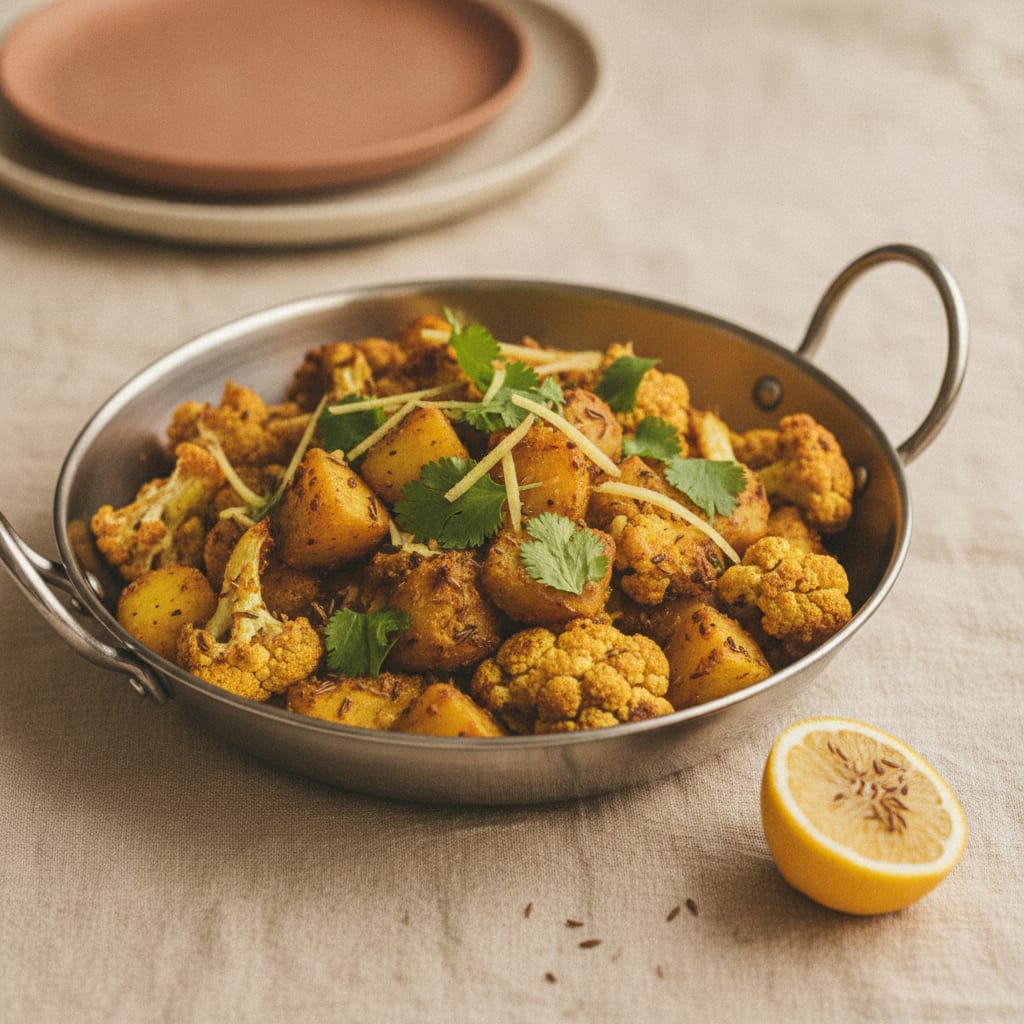
Punjabi dry aloo gobi: potato and cauliflower dry-roasted till browned and tender, not stewed, with turmeric, cumin, ginger, and an amchur finish.
- Prep
- 15 min
- Cook
- 30 min
- Total
- 45 min
- Servings
- 4
- Difficulty
- Easy
Getting ready…
Ingredients
For 4 servings · 13 items
For the dish
To finish
Method
6 steps · check as you go
- →
Serve
Serve aloo gobi dry, mounded in a warm bowl, scattered with fresh coriander and raw ginger juliennes, with hot roti or paratha to scoop and a bowl of dal alongside. A spoon of plain coconut yogurt and a few slices of raw onion and lemon on the side make it a full plate. It's a dry sabzi — there is no gravy to mop, so the bread is the tool.
The story
Aloo gobi taught me, in a single dinner, that I’d been cooking it wrong for years. It was April 2025, a weeknight, in a friend’s apartment kitchen in Takoma Park on the northern edge of D.C., and her mother — visiting from Amritsar, a woman named Surinder who cooked with the radio on and no measuring spoons in sight — took one look at the splash of water I was about to add to the pan and physically moved my wrist. “No, no. Why are you drowning it?” She tipped the pan to show me the cauliflower sitting in a single layer, catching gold on its cut faces. “You let it sit. You let it brown. Gobi wants to be roasted, not boiled. The water comes from inside it, when it’s ready.” Then she walked off to make the roti, and the cauliflower browned exactly as she said it would, with not a drop added.
There is no grand origin story here, and the dish doesn’t pretend to one. Aloo gobi is Punjabi home cooking — aloo, potato; gobi, cauliflower — built on the cheapest, hardiest vegetables of the North Indian winter, cooked dry and fast in a kadai, varying house to house. It was never a restaurant showpiece. It’s the thing on the table every other night, which is exactly why it has to be made right: there’s nowhere to hide.
This aloo gobi has never had anything in it but vegetables and spice — it’s one of the dishes that was already itself, no defending required. There’s no “veganising” to do. It is simply aloo gobi, cooked the way Surinder cooked it: dry, browned, finished with amchur, and never, ever drowned.
À la maison
The weeknight reading is the recipe above, and it is genuinely easy — it just demands you fight one instinct. When the pan looks dry and you reach for water: don’t. Aloo gobi is dry-roasted, not stewed. Give the potato a head start so it catches up with the cauliflower, then spread everything in a single layer and let it sit to brown before you toss it. That patience — letting the cut faces catch gold instead of stirring constantly — is the whole difference between a dish that tastes roasted and one that tastes boiled. Finish with garam masala and amchur off the heat so they stay bright, and pile on the fresh coriander and raw ginger. That’s it. Forty-five minutes, one pan, no liquid.
Au bistrot
The bistronomique reading keeps the dry-roast principle and turns a rustic sabzi into a composed vegetable plate.
Roast the cauliflower harder and more deliberately — break the head into one or two beautiful large florets per plate and roast them whole until deeply caramelized and tender, almost like a steak, basted in the cumin-ginger oil. Turn the potato into two textures: a smooth turmeric-and-amchur potato purée swiped across the plate, and a few crisp roasted potato cubes for crunch. Make a quick coriander-mint chutney and loosen it into a vivid green oil to dot around. Add a cool element — a small quenelle of coconut yogurt whipped with toasted cumin — and a scatter of crisp fried ginger juliennes and a few tempered cumin seeds. Plate the turmeric purée as a base swipe, set the roasted caramelized cauliflower floret on it, tuck the crisp potato around, dot the green oil, lay the yogurt quenelle to one side, and finish with the fried ginger and a single coriander leaf. The amchur lives in the purée and a final dusting over the floret, so the brightness reads.
Le dressage — Three-quarter, raking side light to catch the caramelized edges of the cauliflower. Wide pale plate. A swipe of golden turmeric purée, one deeply browned cauliflower floret standing on it, crisp potato cubes, green oil dots, a pale cumin-yogurt quenelle, crisp ginger threads on top. The plate should say a humble sabzi, given a single beautiful read — the everyday vegetable, roasted with intent.
What the other recipes get wrong
Most aloo gobi recipes online — I read the top ten in May 2026 — hedge toward the stew: a splash of water, a lid kept on, “cook until soft,” constant stirring. That gives you a pale, grey, collapsing aloo gobi that tastes boiled. I ran the test over four nights in May 2026 — same cauliflower, same potato, same spice mix, same pan — and changed only the cooking method:
- Lid on, splash of water, stirred often: steamed soft and grey, the florets broke down into the potato, no browning anywhere. It tasted vegetal and flat — boiled vegetables wearing spices.
- No water but stirred constantly: better colour than the steamed batch, but the constant agitation kept any face from sitting long enough to brown, and broke the florets apart. Patchy and uneven.
- Dry, single layer, tossed occasionally: cauliflower browned on its cut faces, potato caramelized at the edges, florets held their shape. Nutty, roasted, distinct. This was the dish.
- Dry, with one brief 2-minute cover near the end: the best of all — the dry-roast built the browning, and a short covered moment let the cauliflower’s own moisture steam the centres tender without any added water or loss of colour.
The reason is the Maillard reaction versus steaming. Browning — the deep, savoury, roasted flavour aloo gobi is built on — only happens above about 150°C, on a dry surface, where sugars and amino acids react. The instant you add water or trap steam under a lid, the surface temperature is capped at 100°C and can’t brown; you steam instead of roast, and you get grey, soft, flat vegetables. Cauliflower is mostly water and releases plenty of its own as it heats, so it never needs added liquid — given a hot dry pan and a moment to sit undisturbed, it browns on its cut faces and stays whole. Constant stirring defeats this twice: it never lets a face rest long enough to brown, and it physically breaks the florets. The single brief cover at the end is the one honest concession — it uses the vegetable’s own steam to finish the centres, not water from the tap. Across all four nights, the roasted character came only from the dry, single-layer, leave-it-alone method.
The line I draw
I will not add water to an aloo gobi. Not a splash to “help it cook,” not a lid kept on the whole time to speed it up. The entire identity of the dish is dry-roasted vegetables — cauliflower and potato browned on their faces, holding their shape, tasting of the Maillard reaction and not of a boil. The moment water hits the pan, the surface drops to 100°C, the browning stops dead, the florets soften and slump, and you’ve made a pale, grey vegetable stew that happens to have the right spices in it. If it’s cooking too fast on the outside, lower the heat or cover it for two minutes to use its own steam — never reach for the tap. Surinder moved my hand for a reason.
When this can fail
Three ways, all from my own kitchen between 2022 and 2026:
- The grey, soggy version. Added water and kept the lid on to “make sure it cooked through”; it steamed into a pale, collapsing mush with no roasted flavour at all. Fix: no added water, ever — dry-roast in a single layer, and if the centres need help near the end, cover for just two minutes and let the vegetable’s own moisture do it.
- The broken-up florets. Stirred constantly out of nervousness; the cauliflower fell apart into the potato and nothing browned. Fix: cut medium florets, spread them in a single layer, and let them sit to catch colour — toss only every few minutes, not every few seconds.
- The flat, sour-less finish. Cooked the amchur in from the start once; by the end its brightness had cooked away and the dish tasted heavy and one-note. Fix: add amchur and garam masala at the very end, off the heat, so the sourness and the aromatics stay sharp. Late, not early — that lift is the whole point.
FAQ
QWhy is my aloo gobi mushy?
Almost always too much liquid and too much stirring. Aloo gobi is a dry sabzi: it's meant to be dry-roasted until the cauliflower and potato brown at the edges, not stewed in water or gravy. Adding water (or covering it the whole time) steams the vegetables soft and grey; constant stirring breaks the florets apart before they can brown. Spread it in a single layer, let it sit to catch colour, toss only occasionally, and add no water. If anything needs help, cover for two minutes — don't pour.
QWhat does amchur do in aloo gobi?
Amchur (dry mango powder) is the souring agent that lifts the whole dish — a fruity, tangy sharpness that cuts through the starch of the potato and the richness of the oil. Because it's a dry powder, it adds that brightness without adding any liquid, which matters in a dish whose entire point is staying dry. Add it at the end so its flavour stays bright; lemon juice works if you have no amchur, but adds a little moisture.
QShould the cauliflower be in florets or chopped small?
Keep it in good bite-size florets. Cut too small, cauliflower breaks down and disintegrates into the potato, and you lose the distinct browned florets that define the dish. Medium florets hold their shape through the dry-roast, brown nicely on their cut faces, and stay tender-crisp rather than collapsing. Cut the potato to a similar size so everything cooks evenly.
QWhere does aloo gobi come from?
Aloo gobi is a North Indian and Pakistani dish, most associated with Punjab, where robust, quick-cooked vegetable sabzis built on cheap, hardy produce — potato (aloo) and cauliflower (gobi) — are everyday staples. It's a home-kitchen dish before it's a restaurant one, traditionally cooked dry, and the proportions and spicing vary from house to house.
QCan I roast aloo gobi in the oven instead?
Yes, and it's a reliable way to get browning without babysitting a pan. Toss the florets and potato with the oil and ground spices and roast at around 220°C (425°F), turning once, until browned and tender; bloom the cumin and ginger in a little oil separately and toss it through at the end with the garam masala and amchur. You get the same dry, roasted character — the oven just does the Maillard work for you.