White gazpacho, before the tomato.
Ajoblanco.
Málaga's cold almond-and-garlic soup, two ways: marcona almonds and soaked bread emulsified with garlic, water and oil, chilled, moscatel grapes on top.
- Prep
- 20 min
- Cook
- 0 min
- Total
- 20 min
- Servings
- 4
- Difficulty
- Easy
Getting ready…
Ingredients
For 4 servings · 10 items
For the soup
To finish
Method
6 steps · check as you go
- →
Serve
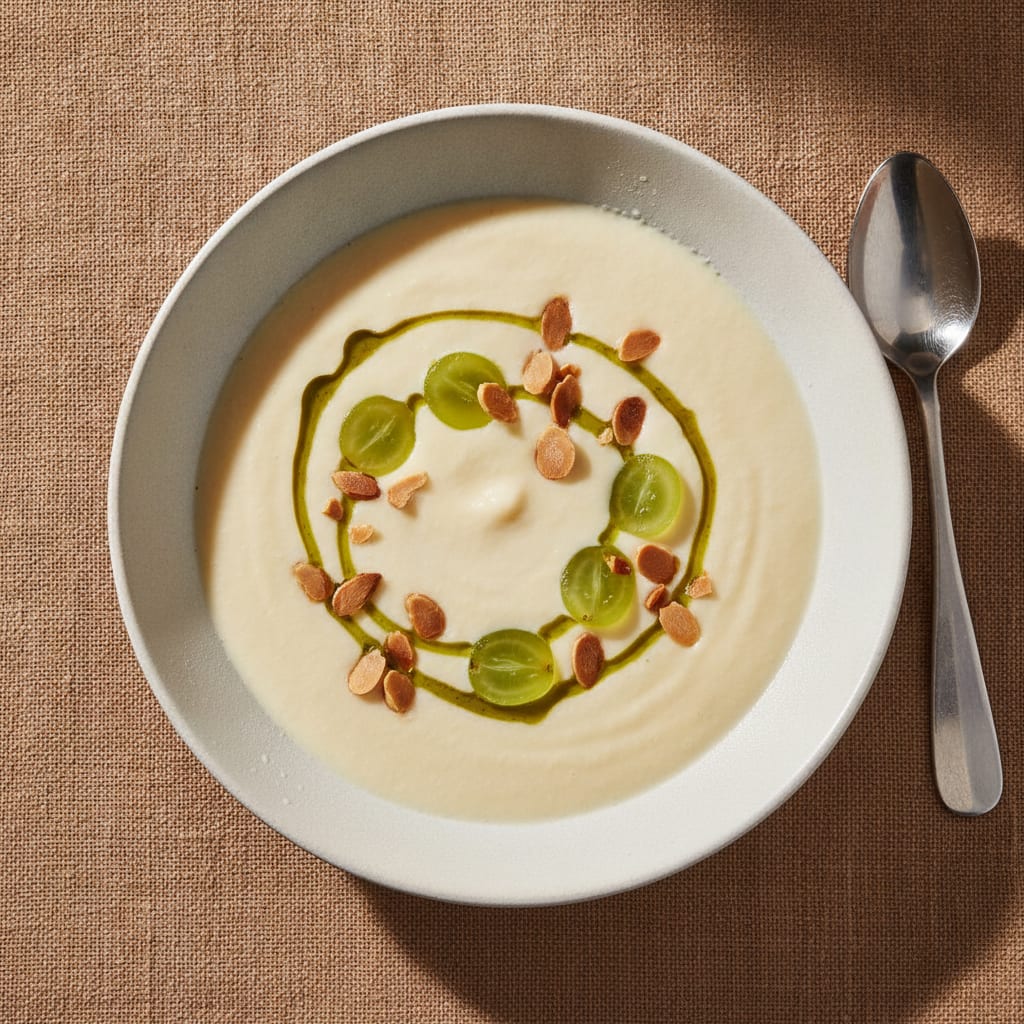
Serve very cold in chilled shallow bowls, with halved moscatel grapes, slivered toasted almonds, and a thread of good olive oil on top. Some in Málaga add melon or apple instead of grapes; the point is one cold, sweet element against the garlic. A chilled fino or a Málaga moscatel wine is the local pour. Keep the bowls in the fridge until the moment you fill them.
The story
Ajoblanco is the soup that was here before the tomato. Long before red gazpacho — before peppers and tomatoes crossed the Atlantic and remade Spanish cooking — Andalusia was eating a pale, cold soup of bread, oil, vinegar, garlic and water, a thing with Roman bones. When Moorish cultivation spread almond trees across the south, cooks ground blanched almonds into that humble mix and made it rich, and ajoblanco as Málaga knows it was born. It is, in the most literal sense, white gazpacho: the original, the one that came first. The village of Almáchar in the Axarquía hills still throws a festival for it on the first Saturday of September, ladling it out free in the streets alongside the local wine and raisins.
I learned to balance it in the summer of 2018 in Valencia, off-shift from the rice pans at La Riuà, in the flat of a cook from Málaga who made it almost every hot afternoon. She kept it brutally simple and was merciless about two things: one clove of garlic, never more to start, and blend it longer than you think. She’d run the blender until the motor complained, pour a spoonful onto the back of her hand to check it was silk and not sand, then chill it until the bowls sweated. The grapes went on at the table — “para cortar el ajo,” she’d say, to cut the garlic — cold and sweet against the bite.
This ajoblanco has nothing animal in it and never did; it is almonds, bread, garlic, water, oil and vinegar, the way it has always been. Nothing about the method changes: the soak, the long hard blend to silk, the slow stream of oil to emulsify, the deep chill, the grapes on top. It is not a “dairy-free version” of a cream soup. It is ajoblanco, the way the Málaga cook made it, with what is in my hands.
À la maison
The weeknight reading is the recipe above, and it asks almost nothing of you but patience at two points. Blend the almonds long and hard — a full two minutes, until a spoonful smeared on your hand reads as silk and not sand — because that is the entire difference between a luxurious soup and a gritty one. And stream the olive oil in slowly so the bread starch and almond emulsify it creamy instead of letting it split out greasy. Then chill it hard, taste it cold, and re-season, because the fridge mutes both salt and acid. One clove of garlic to start; you can always add. The grapes go on at the end, cold and sweet, to cut the garlic.
Au bistrot
The bistronomique reading is the same soup, taken to glass-smooth and composed in the bowl as a study in cold, white, and sweet.
Keep the base identical but refine it: after blending, pass the soup through a fine sieve or a chinois so it is flawless and pourable, then chill it over ice so it goes out genuinely cold. For the garnish, lift the grapes from a scatter to a deliberate set — peel and halve a few moscatel grapes, and lightly compress a few more in a little sherry and oil so they turn glossy and intense. Toast slivered almonds to gold for crunch, fry a few tiny cubes of bread into croutons, and, if you want a third note, dot in a little green-oil emulsion or a few drops of sherry-vinegar reduction. Pour the cold soup into a wide shallow bowl tableside over the arranged garnish so the grapes and almonds sit half-submerged, islands in the white. Finish with a single thread of the greenest olive oil and a few micro-leaves or chive tips for colour against the pale.
El emplatado — Overhead, hard cold light, a sweat on the bowl. A wide shallow white bowl of flawless ivory soup, poured tableside over halved moscatel grapes, gold almond slivers and tiny croutons arranged off-centre. One thread of green oil, a few chive tips for contrast. Negative white space. The plate should say cold, white, and sweet against garlic — the oldest gazpacho, read once at a white tablecloth.
What the other recipes get wrong
Most ajoblanco recipes online — I read the top ten in June 2026 — make two mistakes that flatten the soup: they under-blend the almonds, and they leave the skins on or use too much garlic. I ran the test over two days in June 2026: seven batches, same almonds and same bread, changing only the blend time, the almond skins, and the garlic.
- Skins on, short blend, two cloves: grey-beige, gritty on the tongue, and aggressively sharp — the garlic and the tannic skins fighting, the texture like wet sand. Unpleasant cold.
- Blanched almonds, short blend, one clove: the right flavour but still grainy, the soup never reaching the silk that makes ajoblanco feel rich; it read as thin almond water with bits.
- Blanched almonds, two-minute blend, one clove, oil streamed slow: pale ivory, completely smooth, creamy from emulsion rather than dairy, the garlic present but round after a chill. Not close.
The reasons are mechanical and chemical. Almond cell walls are tough; only a long, hard blend shears them down past the threshold where the tongue stops feeling grit — under-blend and no amount of straining fully fixes it. Almond skins carry tannins and a grey pigment, so blanched almonds give both a whiter colour and a cleaner, less bitter taste. The garlic’s harshest compounds, concentrated in the green germ, are tamed by cold, which is why one clove and a hard chill beats two cloves served cool. And the creaminess is emulsion, not fat alone: streamed in slowly, the oil breaks into fine droplets held by the bread’s starch and the ground almond, so it reads as silk rather than slick. Across all seven batches, only blanched-almond, long-blend, slow-oil gave the bowl the Málaga cook would have nodded at.
The line I draw
I will not serve ajoblanco gritty, and I will not serve it warm. The whole pleasure of the soup is the contradiction it pulls off — that something this simple can taste this silky and this cold — and both halves are non-negotiable. Grit means you didn’t blend the almonds past their cell walls, and there is no rescuing a sandy ajoblanco after the fact; you blend it to silk or you have made something else. And a tepid ajoblanco is a sad, garlicky thing, because the cold is what rounds the garlic and makes the richness feel refreshing instead of heavy. The Málaga cook checked it on the back of her hand and chilled it until the bowls sweated. Silk and cold, or don’t pour it.
When this can fail
Three ways, all from my own kitchen between 2022 and 2026:
- The sandy bowl. Rushed the blend to save a minute; the soup went out grainy and no one finished it. Fix: blend a full two minutes or more, starting from a thick almond paste before the water, and check a spoonful on the back of your hand for silk before you stop.
- The slick, split soup. Dumped the olive oil in all at once; it split out and the ajoblanco tasted greasy rather than creamy. Fix: stream the oil in slowly with the motor running, and if it splits, blend in a little extra soaked bread to bring the emulsion back.
- The garlic punch. Used two cloves and served it barely cool because I was in a hurry; the raw garlic was scorching. Fix: start with one clove, remove the green germ, and chill it hard — the cold tames the garlic, so always judge and re-season the soup cold.
There is a humility to ajoblanco that I have come to love: six cheap ingredients, no cooking at all, and yet it can be the best thing on a hot table or the worst, decided entirely by how long you blend and how cold you serve it. The Málaga cook never wrote anything down. She tasted it on the back of her hand, chilled the bowls until they wept, and put the grapes on last. That is the whole recipe, and it is older than the tomato.
FAQ
QWhat is ajoblanco and how is it different from gazpacho?
Ajoblanco is a cold Andalusian soup of blanched almonds, garlic, soaked bread, water, olive oil and vinegar, blended smooth and served chilled. It is often called white gazpacho, and it predates the red one: long before tomatoes and peppers arrived from the Americas, this pale almond-and-bread soup was already being eaten in Andalusia, descended from a Roman-era mix of bread, oil, vinegar, salt and water that Moorish cooks enriched with ground almonds. Where gazpacho is built on raw tomato, ajoblanco is built on almond and garlic — creamy and nutty rather than bright and acidic.
QWhy is ajoblanco called white gazpacho and is it older than gazpacho?
It is called white gazpacho because it is a cold, bread-thickened Andalusian soup like gazpacho but pale instead of red, and it is widely held to be the older of the two. Tomatoes and peppers only reached Spain after the Columbian exchange and were not widely eaten until centuries later, whereas ajoblanco's ingredients — almonds, bread, garlic, oil, vinegar — were all present in Al-Andalus. Almonds were spread through Spain under Moorish cultivation, which is why the soup is often described as a dish of Arab and Roman roots.
QHow do I stop my ajoblanco being too garlicky or bitter?
Three things. Use one clove to start and remove its green inner germ, which carries the harshest, most bitter bite — you can always blend in more. Use blanched almonds with their skins off, because almond skins add a tannic bitterness and a grey colour. And chill the soup well before judging it; cold tames raw garlic considerably, so a soup that feels aggressive warm often settles round and balanced after a few hours in the fridge. Balance with a little more salt and the sweetness of the grapes on top.
QWhat can I use instead of moscatel grapes for ajoblanco?
Moscatel (muscat) grapes are the traditional Málaga garnish because their honeyed sweetness plays against the garlic, but any sweet seedless grape works, halved. Failing grapes, the classic alternatives are small cubes of cold melon or crisp apple — the point is a single cold, sweet, juicy element to cut the garlic and vinegar. A few toasted almond slivers and a thread of good olive oil complete the bowl.
QWhy is my ajoblanco grainy or split?
Graininess comes from under-blending the almonds; they need a long, hard blend — two minutes or more — to break past gritty into silk, and starting with a thick almond paste before adding the water helps. A split, oily soup comes from adding the olive oil too fast: stream it in slowly with the motor running so the bread starch and ground almond can emulsify it into tiny droplets. If it does split, blend in a little more soaked bread to bring it back together.