The Lighter Plate.
A vegetarian batch-cooking week built like beans, rice, and a side — but lighter. One Sunday, seven satisfying dinners, no diet sadness.
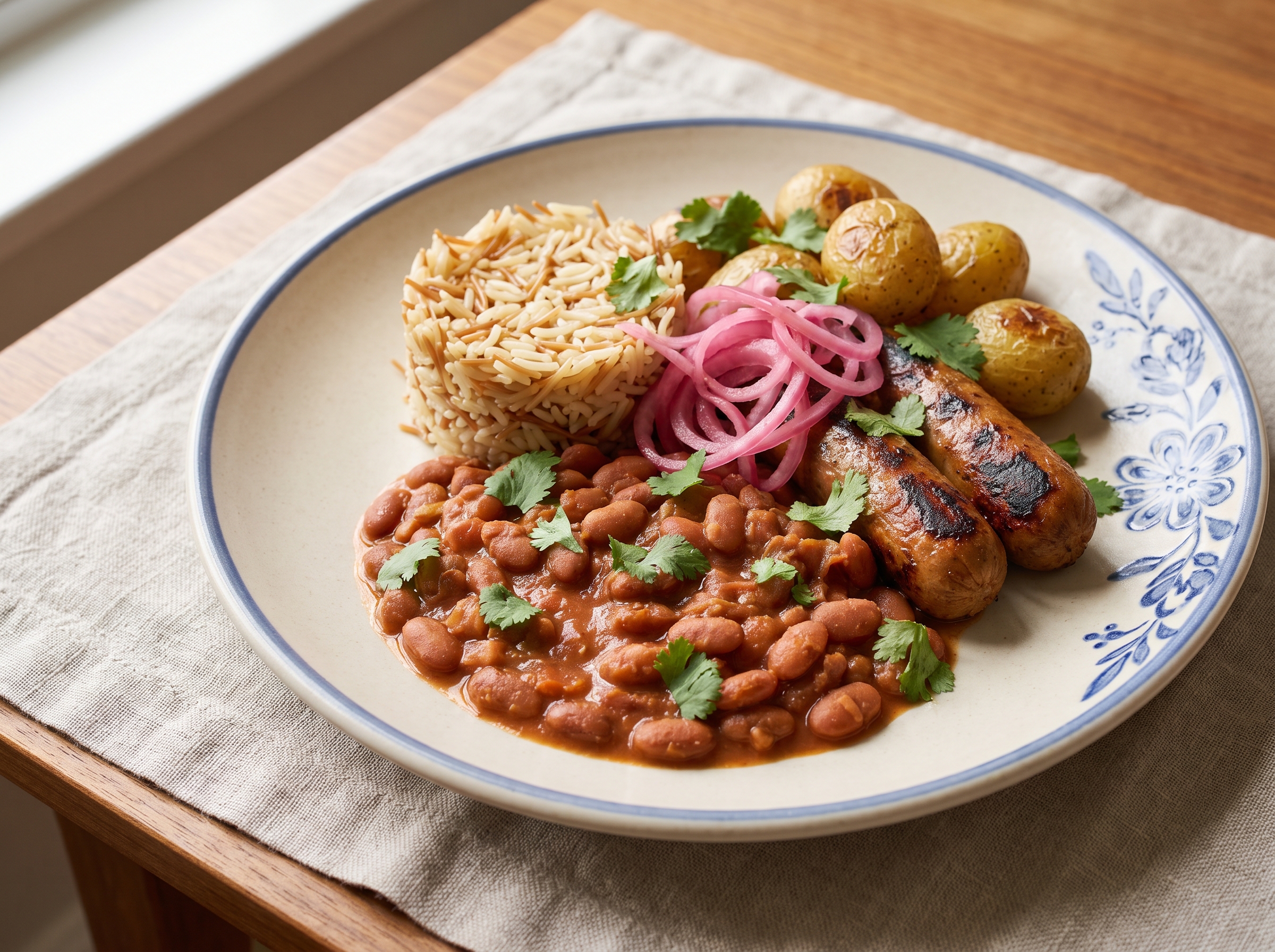
This is the plate in the photo, taught to eat a little lighter.
Beans in their sauce, rice with the toasted threads running through it, something on the side, a green herb on top. It’s the plate half the world goes home to — arroz e feijão, rice and peas, riz haricots — and it’s one of the most satisfying things you can put in front of someone. The only thing wrong with it, if you’re trying to eat a bit lighter, is the proportions: a small island of beans, a mountain of rice, a sausage, fried potatoes, and the whole thing swimming.
So we keep the plate and flip the proportions. The beans become the centre — they’re the protein and the fibre, the two things that actually keep you full. The rice becomes the side, a cupped handful instead of half the plate, with the cauliflower trick hiding underneath if you want it. Half the plate goes to vegetables: a tray that roasts itself, a salad that stands in the fridge. The sausage becomes a vegetable sausage, grilled, one or two. Nothing is banned. Nothing tastes like a diet. You just rebuild the same plate around the parts that fill you up.
One Sunday afternoon — mostly the oven and the pots working while you don’t — buys a week of these.
What the Sunday produces
Five things go into the fridge and freezer:
- Stewed beans base — six portions of saucy, smoky beans. The centre of the plate, and the base of half the other dinners.
- Vermicelli rice — four portions of the toasted pilaf, with the cauliflower swap if you’re lightening hard.
- A big tray of roasted vegetables — whatever’s cheap and in season, roasted until edges catch. The volume of the week.
- A standing salad base — shredded cabbage, fennel, herbs; dressed at the plate, not before. (Borrow it straight from the Sunday Mise.)
- A jar of five-minute pickled onions — the sharp, bright top note that makes lean food taste finished.
Plus a pack of vegetable sausages in the fridge and a vinaigrette you already keep on hand.
The shopping list
Write one list, shop once. The whole week for two runs about $35–45.
- Dried pinto or borlotti beans — 500 g (or 3 cans)
- Long-grain rice — 1 cup, and a small bag of vermicelli or thin spaghetti
- 1 head cauliflower (riced, for the lighter rice and to bulk the salad)
- Roasting vegetables — 1 kg mix: zucchini, peppers, red onion, cherry tomatoes, a head of broccoli
- A bag of baby potatoes — 500 g (the roast-not-fry version of the ones in the photo)
- 1 head red or green cabbage, 1 fennel bulb, herbs (cilantro and parsley)
- 1 pack vegetable sausages (6–8)
- A jar of sofrito from your freezer, or 1 onion + 1 tomato + garlic to fake it
- Lime, vegetable stock, your pantry oil, cumin, smoked paprika, bay
The schedule — 2 hours 15 minutes
0:00 — Beans on first (the longest cook)
Drain your soaked beans, get them into the big pot with water and bay, and bring them to a simmer. They now cook themselves for 40 minutes while you do everything else. (Canned beans? Start them at 1:15 instead — they only need 25 minutes.) Full method: Stewed beans base.
0:10 — Oven on, two trays in
Heat the oven to 220°C / 425°F. Toss the roasting vegetables on one tray and the halved baby potatoes on another, each with a tablespoon of oil, salt, and pepper. Both trays go in. They roast 30 to 40 minutes while you keep moving — give them one shuffle halfway.
0:20 — The pickled onions (fastest thing here)
Thinly slice a red onion into a jar. Cover with equal parts vinegar and warm water, a teaspoon each of salt and sugar. Shake. Done — they’re sharp and pink in an hour and keep three weeks. (Full version: the five-minute pickled onion.)
0:30 — The standing salad
Shred the cabbage, shave the fennel, chop the herbs, toss in any leftover riced cauliflower. Into a container with a dry paper towel on top, undressed. It keeps five days and goes on every plate. Dress only what you’re eating, at the plate.
0:45 — Finish the beans
The beans are nearly tender. Bloom the cumin and paprika, stir in the sofrito, salt them now, and let them go saucy for another 20 minutes. Pull the roasting trays when the edges are caught and brown.
1:05 — The rice
Toast the vermicelli to gold, add the rice and stock, lid on, low, and walk away for the 15-minute cook plus 10-minute rest. (Full method: Vermicelli rice.)
1:30 — Portion and label
Beans into six containers. Rice into four. Roasted vegetables and potatoes into their own. Salad standing, pickles in the fridge, sausages in their pack. Label everything with today’s date. The active work is done — the last forty-five minutes was mostly the oven and the pots.
The week these plates make
Each dinner is fifteen minutes or less, because the slow parts are already in the fridge.
- Monday — the plate. Beans, a scoop of vermicelli rice, two grilled vegetable sausages, roasted potatoes, cilantro and a few pickled onions on top. The photo, lightened.
- Tuesday — the bowl. Beans and rice in a bowl, the roasted vegetables piled on, salad dressed beside it, a spoon of beans’ sauce over everything.
- Wednesday — the stuffed potato. Reheated beans spiked with chili and lime over a split baked potato or sweet potato, salad on the side. No rice tonight.
- Thursday — the grain bowl. The last of the rice, roasted vegetables, a handful of the salad, beans, vinaigrette. Skip the sausage; let the beans carry it.
- Friday — the soup. Thin a portion of beans with stock into a quick soup, blend half if you like it smooth, toast some bread. Big salad alongside.
- Saturday — the fridge plate. Whatever’s left, plated generously, the pickled onions doing the bright work. Cook nothing.
- Sunday — light, then start again. Salad and a couple of sausages, or just toast and the last of the beans, and you set the next batch going.
Seven dinners. Average hands-on time at night: about twelve minutes. The plate stays generous and saucy and worth sitting down to — it’s just been quietly rebalanced toward the things that fill you up.
The line I draw
I will not make this taste like a punishment. The whole reason people abandon eating lighter is that the food turns sad — dry chicken and steamed broccoli and a sense of going without. This plate doesn’t go without. It’s saucy, it’s seasoned hard, it’s got the toasted rice and the pickle and the herb on top. The lightness is structural — beans at the centre, vegetables doing the volume, the rice as a side — not a matter of taking things away. Eat the full plate. It just adds up to less than it tastes like.
Cook fast on a Tuesday because you did this on a Sunday.
Questions, honestly answered
FAQ
QWhat makes this lighter than a normal beans-and-rice plate?
Three small shifts, none of which make it taste like diet food. First, the beans become the centre of the plate and the rice the side — protein and fibre fill you up, so a smaller scoop of rice satisfies. Second, half the plate is vegetables: a roasting tray and a standing salad do the volume. Third, the lean cooking adds up — the beans carry almost no fat, the rice is one tablespoon of oil across four portions, and the vegetable sausage stands in for the pork in the photo. You eat a full, saucy, satisfying plate; it just happens to be built around the foods that keep you full for the fewest calories.
QIs this safe for someone trying to lose weight?
This is balanced home cooking, not a diet protocol or medical advice — it's vegetable-forward, high in protein and fibre, and portion-aware, which is the kind of cooking that makes eating a bit less feel easy rather than punishing. It is not about skipping meals or eating tiny portions; the plates are generous on beans and vegetables on purpose, because feeling full is what makes any change last. Anyone with specific health needs or a target should run their plan past a doctor or dietitian — this gives you the cooking, not the prescription.
QDo I have to do the whole Sunday session at once?
The two and a quarter hours are built for parallelism — the beans simmer while the vegetables roast while the rice steams, so most of it is walking-away time. You can split it (beans one evening, the rest another) but you'll lose the overlap and the hands-on time roughly doubles. If you only do one thing, do the beans: they're the base every other dinner leans on.
QWon't I get bored eating the same thing all week?
You won't, because you're not eating the same thing — you're eating the same three or four building blocks wearing a different outfit each night. Beans and rice on Monday; beans on a baked sweet potato on Wednesday; beans thinned into soup with bread on Friday; a grain bowl with the roasted vegetables and salad on Thursday. The prep is repetitive on Sunday so the dinners don't have to be.