The Vinaigrette.
The jar that dresses every salad, marinates every vegetable, finishes every grain bowl. Five ingredients, two minutes, keeps a month. The most leveraged sauce.
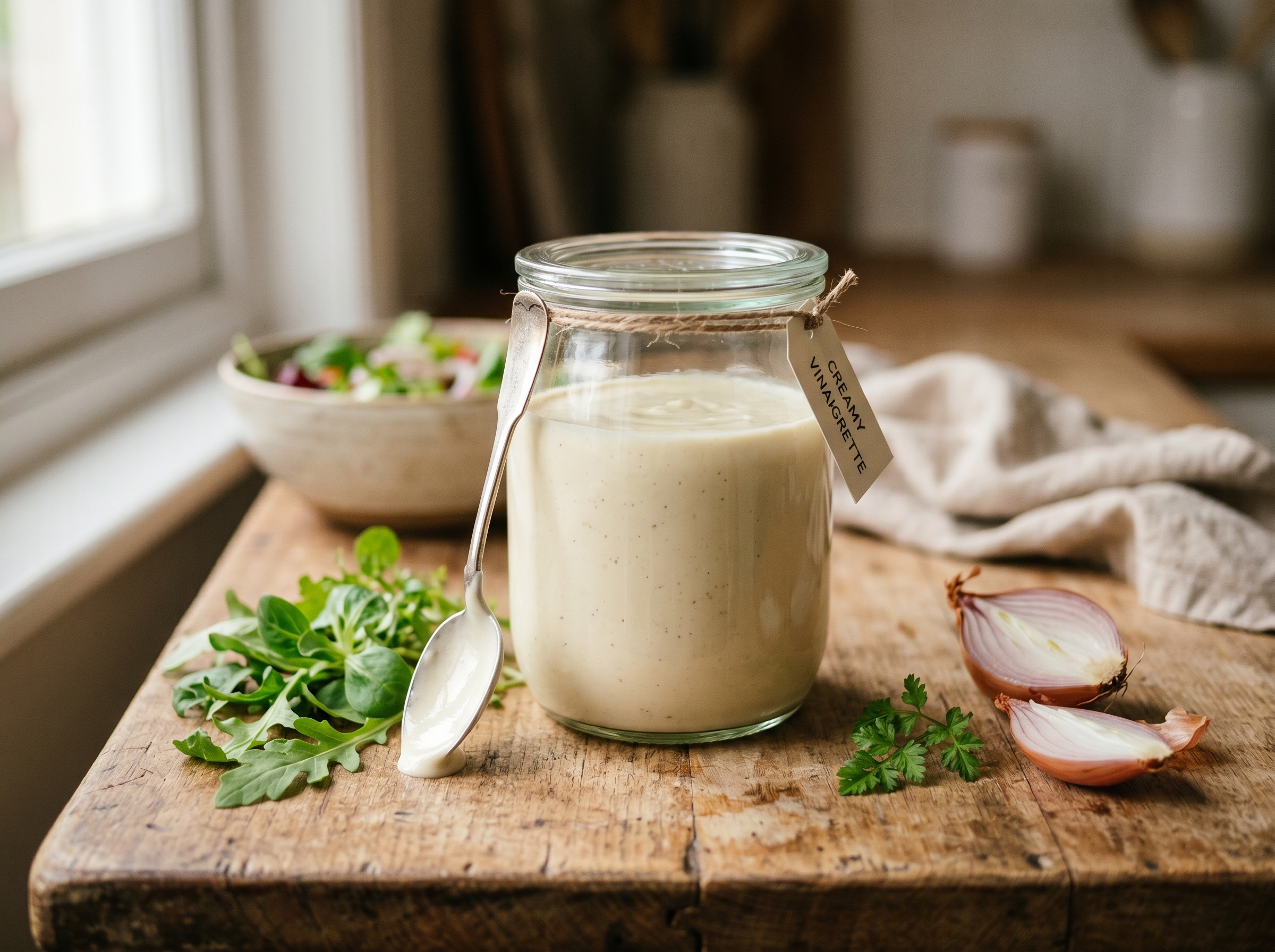
Getting ready…
This is the most leveraged sauce on the site. Five ingredients. Two minutes of work. One jar. A month of salads, dressed vegetables, roasted-grain bowls, and pan glazes. The math: two minutes of investment, thirty dinners’ worth of dressing returned.
I learned the proportions in 2011 at the Lyon bistro where I trained as a commis — the head chef, a man named Pierre who had been at Bocuse in the eighties before going independent, kept a single 1-liter glass bottle of vinaigrette in the walk-in at all times. It was made every Sunday by the prep cook, labeled with the date, and used through Saturday on every salad and every dressed vegetable that left the kitchen. The bottle was the spine of the cold side of the menu.
The non-negotiable moves are simple: soak the shallot in the vinegar before you add anything else (5 minutes — the pickle); dissolve the mustard fully into the vinegar BEFORE the oil hits (30 seconds); stream the oil in slowly while whisking (30 more seconds). Skip any one of these and you get a vinaigrette that separates in the fridge by Tuesday.
The line I draw
I will not use balsamic glaze. The thick, sweet, syrupy stuff in the squeeze bottle marketed as “balsamic” is the supermarket’s worst contribution to home cooking — it’s typically 70% sugar with caramel coloring, sold to people who think “balsamic” is a flavor when it’s actually a technique (the Modena aging process). If you want sweetness in a vinaigrette, use a teaspoon of maple syrup. If you want real balsamic, buy a 12-year aged bottle from Modena and use 1/4 teaspoon as a finishing drop on a dish. Don’t ever pour the squeeze-bottle stuff on a salad.
When this can fail
- The vinaigrette separated within an hour. You didn’t dissolve the mustard fully before adding the oil, OR you added the oil all at once. Fix: re-emulsify by whisking vigorously for 60 seconds — usually works. If it keeps separating, transfer to a blender and blend for 30 seconds on high. The blender is the brute-force solution.
- The vinaigrette tastes too sharp. Your vinegar is more acidic than expected (some brands run hot), OR you over-measured. Fix: stir in 1 teaspoon of maple syrup or 1 teaspoon of olive oil. Taste. Repeat.
- The shallot is overpowering. You used too much, OR you skipped the 5-minute vinegar-soak step. Fix: there’s no easy fix once mixed — make a second batch without shallot, combine 50/50. Lesson: 1 small shallot, not 1 medium. And ALWAYS soak it first.
Cook fast on a Tuesday because you did this on a Sunday.
You'll need
Ingredients
For 1 servings · 8 items
The base — five ingredients
Optional but recommended
The method
Method
5 steps · check as you go
Questions, honestly answered
FAQ
QWhat can I use this vinaigrette for besides salads?
Five jobs, in increasing order of leverage: (1) Dressing leafy salads — 2 tablespoons over 4 cups of greens. (2) Marinating vegetables before roasting — toss 4 cups of cut vegetables in 1/4 cup of vinaigrette, roast at 425°F. (3) Finishing roasted vegetables off the heat — drizzle 2 tablespoons over a finished tray of vegetables. (4) Dressing cooked grains — toss 2 tablespoons through 3 cups of cooked farro/quinoa/freekeh while still warm. (5) As the sauce base for a quick pan glaze — reduce 1/2 cup of vinaigrette in a hot pan for 90 seconds, the dressing thickens into a glaze you spoon over anything.
QWhy French vinaigrette specifically?
Because the French standard recipe — oil + vinegar + mustard + shallot + salt — is the most versatile dressing in the Western kitchen. It's the base from which a hundred variations spread: add tarragon for poultry-replacement dishes, add maple syrup for sweet salads, add miso for a brighter umami version, add lemon juice for delicate fish-replacement salads. The classical French ratio of 3:1 oil-to-vinegar is the sweet spot — balanced enough to dress without dominating, acid enough to brighten without harshness. Italian dressing tends to be heavier on the herbs; American 'vinaigrette' tends to be heavier on sugar. The French version is the foundation.
QWhat's the right ratio of oil to vinegar?
Classical French ratio: 3 parts oil to 1 part vinegar by volume. This recipe is 1 cup oil + 1/3 cup vinegar — exactly 3:1. The variation is in the vinegar's acidity: red wine vinegar is around 6% acetic acid; sherry vinegar is 7%, balsamic is 4%, rice vinegar is 4.5%. If you switch vinegars, adjust slightly. Use 1/4 cup of sherry vinegar instead of 1/3 cup of red wine. Use 1/2 cup of balsamic instead. Taste and adjust.
QCan I make this without mustard?
You can, but the vinaigrette won't emulsify properly. Without mustard you get separation within an hour — the oil floats on top of the vinegar. The mustard is what holds them together. If you genuinely don't want mustard flavor, use 1/2 teaspoon of soy lecithin granules as the emulsifier — they work the same way without adding any taste. Or use 2 tablespoons of pureed roasted garlic, which also emulsifies (and adds a different but equally complementary flavor).