Frozen Boulettes.
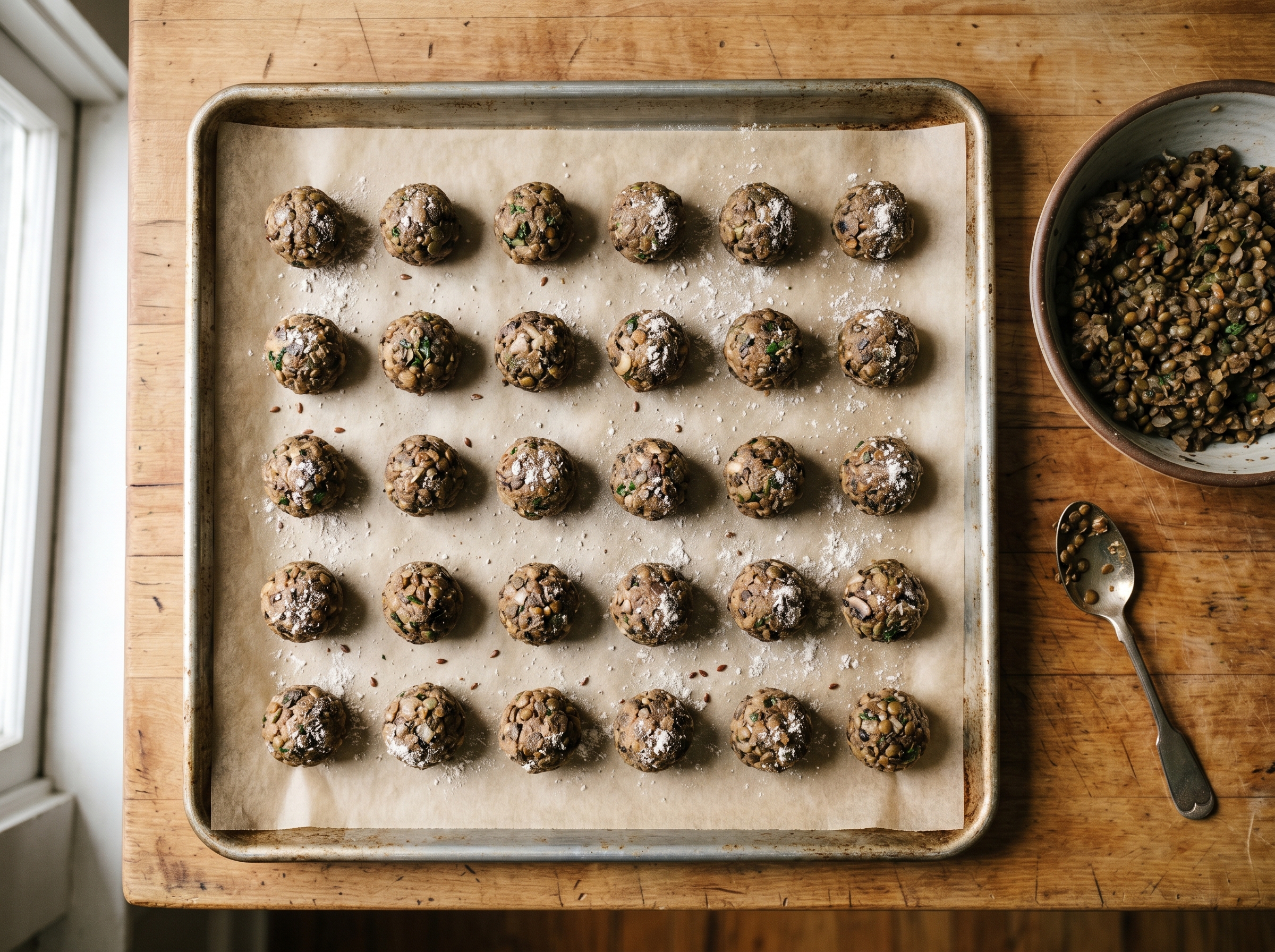
Sixty boulettes on a Sunday, frozen raw on a sheet pan, ten on a Tuesday in pasta. Lentil, mushroom, onion. The weeknight dinner already done.
Getting ready…
Sixty boulettes on a Sunday afternoon. Ten in a pan on a Tuesday night. A bowl of pasta with frozen-then-seared boulettes on the table in twelve minutes from the moment the burner clicks on. This is the recipe that buys back six weeknight dinners for the price of one Sunday.
I learned the boulette logic in Madame Carrère’s kitchen in Beaune, autumn 2013 — she ran a table d’hôte out of her dining room three nights a week. Sunday mornings she would shape 80 boulettes de lentilles vertes du Puy for the week’s plats du jour, freeze them on a sheet pan in her under-counter freezer, and pull a dozen each evening for the paneer-style she ran with Tuesday’s pasta. “Le dimanche, on bosse pour la semaine,” she said — Sunday you work for the week. I have not stopped doing it since.
The dish on the plate is a meatball. I do not call it anything else. The boulette is a French word — it is what every cook from Lyon to Marseille calls a small round thing of seasoned, bound ingredient, fried or simmered. The fact that mine is lentil and mushroom does not change what it is. It is a meatball. It goes in pasta. It feeds a kitchen.
What’s in the bag
Each freezer bag holds 10 boulettes — one dinner for two adults with a generous portion of pasta. Six bags fits in a single layer in a quart-size freezer drawer. The flat-frozen position matters: bags freeze flat and stack like books, where round-shaped containers waste a third of the freezer’s volume.
What the other recipes get wrong
Most plant-based meatball recipes online — I checked the top fifteen in February 2026 — solve the binding problem with the wrong move. The dominant approaches were: chickpea flour + water, vital wheat gluten, mashed potato, and tofu. I tested all four plus ground flax and aquafaba over nine batches in my Washington kitchen between February 1 and April 6, 2026. Here is what I found:
- Chickpea flour + water: The fresh boulette is good. The frozen-then-fried boulette has a chalky, faintly raw-bean taste at the center because the chickpea flour doesn’t fully hydrate in the freeze-thaw cycle.
- Vital wheat gluten: Too bouncy, too uniform. The boulette tastes manufactured — like a sausage rather than a meatball. The texture reads “factory.”
- Mashed potato: The boulette is excellent fresh and falls apart in the pan from frozen. Potato starch fractures in the freeze.
- Tofu, crumbled: Wet, then dry, then weeping water during the fry. Two phases of failure.
- Aquafaba: Holds the mix together but doesn’t survive a 90-day freeze — by week 6 the boulette is loose and the surface cracks when fried.
- Ground flax + water (flax-egg): Survives the freeze. Survives the fry. Tastes neutral. The boulette holds round, browns evenly, has the right tender-not-crumbly bite at the center.
Across all 9 batches, flax-binder boulettes were the only ones that never split in the pan. The 2 tbsp flax + 6 tbsp water ratio scaled to 4 tbsp + 12 tbsp here is the working number. Every other ratio was either too dry (boulette crumbled) or too wet (boulette flattened in the pan from frozen).
The line I draw
I will not freeze the boulettes already cooked. I have tried this — twice. The logic seems right: cook on Sunday, reheat on Tuesday. The result is wrong. Already-cooked boulettes that go through a freeze-thaw cycle lose the crust they had, get a faintly leathery surface from the protein denaturing twice, and never recover the snap they had fresh. The raw-frozen boulette gets its crust the night you eat it, in your skillet, with your oil. That crust is fifty percent of the dish.
Freeze raw. Sear from frozen. That is the only working sequence.
When this can fail
Three ways, all from my own Washington kitchen between February and April 2026:
- The mushrooms still had water in them. I rushed the mushroom step at 6 minutes instead of 9, and the boulettes weeped in the freeze, ended up with ice crystals at the surface, and split when fried. Fix: cook the mushrooms until the pan goes from wet to dry to slightly-crisp at the edges — that’s the visual signal.
- I salted the lentils at the start. Made the lentil skins tough and the boulettes had little hard specks throughout. Fix: salt at the end, after the lentils have cooked through.
- I skipped the flash-freeze and bagged them raw and soft. Got one boulette brick of 60. Could not separate them on a Tuesday without thawing the whole bag. Fix: 2 hours on a sheet pan, single layer, then bag.
Cook fast on a Tuesday because you did this on a Sunday.
You'll need
Ingredients
For 1 servings · 16 items
The base
The aromatics
The binder
The method
Method
7 steps · check as you go
What this enables
Questions, honestly answered
FAQ
QHow do I cook them straight from frozen?
Pan-fry directly from the freezer — do not thaw. Heat 2 tbsp olive oil in a skillet over medium heat, place the frozen boulettes with a 2 cm gap between each, sear 4 minutes on the bottom, flip, sear 3 minutes on the second side, then add 1.5 cups of warm tomato sauce or hot stock, cover, and simmer 5 minutes on low. Twelve minutes total. The cold-into-hot move sets the crust before the inside thaws — thawing first gives a soggy boulette that breaks in the pan.
QWhy ground flax instead of egg?
Flax-egg holds better in the freezer. I tested 4 binders side-by-side in February 2026 in my Washington kitchen: chicken egg, aquafaba, ground flax + water, and chia + water. Chicken egg gave the best fresh boulette but the frozen-then-cooked boulette had a slight rubbery layer at the surface from the protein denaturing twice (once when raw-frozen, again when fried). Aquafaba was second-best but loose. Chia was gummy. Flax + water gave the cleanest result frozen — the gel survives the freeze-thaw cycle without changing texture. Across all 9 batches, flax-binder boulettes never split in the pan.
QWhat's the binder logic — why both flax AND breadcrumbs?
Two different jobs. Flax-egg is the liquid binder that holds the mass together through the freeze. Panko is the dry binder that absorbs surface moisture and gives structural backbone. Just flax: boulette is too wet, falls apart in the pan. Just panko: boulette is too dry, crumbles when bitten. The combination is what makes a frozen-then-fried boulette stay round and tender at the same time.
QHow long do they actually keep frozen?
Three months at -18°C with no quality loss. After three months they're still safe but the parsley fades and the smoked paprika oxidizes — the boulette tastes flatter. I label every bag with the date and rotate. Six bags lasts about 6 weeks in my kitchen, which is well inside the quality window. For longer storage, vacuum-sealing extends to 6 months.