On the Frontier.
Dear reader,
I want to write to you about a Spanish chef I have never met. His name is Ángel León. He runs a three-Michelin-star restaurant called Aponiente, built on a converted salt flat outside the port of Cádiz, where the Atlantic and the Bay of Cádiz meet. He is the most exciting cook on the planet right now. And the reason for that — the reason I have been thinking about him for weeks — has very little to do with the three stars.
It has to do with the fact that in 2017, in the shallows of his own bay, he found a grain humans had never eaten.
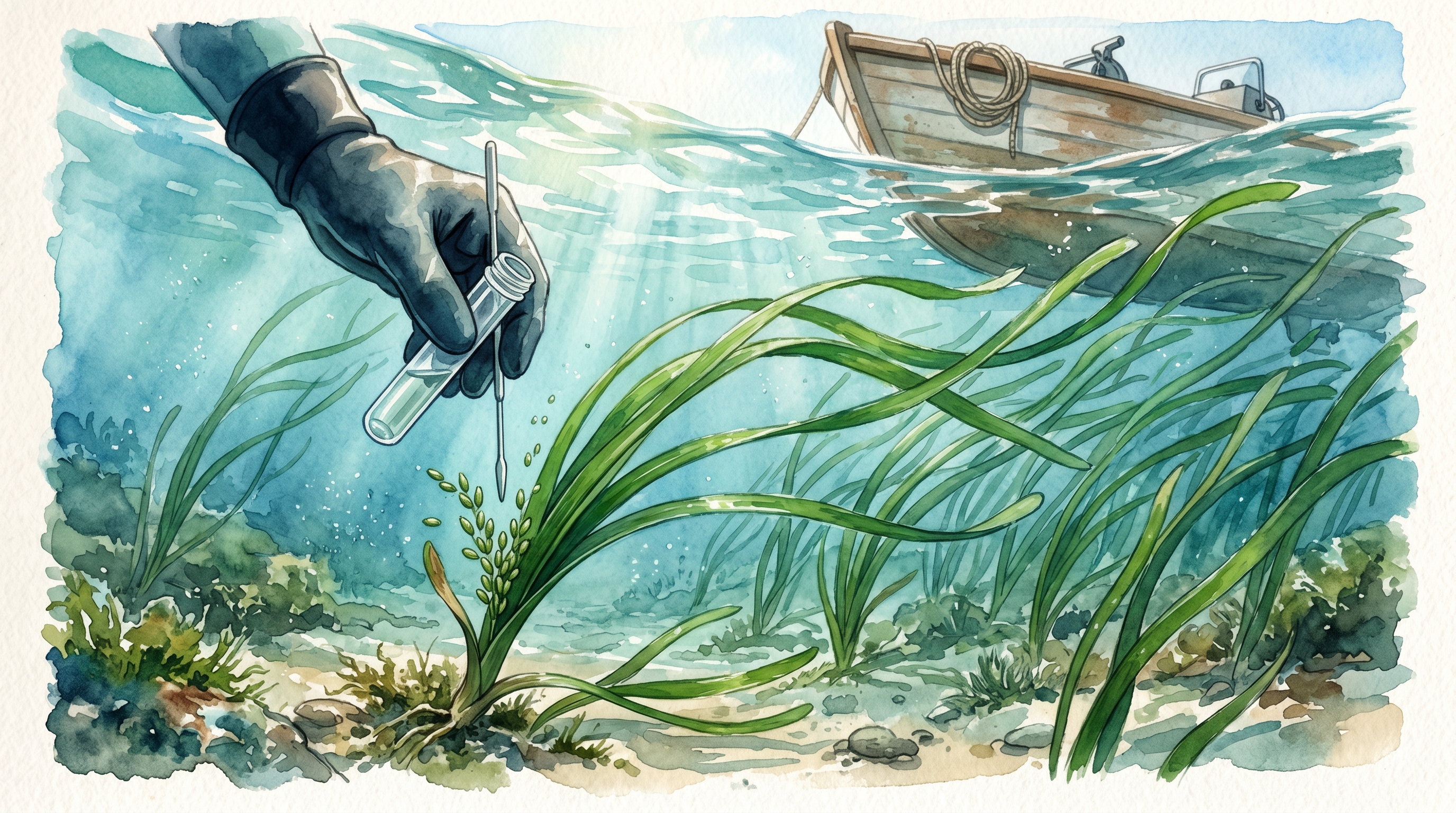
The grain came from Zostera marina, a marine seagrass that covers the floors of coastal bays across the temperate world. The seagrass itself has been there for thousands of years. Every fisherman in Cádiz had walked past it. Every cook in Andalusia had eaten near it. Nobody had ever picked up the small green seeds that cluster at the base of its blades and asked whether they were food.
León sent samples to the lab at the University of Cádiz. The results came back, and they were almost cinematic in their goodness: fifty percent more protein than rice. Seventeen times more fiber. Gluten-free. Rich in the kind of fatty acids that cooks chase across continents. Grown in salt water — no fresh water, no fertilizer, no arable land. The seagrass itself is part of a system of underwater meadows that covers less than one percent of the world's oceans but accounts for nearly twenty percent of all carbon sequestered in the sea.
Humans have farmed wheat for ten thousand years. Rice for nine thousand. The first chef-driven harvest of Zostera marina grain happened in 2017.
Read that sequence of numbers again. Wheat: ten thousand years. Rice: nine thousand. Sea-rice: nine years.
The thing that I want you to feel, in the time it takes to read this letter, is what those numbers mean. They mean that there are foods our species has not yet noticed. They mean that the universe of edible things has not been fully indexed. They mean that the cuisine we know — the one our grandmothers cooked, the one we trained in, the one our chefs recreated in three thousand-dollar tasting menus — is not the end of cooking. It is the start.
The phytoplankton vial
Eight years before the sea-rice, in 2009, León climbed onto the stage at Madrid Fusión — the most-watched culinary conference in the Spanish-speaking world — and held up a small vial of emerald-green liquid. Marine phytoplankton. The microscopic algae that form the base of every ocean food chain. He was the first chef on earth authorized to use it as a food ingredient.
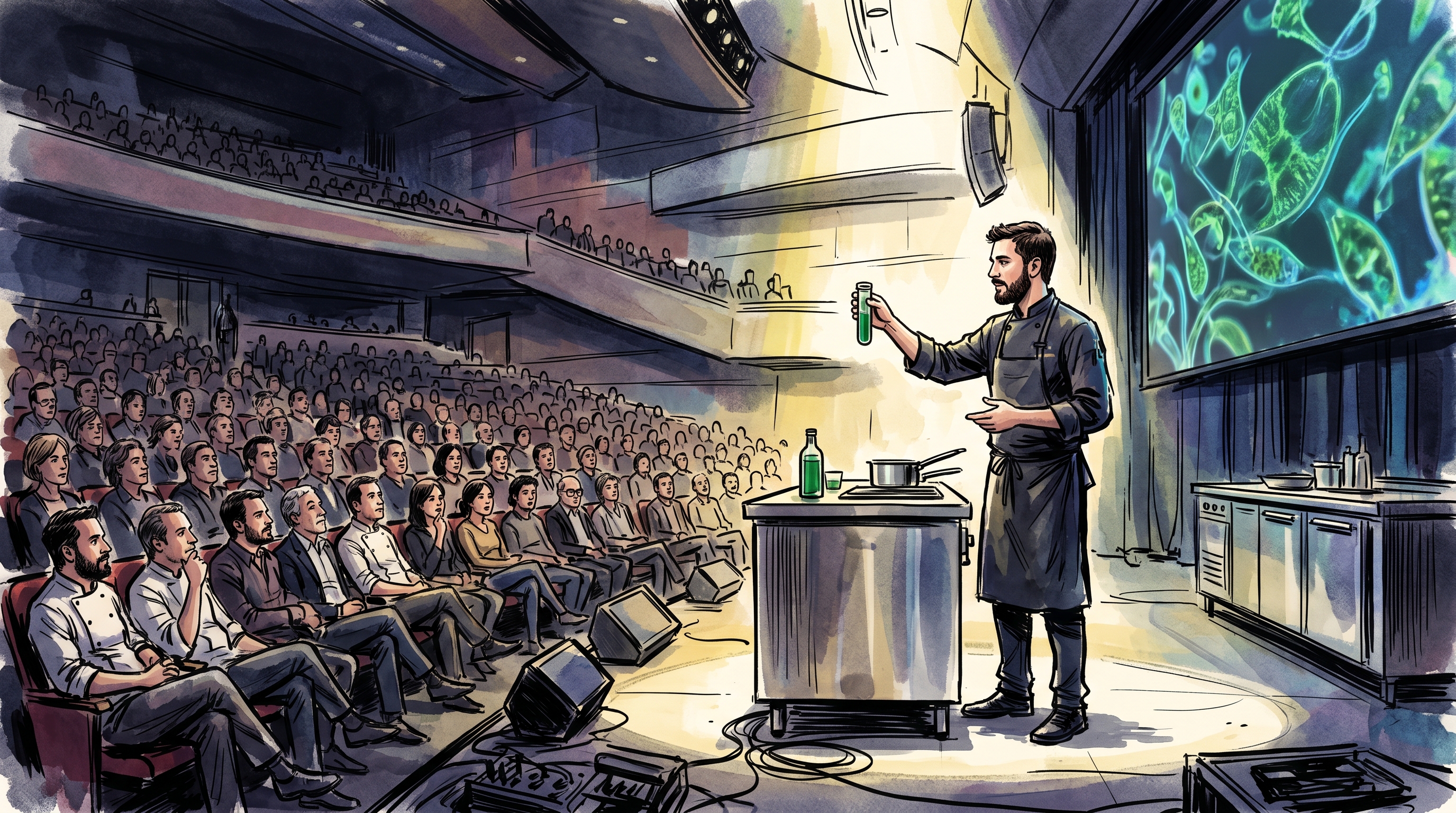
The audience that day was split. Scientists in the room knew what he had done: phytoplankton is one of the most nutritionally dense organisms alive, and putting it into food was a regulatory and technical achievement that had taken three years of work. Other chefs in the room were puzzled. You cooked algae?
The question, León later said, was the wrong question. He had not cooked algae. He had cooked the first ingredient ever pulled from the bottom of the ocean food chain. Today, phytoplankton appears in restaurant kitchens from Tokyo to Copenhagen. The vial was the start.
The marine charcuterie
Two years after the phytoplankton, in 2011, León returned to Madrid Fusión with a wooden board. On the board: a coil of mackerel sobrasada, a slice of sea-bass mortadella, a small pile of hake-collagen noodles, a strip of sea-bass-belly bacon, a few discs of Atlantic porchetta, and a curl of crisped moray-eel-skin crackling.
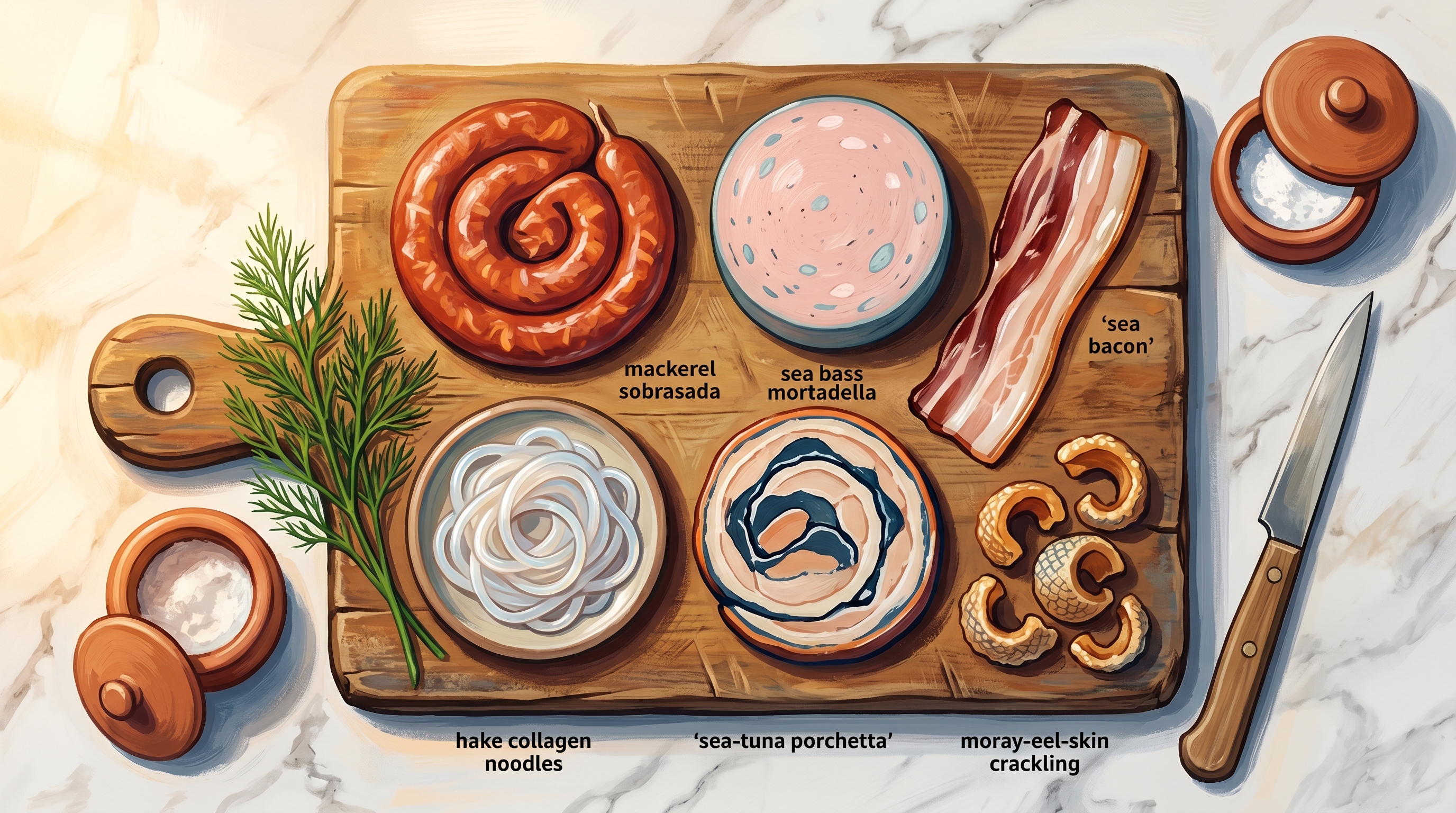
The premise was simple and revolutionary: every technique European peasants invented to preserve and transform pork over the last eight hundred years could be applied to fish parts that fishermen routinely discard. The bellies, the skins, the offal, the collagen. The result is a charcuterie tradition that no one had written down before.
It is also, beneath the surface, the proof of a much larger thesis — the one I keep coming back to in my own kitchen. The technique stack of European cuisine does not need land animals. It needs structure. And the sea has structure.
What this means for the rest of us
Here is the part of the letter where I tell you why I have been thinking about all of this so much.
For ten thousand years, humans built cuisine on the assumption that animal protein sat at the center of every meal. The technique stack — reductions, braises, charcuterie, croûtes, demi-glace, beurre blanc — was built to handle that protein. Cooks trained on it. Cookbooks codified it. Restaurants enshrined it. By the time I went to culinary school in Lyon in 2010, the assumption was so deep that nobody named it. It was just cooking.
And then, slowly at first, and then all at once, a handful of chefs began to ask what cuisine looks like outside the meat-axis. Not as a sacrifice. Not as a substitute. As an open question. What happens if we apply the full toolkit of bistro technique to ingredients we have not seriously cooked with before? What happens if we look, for the first time, at the bottom of the ocean food chain? At the base of a seagrass blade? At a fungus we'd previously thought of as a garnish?
What happens is that we discover, fast and at scale, that the universe of edible things is much bigger than the one our cookbooks indexed. León is the most visible figure in this story. He is far from the only one. There are koji-fermented protein labs in Copenhagen. Mycelium-meat startups in California. Algae-oil chemists in Lisbon. Sea-vegetable farmers off the coast of Maine. Each of them is doing what León is doing — looking outside the meat-axis and finding more than they expected.
Stop eating meat is not the loss of anything. It is the entry ticket to the most exciting frontier in human cooking.
I want to say this clearly, because I think it gets said badly almost everywhere else: stop eating meat is not boring. It is not a subtraction. It is not the small, sad table at the wedding. It is — for anyone who cooks seriously — the most exciting frontier in human cooking right now, and probably for the rest of this century. The only people in the room are the ones who chose to look outside the meat-axis. León chose. Many others are choosing. There is a place at the table for anyone else who wants to.
The recipe at the end
Every Letter ends with a small recipe. This one is a gift, not the focus.
Around the time I started writing this letter, I was working out a new puttanesca — the Naples late-night pasta that classically uses two or three anchovies dissolved in hot oil to give the sauce its marine umami. I wanted the same dish, with the sea kept in, but without the anchovies. I tested eight batches across three weekends in March 2026. The combination that hit identical to the original on a blind taste was: one full sheet of torn nori + one heaping teaspoon of white shiro miso, dissolved into the hot oil before the tomato hits.
The chemistry is exact: nori and miso between them deliver both of the umami amino acids — glutamic and inosinic — that anchovy delivers. The marine top note is there. The salt is there. The depth is there. And the dish stays exactly the dish that Naples invented at midnight two centuries ago — same architecture, different source for the sea.
The full recipe is at maisonteulade.co/recipes/puttanesca.
The new world is not unkind to old dishes. The old dishes can be cooked in it. What changes is where the marine umami comes from. What stays is everything else.
À bientôt,
— Alexandre
Washington, D.C.