Ain't Got No Beef Smash Burger.
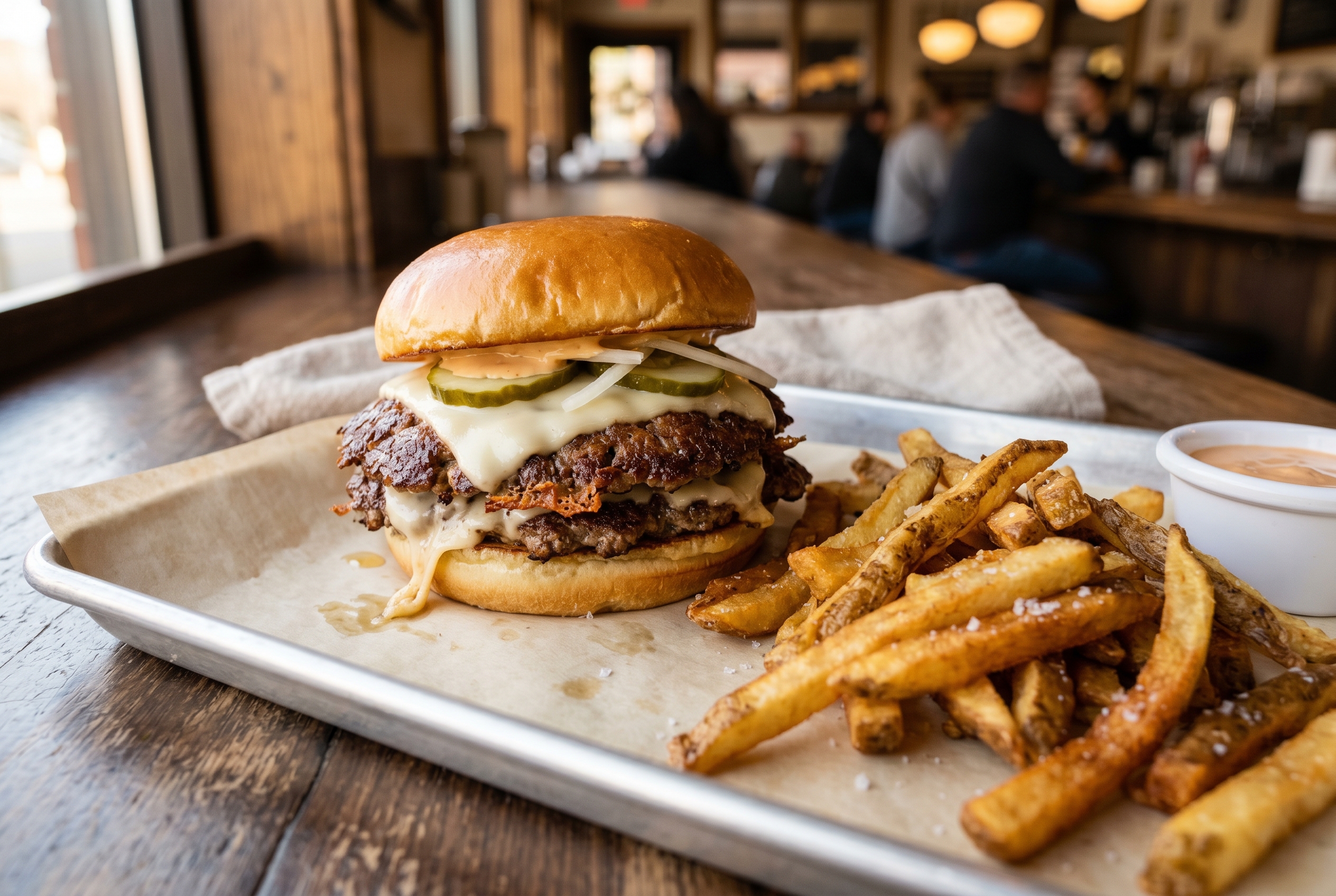
A smash burger built on a TVP patty with a real lacquered crust, served with hand-cut double-fried fries and a sharp special sauce.
- Prep
- 35 min
- Cook
- 25 min
- Total
- 1h
- Servings
- 4
- Difficulty
- Medium
Getting ready…
Ingredients
For 4 servings · 34 items
For the flax egg
For the TVP patties (makes 4 × 80 g balls)
For the hand-cut fries
For the special sauce
To build the burger
Method
12 steps · check as you go
- →
Serve
Eat hot. The crust waits for no one. The fries should arrive on the plate within 30 seconds of the second fry — salted, audibly crisp, the steam still escaping when you bite. If you're plating more than four, work in batches and keep the finished burgers under a loose tent of foil for no more than 3 minutes — past that, the bun goes soft and the dish stops being itself.
The story
The first smash burger I ate that mattered was at a counter in Adams Morgan on a Tuesday night in August 2025. I had been in DC for less than a month. The bartender — early thirties, sleeves rolled past the elbows, the kind of patience that comes from working a Tuesday at eleven — slid the burger across the counter without a word, with a small paper-lined tray of fries beside it. Two thin patties. Edges lacquered like a violin. American cheese drape. Pickles. Raw onion. Special sauce. A bun that had been pressed once into a hot pan and never again. I took one bite and understood, finally, what the technique was for.
The smash burger is not a burger. It is a crust with patty attached. That distinction is everything. A thick patty is a patty you cook through. A smashed patty is a patty you let the pan brand. The geometry of the smash — thin, wide, in violent contact with a screaming-hot surface — creates Maillard browning across the entire face of the patty in under three minutes. The crust IS the dish. The patty underneath is the courier.
I went home that night and started cooking. Not the same week. Not the same month. But that bite changed what I thought a burger could be.
The dish on this page is what came of it.
I will tell you now, before we go further: this is a smash burger. Not a “vegan smash burger.” Not a “burger alternative.” A smash burger. The patty is built from TVP — textured vegetable protein, a dry granule made from defatted soy flour, which has been in the back-of-house of restaurant kitchens for sixty years and was, until recently, mostly used to extend ground beef. Here it does not extend anything. It is the patty. Bound with flax and vegan mayo. Hydrated in a dark broth that does the seasoning before the pan does. Salted. Smashed. Crusted.
The fries are double-fried russets, cut by hand, soaked in cold water, fried first at 325°F to cook them through, then at 375°F to crust them. This is how every great French frites and every great American steakhouse fry has been made for a hundred years. It is not a shortcut. There is no shortcut. The double fry is the dish.
The special sauce is the special sauce. Mayo, ketchup, dijon, pickle, smoke. The exact ratio is on the page. You do not need to deviate.
What the other recipes get wrong
I have made bad smash burgers. Twelve of them, across one weekend in October 2025, before I figured out what worked. Every one of them failed in a way that is now on this page as a step. Here is the catalogue.
The pre-pressed patty. Form the mix into a flat disc, drop it in the pan, get a flat browned thing that is not a smash burger. The smash has to happen IN the pan. The whole technique relies on the explosive contact between a loose ball and hot steel. Pre-flatten and you have made a flat burger that happens to be thin. Different dish. Worse dish.
The hesitation smash. Smash, then lift the spatula to check, then re-smash. By the time you press the second time, the patty surface has already started cooking — you cannot bond it any deeper to the pan. The crust splits in zones, thick where you held longest, thin where you doubted. Smash once. Decisively. Walk away.
The cool pan. Tested with a pan that was hot enough for an omelet but not hot enough for a smash. The patty browned slowly and unevenly, sweated water into the pan, and arrived on the bun as a damp grey disc with a faint tan stripe. The pan must be smoking. A drop of water must evaporate in two seconds. If you cannot get your pan that hot, you cannot make this dish — try the cast iron, try the broiler, try a steel griddle. Find the heat.
Oil instead of mayo in the patty mix. This was my first attempt — I assumed the fat was the only variable. The crust came out thin and crackery rather than lacquered. The mayo’s water-in-oil emulsion is doing structural work that oil alone cannot. Use the mayo.
Single-fry fries. Tested at every temperature from 325°F to 400°F. Every single one was either pale-and-cooked or brown-and-raw. The double fry is not optional. The first fry cooks the potato. The second fry crusts the cooked potato. Both fries do exactly one job. Either is useless alone.
The line I draw
A smash burger is not a substitute for anything. It is a smash burger. If you serve this with quinoa, or wrap it in a lettuce cup, or call it a “patty melt” because the word “burger” makes you nervous, you have made a different dish that I will not stand behind. The brioche bun is the bun. The fries are the fries. The sauce is the sauce. The pickles are the pickles.
I will not bake this patty. I have tried. Twice. The crust does not happen. Without the screaming pan, you have a TVP loaf — perfectly fine, occasionally good with gravy, but not what we came here for.
I will not air-fry the fries. I have tried that too. The air fryer is a fine machine for certain things — toasting nuts, reheating leftovers, getting one or two pieces of breaded tofu hot. It is not a fryer. It does not give you the second-fry shatter that defines the dish. Buy a heavy pot, four cups of neutral oil, and a candy thermometer. Or skip the fries and serve the burger with crispy potatoes oven-roasted, which is its own real dish and not a fry.
The dinner
A few notes before you start. Mise en place first — this dish moves fast once the pan is hot, and you cannot pause to dice an onion between the smash and the flip. Cut the fries first; they soak while everything else happens. Make the sauce while the TVP hydrates. Slice the onions and pickles. Get the buns split and ready. Put the cheese slices on the patties’ wait-plate so they’re at room temperature when they hit the pan.
Two patties per bun is the move. The classic American smash burger is double-patty for a reason — the crust-to-patty ratio doubles, the cheese has two faces to melt against, the geometry of the bite improves. If you want a single, you can; the recipe makes four singles or two doubles.
This is dinner. The whole dinner. Made with a French chef’s habits and an American counter cook’s technique, refracted through a Tuesday night at a bar in Adams Morgan where a stranger handed me a bite I have been chasing ever since.
The crust waits for no one. Eat hot.
FAQ
QCan you make a real smash burger without meat?
Yes, with a TVP patty bound by flax egg and vegan mayo. The smash technique itself — a loose ball of patty mix pressed flat onto a screaming-hot steel pan — works because the contact creates a lacquered Maillard crust. With a beef patty, fat rendering does the crusting. With a TVP patty, the vegan mayo in the mix does the same job: an emulsion of oil and water that renders out under heat, leaving a real crust on the smashed face. Form loose balls (not pre-flattened patties), heat the pan until smoking, smash with firm pressure under a square of parchment, and do not move the patty for 2 to 3 minutes.
QWhy do you use vegan mayo in the patty mix instead of just oil?
Mayo is an emulsion of oil, water, and a touch of acid. That structure does two things plain oil cannot. The water content evaporates in the pan and lifts the patty surface, giving the crust texture. The emulsifier in the mayo coats the loose TVP granules evenly, so the patty holds together through the smash. If you substitute plain oil, the patty crust will be thinner, the bind looser, and the texture less satisfying. Three tablespoons of neutral oil is the closest acceptable substitute when you must.
QWhat kind of potato makes the best fries?
Russet potatoes, also known as Idaho potatoes. They are high in starch and low in moisture, which is what you need for a fry that crisps on the outside while staying fluffy inside. Yukon gold or red potatoes have too much moisture and will steam in the oil rather than fry, leaving the outside pale and the inside dense. Cut the fries 1/3-inch thick, soak them in cold water for at least 30 minutes to draw out surface starch, then double-fry: 5 to 6 minutes at 325°F to cook through, cool for 10 minutes, then 2 to 3 minutes at 375°F to crust.
QWhy do you have to double-fry the fries?
A single fry cannot do two jobs. At one temperature, you can either cook the interior or crust the exterior — not both. The double fry splits the work. The first fry at 325°F (165°C) cooks the potato through, pushes interior moisture toward the surface, and sets the structure. The cool-down between the two fries lets that surface moisture evaporate. The second fry at 375°F (190°C) flash-crusts the dry exterior into a glassy, shattering shell while the interior stays fluffy. This is how every classic French frites and American steakhouse fry is made.
QCan I cook the patties on a regular non-stick pan instead of cast iron?
It will work, but the crust will be noticeably weaker. Non-stick coatings are rated to about 500°F at most and most home cooks use them well below that. A smash burger crust forms at 450 to 500°F on the cooking surface. Cast iron and carbon steel hold that heat without warping or releasing chemicals. If non-stick is your only option, get it as hot as the pan allows, use parchment to smash, and accept a softer crust. Stainless steel (heavy-bottomed) is a better fallback than non-stick if you have it.
QHow do I store and reheat leftover burgers and fries?
Patties keep three days in the fridge in an airtight container, layered with parchment between them. Reheat in a hot pan with a teaspoon of oil for 60 seconds a side to wake the crust. Microwave will work but the crust softens — use it only if you do not care. Fries do not reheat well — they lose the crust within an hour. Eat them the day they're made. If you must save them, par-cook the first fry only and refrigerate the par-fried potatoes up to 24 hours; finish the second fry to order.