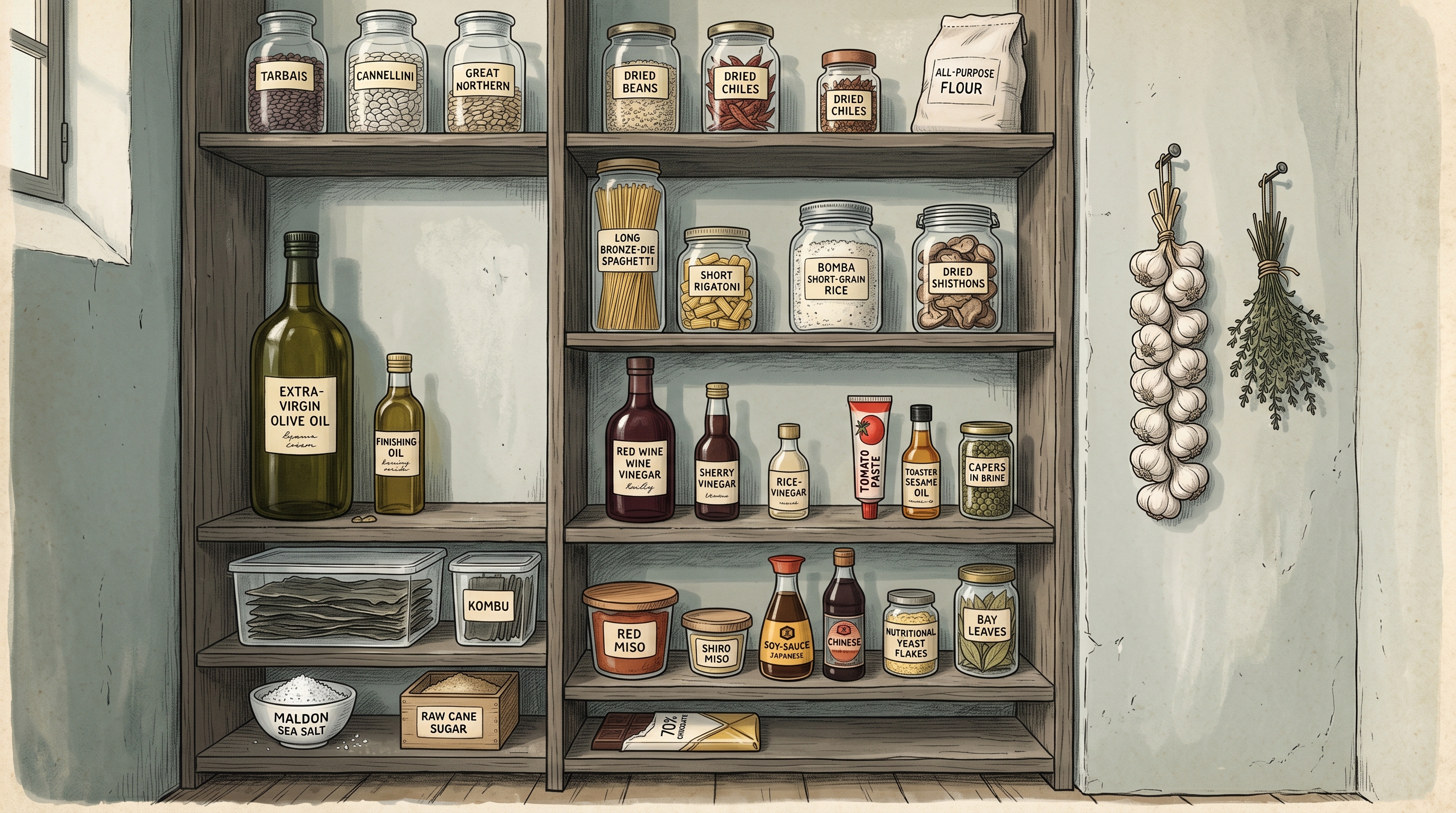
 Huile d’olive The fats Vinaigre The acids Tresse d’ail The aromatics Spaghetti The starches Miso The umami Sel Maldon The salt
 This is the dry-goods spine of the kitchen. Twenty-eight items. The promise of this list is simple: if all twenty-eight are in your cupboard on a Tuesday at 6:30 p.m., you can cook almost anything on this site without leaving the house.
I keep this list pinned inside the cupboard door. Every month I look at it, mark what’s running low, write the shopping list. Three years of doing this, and I have never started a recipe and discovered I was missing the smoked paprika.
The fats
- Olive oil, extra virgin, two bottles — one for cooking (the cheaper Cobram or California Olive Ranch, 16-oz, you go through it fast) and one for finishing (a single-origin from Spain or Sicily, smaller bottle, expensive). Never finish with the cooking oil. Never cook with the finishing oil.
- Neutral oil, 32 oz — grapeseed, refined sunflower, or refined olive. For frying. Smoke point above 400°F. No flavor of its own.
- Toasted sesame oil, small bottle — for the lomein sauce and any Asian finish. Refrigerate after opening.
The acids
- Red wine vinegar — for vinaigrettes, deglaze, the finishing drop on a stew. A good one is worth twice the price.
- Sherry vinegar — the secret of every French sauce. Use sparingly.
- Rice vinegar, unseasoned — for the ramen tare, the lomein sauce, any quick pickle.
- Lemons, 4 to 6 — yes the pantry. They keep two weeks on the counter, longer in the fridge. The lemon is the cheapest finish in cooking.
- Capers, in brine — a tablespoon transforms a sauce. Keep the brine; it’s flavored vinegar.
The aromatics
- Yellow onions, 6 — the base of nine out of ten dishes on this site.
- Garlic, 2 heads — buy whole heads, not pre-peeled. Pre-peeled has been in chlorine.
- Shallots, 4 — for the sauces where onion is too aggressive.
- Dried bay leaves, a jar — French preferred over Turkish, the flavor is woodier.
- Dried chiles — at least three kinds: ancho (Mexican depth), guajillo (Spanish-leaning), and Calabrian or piment d’Espelette (heat that’s also fruity).
The starches
- Short-grain rice — Bomba for paella, Carnaroli for risotto. If you can only buy one, Bomba. Bomba can do risotto in a pinch; Carnaroli cannot do paella.
- Long pasta, one good brand — De Cecco bronze-die, or Rustichella d’Abruzzo if you want the upgrade. Spaghetti or linguine. Skip the no-name boxes — the rough surface of bronze-die pasta holds sauce in a way Teflon-extruded never will.
- Short pasta, one shape — rigatoni or penne. For different sauces.
- Dried beans — Tarbais (cassoulet), cannellini (Italian sides), great northern (chorizo base). One bag of each.
- Chickpeas, dried and canned — dried for when you have planned ahead, canned for milanesa Tuesdays.
- Vital wheat gluten — for seitan. Bob’s Red Mill is reliable. Two bags if you cook seitan once a month.
- Panko breadcrumbs — Kikkoman is the standard. Toast before using.
- All-purpose flour — for breading, béchamel, bread.
The umami
- Kombu, dried — a 100g bag lasts a year. The single most important umami source in a plant-only kitchen.
- Dried shiitake — same logic. Soak and use both the mushrooms and the soaking liquid.
- Nutritional yeast, large container — the “cheese” undertone. Store in the fridge after opening to keep the B vitamins.
- Soy sauce, two bottles — light Japanese (Yamasa or Kikkoman) for general cooking; dark Chinese (Pearl River Bridge) for color in braises.
- Miso paste, two kinds — white shiro miso (light, sweet, for dressings and soup) and red aka miso (dark, salty, for deep umami in stews). Both keep six months in the fridge.
- Tomato paste — a tube, not a can. The tube means you use a teaspoon at a time without committing to the whole thing.
The salt and the sugar
- Fine sea salt — for cooking. Diamond Crystal Kosher works too. Avoid table salt; the iodine taste comes through.
- Flaky sea salt — Maldon, for finishing. The crunch is half the point.
- Raw cane sugar — for the rare time a stew needs balancing.
The finish
- 70% dark chocolate, one bar — a teaspoon grated into a mushroom braise is the trick most home cooks don’t know. Also: emergency dessert.
What’s not on this list
Sugar substitutes. Vegan cheese in any form. Flavored oils. “Plant-based” sauces in jars. Anything labeled “alternative.” Two of those things might be useful occasionally; the rest are noise. The list above is twenty-eight items that have been the same for a hundred years in serious kitchens.
How to use this
Pin the list inside a cupboard door. Once a month, ten minutes before you write your grocery list, look at it. Mark what’s down to the last quarter. Replace it before it’s empty. The reason restaurants always have everything is not magic — it’s that someone reads a list, every shift, before the doors open.
Cook fast on a Tuesday because you did this on a Sunday.
Questions, honestly answered
FAQ
QWhat pantry items should I always have on hand for cooking from scratch?
Twenty-eight items, grouped: fats (good olive oil, neutral oil, sesame oil), acids (red wine vinegar, sherry vinegar, rice vinegar, lemons, capers), aromatics (yellow onions, garlic, shallots, dry chiles, bay leaves), starches (short-grain rice, long pasta, dried beans, vital wheat gluten, panko, all-purpose flour), umami (kombu, dried shiitake, nutritional yeast, soy sauce, miso paste, tomato paste), salt (fine sea, flaky), sugar (raw cane), and chocolate (a 70% bar, for finishing braises). Each of these enables a category of dish — drop one and you start needing the supermarket.
QWhy aren't fresh vegetables on this list?
Fresh vegetables live in the fridge or the basket on the counter, not the pantry. The pantry list is the dry-goods spine — the things that don't go bad in eight weeks. See the separate Fridge list for fresh ingredients, and the Freezer list for stocks and doughs.
QIs this a 'vegan pantry' list?
It's a pantry list. The fact that none of the twenty-eight items are animal products is incidental — none of them have to be. A French bistro pantry from 1920 looked almost identical. The pantry of a serious cook isn't defined by what's not in it. It's defined by what is.