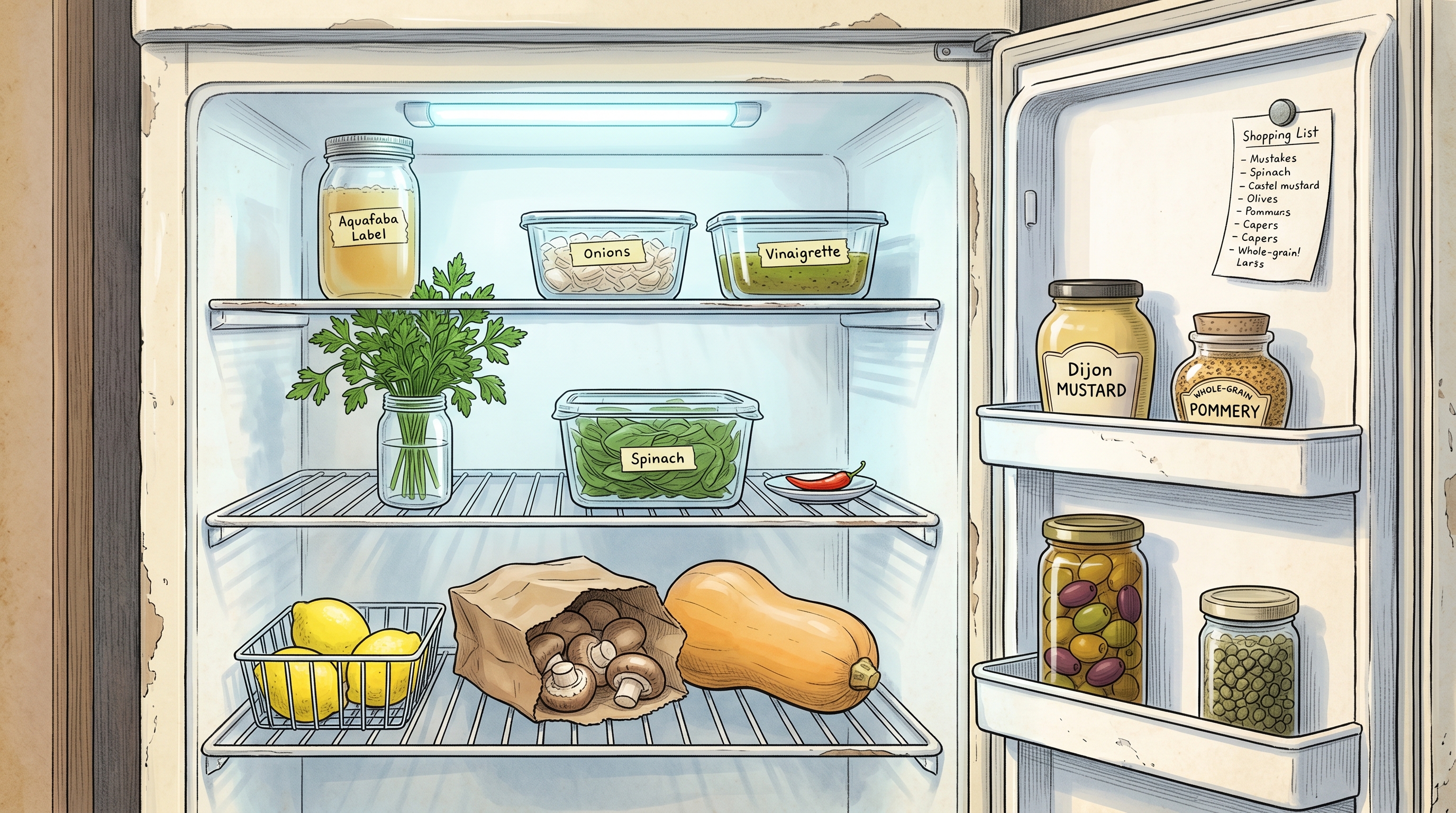
 Persil en bouquet Greens & herbs Champignons The vegetables Citrons The acids Moutarde de Dijon Fermented & briny Aquafaba Aquafaba
 The fridge is the bridge between the pantry and the plate. Pantry alone gives you a list of ingredients. Pantry plus a stocked fridge gives you dinner.
Twelve items. Refresh weekly. Buy them all on Sunday morning, before the rest of the day starts. The market on Sunday morning is the cheapest groceries you will ever buy — vendors are pricing to clear what they had on Saturday.
The greens, fresh herbs, and aromatics
- Leafy greens, one bag — spinach Monday through Wednesday, arugula Thursday through the weekend. Spinach goes in the pasta; arugula goes on the plate.
- Flat-leaf parsley, a bunch — keep the stems in a glass of water in the door of the fridge, like a small bouquet. Lasts ten days that way. Use the leaves for finishing, the stems for stocks.
- A second fresh herb, rotating — cilantro one week, basil the next, dill the third. The one that’s right for what you’re cooking that week.
- A head of garlic, the one in use — separate from the pantry head, which is for keeping. The fridge garlic is the one with two or three cloves peeled and ready.
The vegetables
- Mushrooms, 8 oz of cremini and 4 oz of king oyster — cremini for the duxelles and the braises, king oyster for when a recipe wants something with structural integrity. Both keep a week in their original packaging or in a paper bag (never plastic alone; condensation rots them).
- A hard squash or root vegetable — butternut in fall, kabocha in winter, carrots and parsnips year-round. The vegetables that don’t go bad in a week, that anchor a roasted plate.
- One fresh chile, a serrano or a Fresno — for the heat that the dried chiles in the pantry can’t give. They keep two weeks.
The acids
- Lemons, 3 to 4 — the same as the pantry but living in the fridge for the long-life ones. Pantry holds two; fridge holds four. Together: enough lemons for two weeks of cooking.
The fermented and the briny
- Olives, a jar of two kinds — Castelvetrano (green, mild) and Kalamata (purple, briny). Snack-able and recipe-ready.
- Capers in their brine — pantry-mentioned but they actually live in the fridge after opening. The brine is the better half — vinegar with personality.
- Dijon mustard, full-sized jar — Maille or Edmond Fallot if you can find it.
- Whole-grain mustard — for the wellington, the dressings, the spread on the bread. Pommery is the standard.
The protein-functional
- Aquafaba in a clean jar — every time you open a can of chickpeas, the brine goes into this jar in the fridge. Sealed, it keeps 5 days. The egg-replacement of the kitchen.
How to refresh
One trip a week, Sunday morning, at a farmer’s market if you have one. Maximum 30 minutes. The list above is the standing order. Anything extra is what you’re cooking that specific week — the dish-specific shopping happens after you confirm the standing list is stocked.
What’s not in the fridge
Vegan butter (lives in the freezer, takes a day to thaw, you can’t impulse-bake croissants and you shouldn’t try). Vegan cheese (only in jars of cashew parmesan you made yourself — see Parmesan). Pre-made sauces from the supermarket. Pre-cut vegetables in plastic clamshells.
The fridge holds raw ingredients. What comes out of it is dinner. There’s no shortcut layer in between.
The Sunday refresh
Five minutes of Sunday before the rest of the day starts:
- Open the fridge. Look at each of the twelve items. Touch what’s perishable.
- Throw out anything past five days that won’t make this week’s meals.
- Write the list of what’s missing on the back of last week’s grocery receipt.
- Walk to the market. Buy only what’s on the list. Plus one impulse item.
- Come home, put it away, change the water in the herb glass, wash the salad spinner.
Total time: forty minutes including the walk. The reward is six dinners that didn’t need a second trip to the store.
Questions, honestly answered
FAQ
QWhat fresh ingredients should I always have in the fridge?
Twelve items: leafy greens (spinach or arugula), a fresh herb (parsley most often), lemons, a hard squash or root vegetable, mushrooms (cremini or oyster), aquafaba in a jar, mustard (dijon and grain), one fresh chile, olives, capers in their brine, a head of garlic for short-term use, and a flat-leaf herb in water. With these and the pantry, a Tuesday dinner is twenty minutes of work.
QHow long do these stay fresh?
Greens, 5 days. Herbs in water, 10 days. Mushrooms, 7 days. Lemons, 3 weeks. Mustard and olives, indefinitely. Aquafaba in a sealed jar, 5 days. The list is built to refresh weekly with one trip to a market, not daily.