Set on the stove, not baked.
Crema catalana.
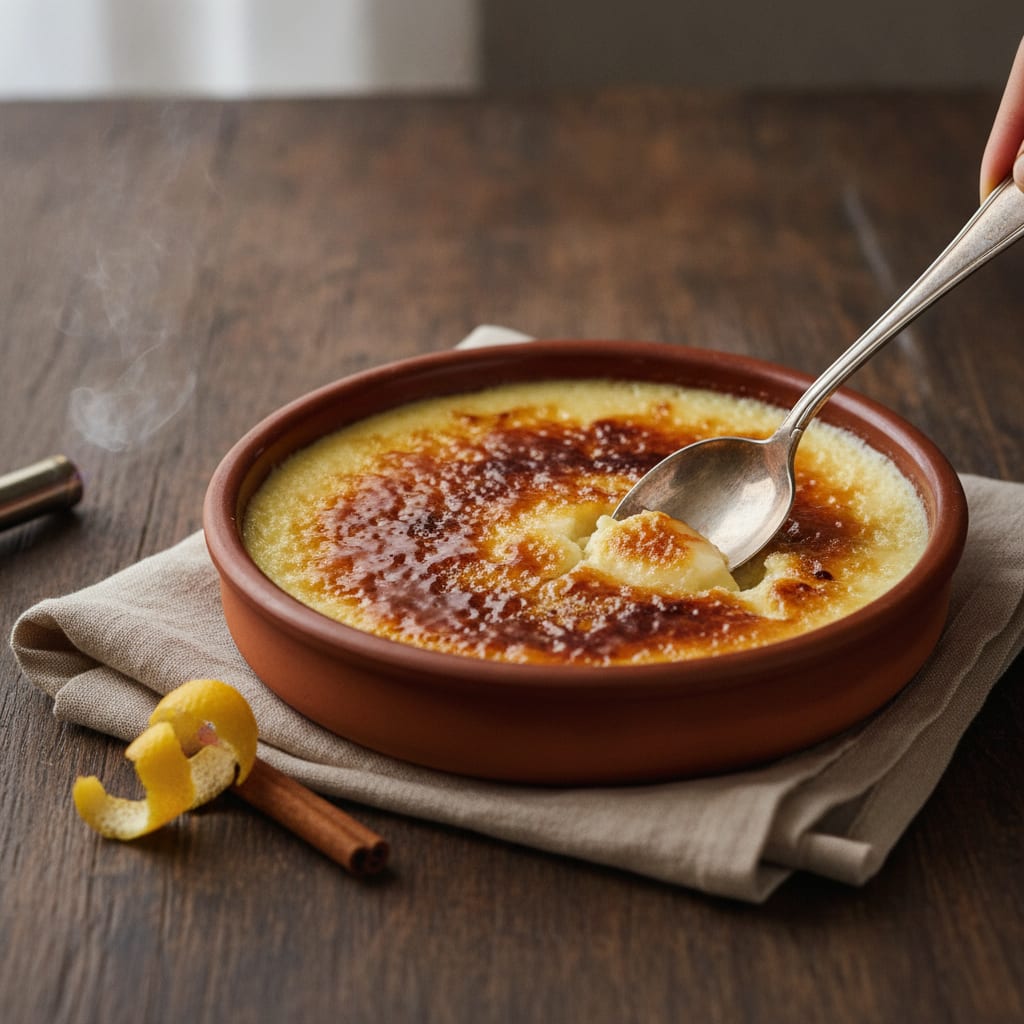
Catalonia's citrus-and-cinnamon custard, two ways: oat milk infused with lemon, orange and cinnamon, set with cornstarch, burnt to a glass crack on top.
- Prep
- 15 min
- Cook
- 20 min
- Total
- 4h 35min
- Servings
- 4
- Difficulty
- Medium
Getting ready…
Ingredients
For 4 servings · 10 items
For the custard
For the burnt top
Method
5 steps · check as you go
- →
Serve
Serve cold, the moment after you burn the top, so the caramel is still a brittle glass crust over cold custard — the crack of the spoon through it is the whole pleasure. Traditional in a wide shallow terracotta cazuela, but ramekins work. A small glass of sweet Pedro Ximénez or a moscatel alongside. In Catalonia it is the dessert of Sant Josep, 19 March.
The story
Crema catalana is the dessert everyone outside Spain mistakes for crème brûlée, and the mistake is older than it looks the wrong way round. The Catalan custard came first — versions of a citrus-and-cinnamon custard that wasn’t burnt on top appear in the 14th-century Llibre de Sent Soví and the 16th-century Llibre del Coch, and the name crema catalana was set down in print by 1745. It is not a cream custard baked in a water bath; it is a milk custard set with cornstarch on the stovetop, perfumed with lemon, orange and cinnamon instead of vanilla, and finished with a burnt-sugar crust. In Catalonia it is the dessert of Sant Josep — Saint Joseph’s day, 19 March — to the point that it has long been called crema de Sant Josep.
I learned it properly in the summer of 2018 in Valencia, just off the rice station at La Riuà, from a pastry cook who had trained in Girona and treated the difference from crème brûlée as a point of honour. “No es brûlée. No lleva nata, no va al horno.” It’s not brûlée — no cream, it doesn’t go in the oven. She infused the milk with wide strips of lemon and orange peel and a stick of cinnamon, slaked the cornstarch in cold milk so it wouldn’t lump, and cooked it on the flame until it thickened all at once, whisking the whole time. Then the shallow dishes, the long chill, and the sugar burnt hard right before it went out.
This crema catalana has no eggs or dairy and doesn’t miss them, because the structure was never the eggs — it was the starch. Cornstarch sets the custard; blended cashew and a richer oat milk give the body the yolks used to. Nothing about the method moves: the citrus-and-cinnamon infusion, the slaked starch, the stovetop set, the cold rest, the burnt top. It is not an “egg-free version” of crema catalana. It is crema catalana, the way the cook from Girona made it, with what is in my hands.
À la maison
The weeknight reading is the recipe above, and it rests on two moves that are easy once you know them. First, slake the cornstarch in a little cold milk before it goes anywhere near the hot pan, so it disperses instead of seizing into lumps. Second, cook the custard to a real bubble for a minute, whisking hard — cornstarch only sets and loses its raw floury taste at near-boiling, so this is what gives you a custard that holds a clean spoonful. Infuse the milk with lemon, orange and cinnamon off the heat for that signature perfume, chill it well, and burn the sugar right before serving so the crust stays a brittle glass crack and not a syrup.
Au bistrot
The bistronomique reading is the same custard, set firmer and plated as a composed dessert rather than served in its dish.
Keep the infused, cornstarch-set custard exactly as it is, but firm it a touch — a whisper more cornstarch, or a few grams of agar bloomed in the milk — so it will unmould and hold a clean shape on a plate. Set it in a shallow ring or a flexible mould and chill it hard, then turn it out as a neat disc. Burn the sugar top as always for the glass crack, but build companions around it: a quick compote of orange segments cooked down with a cinnamon stick, a scatter of candied lemon zest, and a thin shard or two of caramel torn from a baked sugar sheet for height. A spoon of citrus sorbet on a crushed-almond crumb gives a cold, sharp counterpoint to the rich custard. Plate the burnt disc off-centre, the orange compote dragged behind it, the sorbet on its crumb to one side so it doesn’t slide, a caramel shard stood up, and a single fine grating of orange zest over the top. The crack of the burnt top stays the hero; everything else points back to the lemon, orange and cinnamon already inside it.
El emplatado — Three-quarter, warm low light catching the burnt-sugar sheen. A neat disc of pale custard with its glassy amber top, set off-centre, a drag of orange-cinnamon compote behind, a quenelle of citrus sorbet on almond crumb to one side, a caramel shard stood for height. A fine grating of orange zest. Negative space on dark stone. The plate should say citrus and cinnamon under glass — the dessert of Sant Josep read once, at a white tablecloth.
What the other recipes get wrong
Most plant crema catalana recipes online — I read the top ten in June 2026 — reach for the wrong setter or skip the infusion, and the result is either a wobbly pudding or a flavourless one. I ran the test over three days in June 2026: eight batches, same milk and same sugar, changing only the setting agent and whether the citrus was properly infused.
- Agar only, flavour stirred in cold: set firm but bouncy and sliceable, more panna cotta than custard, and the citrus read as a thin top-note instead of a perfume through the whole spoon.
- Cornstarch, undercooked, no real bubble: never fully set, and carried a raw, chalky cornstarch taste — the custard slumped and the starch sat on the tongue.
- Cornstarch cooked to a bubble, milk properly infused, cashew for body: a true crema catalana set — soft, spoonable, holding under the crack of caramel, deeply perfumed with lemon, orange and cinnamon. Not close.
The reasons are gelatinisation and aroma chemistry. Cornstarch sets by gelatinising — its granules absorb liquid and swell, but only fully near boiling point; cook it short of that and it neither thickens properly nor loses its raw, floury flavour, which is why the brief bubble is mandatory. Agar sets by a different mechanism, forming a firm, brittle gel that reads as bouncy rather than the soft, yielding spoon of a starch custard, which is why cornstarch is the right structure for this dessert even without eggs. And the citrus character is volatile aromatic oil locked in the zest and bark, drawn out only by warm infusion and lost if you merely stir in zest at the end. Across all eight batches, only properly cooked cornstarch plus a real off-heat infusion gave the spoon the cook from Girona would have recognised.
The line I draw
I will not bake crema catalana, and I will not call a bouncy agar pudding by its name. The dish is, by its own definition, a stovetop, starch-set custard perfumed with citrus and cinnamon — that is precisely what separates it from crème brûlée, and it is the line worth holding. Bake it in a water bath and you have made the French dessert with a Catalan accent; set it hard with agar and stir in some zest and you have made a flan that is missing the point. The set has to be a soft, spoonable starch set, and the flavour has to be infused, not sprinkled. The cook from Girona corrected me sharply the day I called it brûlée. She was right: it is its own thing, and the cornstarch and the cinnamon are why.
When this can fail
Three ways, all from my own kitchen between 2022 and 2026:
- The lumpy custard. Tipped the cornstarch straight into the hot infused milk; it seized into floury lumps I couldn’t whisk out. Fix: always slake the cornstarch in a little cold milk to a smooth slurry first, then whisk that into the hot pan.
- The wet, weeping crust. Burnt the sugar an hour ahead and let the dishes sit; the caramel drew moisture from the custard and turned to syrup. Fix: sugar and torch the top at the last possible moment before serving, on a cold custard, so it sets a brittle glass crack.
- The raw-starch slump. Pulled the custard off the heat the moment it thickened, before it really bubbled; it stayed loose and tasted chalky. Fix: let it bubble gently for a full minute, whisking hard, so the cornstarch fully gelatinises and the raw flavour cooks out.
The crack of the spoon through the burnt sugar is the sound the whole dessert is built toward, and everything before it is in service of that one moment: the infusion for the perfume, the cornstarch for the soft set beneath, the cold to hold the caramel brittle. Get those right and the eggs are never missed, because they were never the point — the cornstarch and the cinnamon always were. It is the dessert of Sant Josep, and it is its own thing, not the French one with an accent.
FAQ
QWhat is the difference between crema catalana and crème brûlée?
Three things. Crema catalana is made with milk and set on the stovetop with cornstarch, where crème brûlée is made with cream and baked as an egg custard in a water bath. Crema catalana is flavoured with lemon, orange and cinnamon; crème brûlée is flavoured with vanilla. And crema catalana is lighter, because milk rather than cream and a starch set make a less heavy custard. They share only the burnt-sugar crust on top. Crema catalana is also far older — versions appear in Catalan cookbooks as early as the 14th-century Llibre de Sent Soví, and the name was documented by 1745.
QCan you make crema catalana without eggs?
Yes, and it stays true to the dish, because crema catalana is traditionally set with cornstarch rather than baked like an egg custard — the starch does the structural work. Replace the richness the egg yolks gave with a little blended soaked cashew (or a richer barista oat milk), keep the cornstarch for the set, and infuse the milk with lemon, orange and cinnamon as always. Cooked on the stove to a near-boil so the starch gelatinises, poured into shallow dishes, chilled and burnt on top, it sets and eats as crema catalana.
QWhy is crema catalana set on the stove instead of baked?
Because it is thickened with cornstarch, not with eggs alone. Cornstarch gelatinises and sets when heated to near boiling, so the custard can be cooked and thickened entirely in a saucepan, then simply chilled — no oven and no water bath. This is the structural difference from crème brûlée, which relies on egg proteins coagulating slowly in the gentle heat of a baked water bath. The stovetop method also makes crema catalana easier to judge: you can see and feel it thicken.
QWhat flavours go in crema catalana?
Lemon and orange zest and a cinnamon stick, infused into the warm milk and then strained out. That citrus-and-cinnamon perfume is the defining character of crema catalana and what most distinguishes it from vanilla-led crème brûlée. Steep the zest and cinnamon off the heat so the aromatic oils come out without bitterness. A tiny pinch of turmeric is sometimes used only to give the classic pale-yellow colour the egg yolks once provided; it adds no flavour at that dose.
QHow do I get a crisp caramel top on crema catalana?
Sprinkle a thin, even layer of caster sugar over the cold, set custard and burn it with a blowtorch right before serving, moving the flame so it melts and turns deep amber without scorching black. Burning it on a cold custard sets the caramel into a brittle sheet rather than melting into the surface, and doing it just before serving keeps it crisp — left to sit, the crust draws moisture and turns to syrup. Traditionally the crust was made by stamping a fire-heated iron disc, the pala, onto the sugar.